
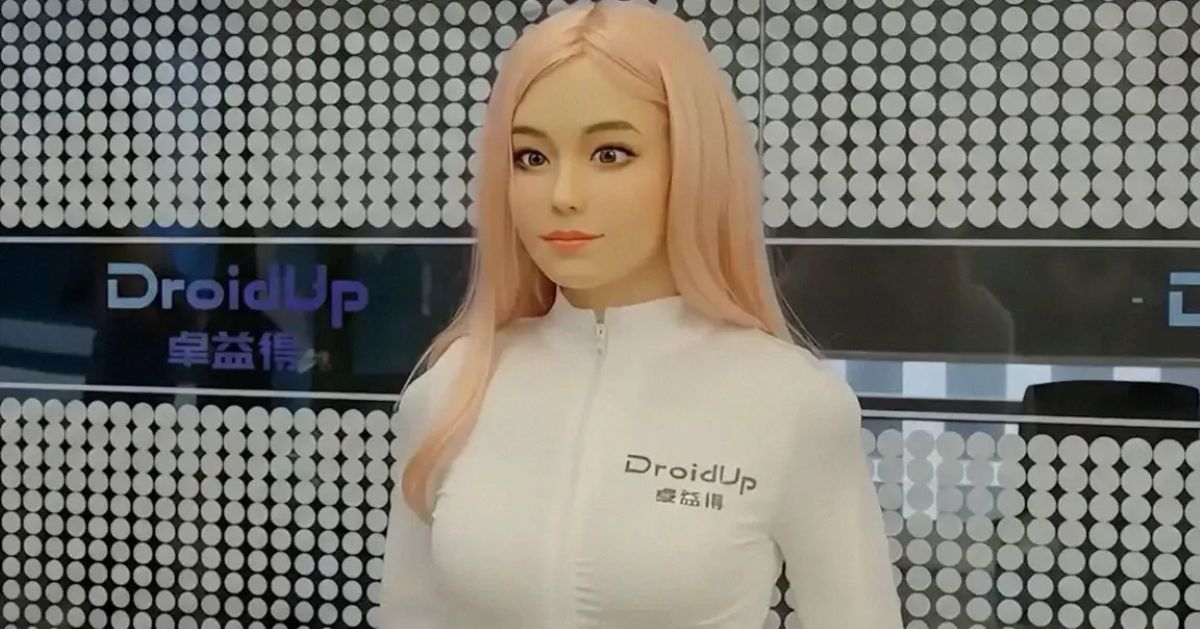
 Meet Moya. Credit: DroidUp.
Meet Moya. Moya wants to be your friend. It can make eye contact, smile, and maintain skin that is warm to the touch, while its body moves with a steady, natural (ish) posture.
Would you take Moya into your home?
Uncanny Valley
Humanoid robots usually struggle the moment they leave the lab. We’ve all seen the videos: they stumble, move with a robotic lag, or fail at basic chores. Many have tried to overcome those challenges, and now, it’s Moya’s turn.
High-definition cameras hidden behind her eyes track faces in real-time, allowing her to nod and maintain eye contact while you speak. Her face is capable of expressing joy, anger, and sorrow, a feat unveiled recently at Shanghai’s Zhangjiang Robotics Valley.
Moya also aims to have an active social presence. She maintains eye contact, nods while listening, and responds in real time to nearby people. Her modular design allows different appearances or gender characteristics, signaling a future where humanoid robots may be customized for specific roles.
But her most “human” feature isn’t her face—it’s her temperature.
Moya’s synthetic skin contains embedded heating elements that keep her between 32 and 36 degrees Celsius. “Most robots today have hard shells and feel cold,” DroidUp founder Li Qingdu explained. He believes a robot that serves humans should feel like a living being, not a refrigerator.
“A robot that truly serves human life should be warm, have a temperature, almost like a living being that people can connect with.”
×
Thank you! One more thing…
Please check your inbox and confirm your subscription.

Science has clearly shown that touch and temperature shape social bonding. By mimicking those cues, engineers hope robots may feel less alien—and more trustworthy.
Yet the illusion is fragile. DroidUp claims Moya’s walking resembles a human’s with ‘92% accuracy,’ but demonstrations still reveal stiff steps and audible mechanical clicks. The result lands squarely in what psychologists call the “uncanny valley,” where near-human realism provokes unease instead of comfort.
Public reactions are mixed. Some viewers describe the robot as ghostlike; others compare it to androids from science fiction. The same lifelike qualities that make Moya compelling also make her unsettling.
Simulating Empathy
 Moya hanging out with friends. Credit: DroidUp.
Underneath the soft exterior lies conventional robotics hardware: sensors, cameras, and autonomous navigation systems derived from DroidUp’s earlier Walker-series robots. One predecessor reportedly completed a half-marathon-length race in Beijing.
DroidUp envisions those roles in health care, education, and other settings that depend on human interaction. Aging populations in many countries have intensified interest in robotic caregivers, while schools and businesses continue to experiment with automated assistants.
But human-like traits come with a price. Moya is expected to cost roughly $173,000 when she hits the market, likely around 2026.