
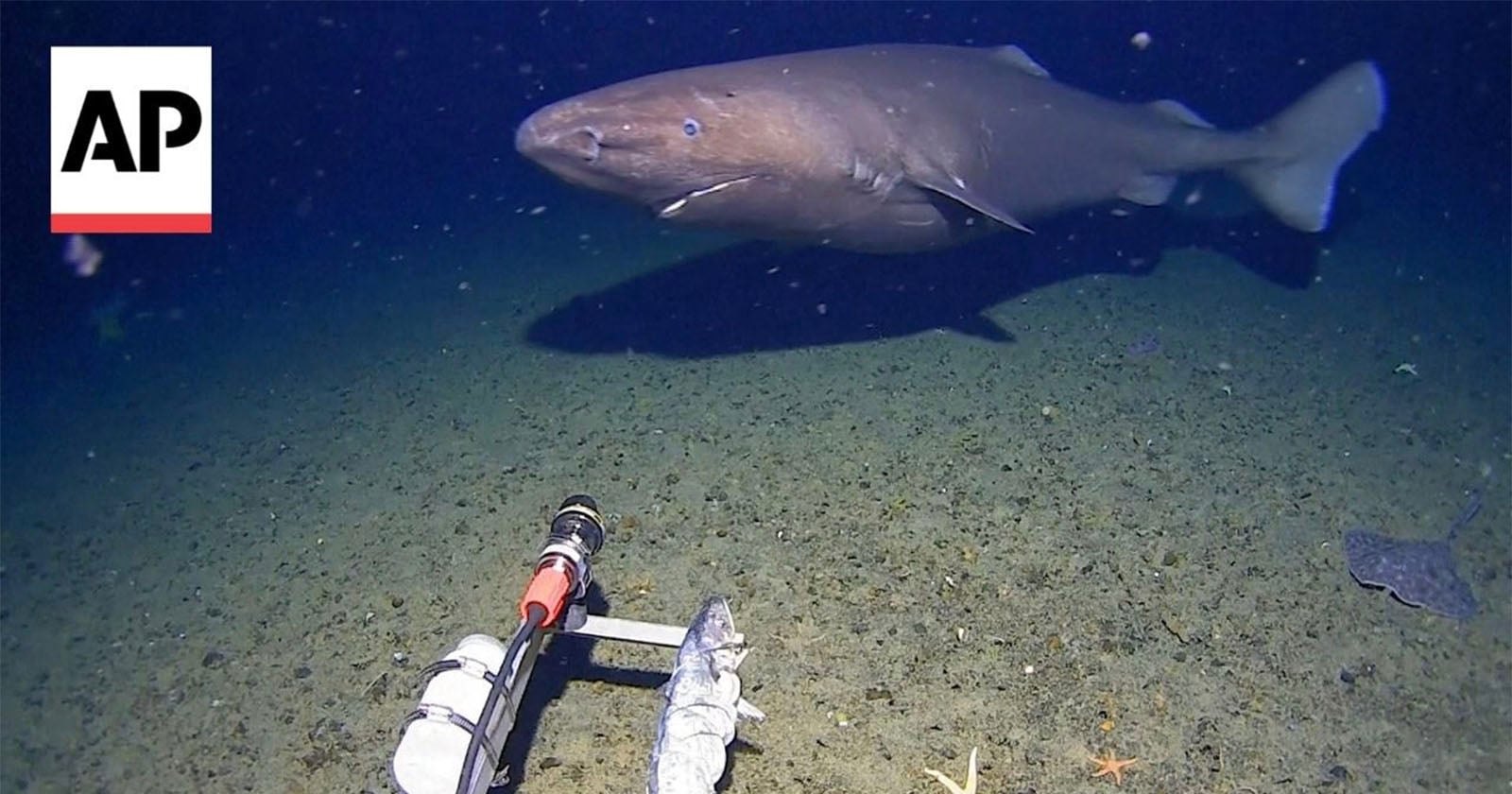
A sleeper shark has been captured on camera for the first time in the icy depths of Antarctica, surprising experts who thought sharks didn’t dwell in the frigid waters of the Southern Ocean.
Minderoo-UWA Deep-Sea Research Centre deploys cameras into the deepest oceans and often makes fascinating discoveries. Last year, Minderoo captured a Pacific sleeper shark in the southwestern Pacific Ocean near the Tonga Trench, but seeing one so far south is a historic first.
“This is great. The shark was in the right place, the camera was in the right place and they got this great footage,” Peter Kyne, a Charles Darwin University conservation biologist who isn’t with the research center, tells the Associated Press. “It’s quite significant.”
The lumbering shark was spotted off the coast of the South Shetland Islands, located roughly 70 miles (120 kilometers) north of the Antarctic Peninsula at a depth of 1,609 feet (490 meters). The rotund shark, estimated to be a length of 10 to 13 feet (three to four meters), was swimming in waters of 34.29 degrees Fahrenheit (1.27 degrees Celsius), just above freezing.
“We went down there not expecting to see sharks because there’s a general rule of thumb that you don’t get sharks in Antarctica,” one of the researchers, Alan Jamieson, tells AP. “And it’s not even a little one either. It’s a hunk of a shark. These things are tanks.”
The Antarctic Ocean, or Southern Ocean, is defined as below the 60-degree south latitude line; the sleeper shark was well within that boundary. Whether there are many others of this kind in that area is unclear. Little is known about these slow-moving, cold-water sharks, including how many exist, the extent of their range and movements, or where they reproduce.
AP notes that the Southern Ocean is divided into layers and the shark’s depth of 500 meters was the warmest of several layers. The colder, denser water below does not easily mix with the fresh water created by melted ice from above.
The footage was shot in January 2025, the southern hemisphere’s summer period, and the only time researchers can operate. “The other 75% of the year, no one’s looking at all,” Jamieson tells AP. “And so this is why, I think, we occasionally come across these surprises.”