
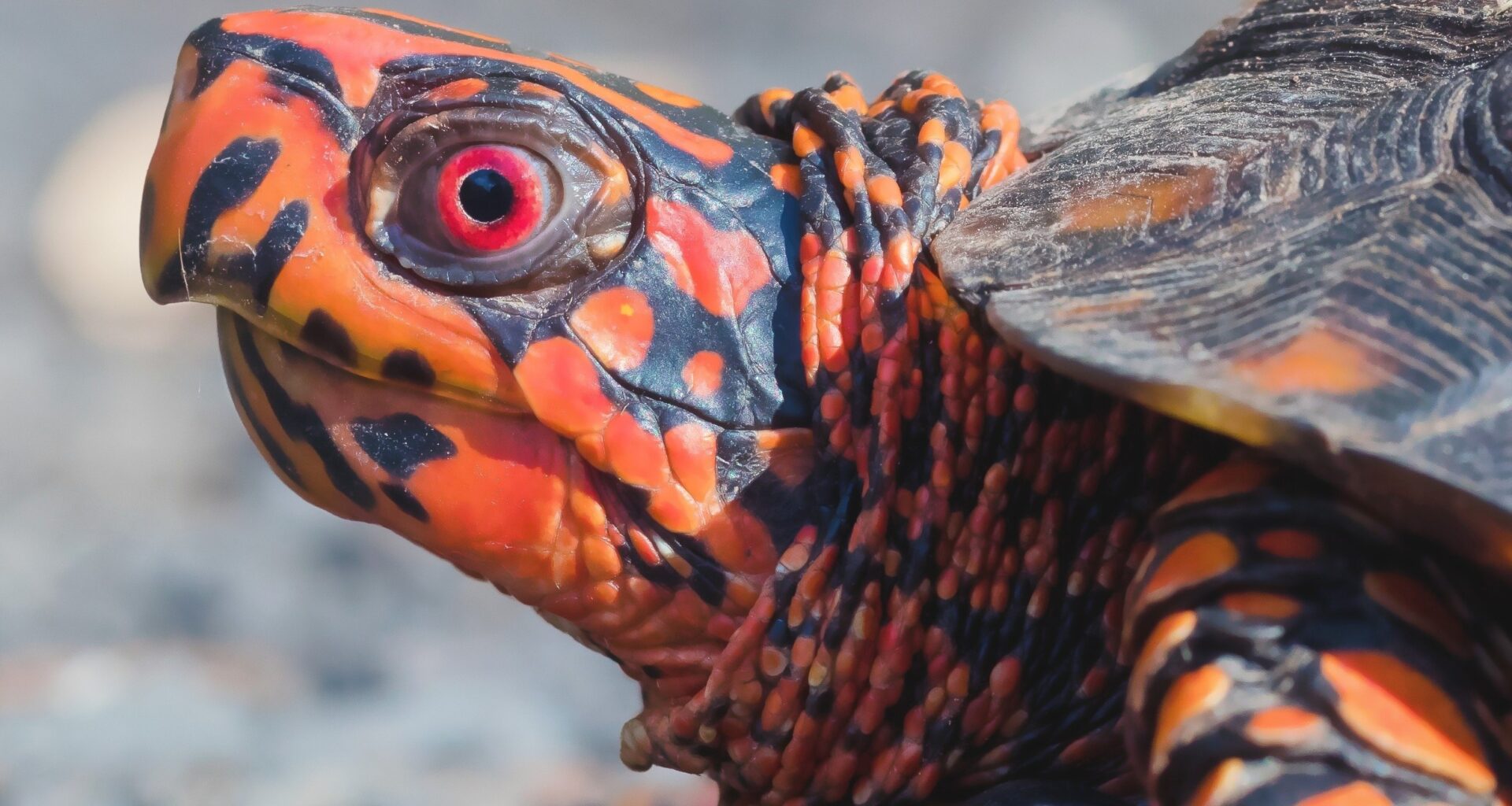
For decades, scientists assumed that sophisticated visual abilities were largely unique to mammals. They believed that only large, folded cerebral cortices could reliably detect and interpret important changes in the environment.
However, new research from Tel Aviv University shows that turtles have a surprisingly advanced visual processing system.

Turtle brains can detect new visual events even when head or eye movement shifts the image on the retina. Such findings suggest that key brain abilities evolved hundreds of millions of years ago.
Reptile and mammal brains
Reptiles and mammals both come from a shared ancestor that lived about 320 million years ago. These early animals, called amniotes, were some of the first animals with backbones to fully live on land.
As life moved onto land, vision became more important. Eyes improved, heads moved more freely, and more visual information reached the forebrain – the front part of the brain that helps with thinking and memory.
The cerebral cortex, the outer thinking layer of the brain, became large and complex in mammals.
In turtles, a similar area called the dorsal cortex stayed smaller and simpler. The dorsal cortex helps process visual information. It is described as three-layered because its cells are arranged in three simple layers.
Even though it is small, the dorsal cortex receives visual signals from a relay area similar to the visual thalamus, which passes messages from the eyes to the brain.
It also connects to the medial cortex, which is similar to the hippocampus, a brain area that helps with memory and navigation. This shows that the turtle brain area involved in vision is also linked to remembering places.
Testing visual processing in turtles
Scientists recorded brain activity from dorsal cortex in awake turtles as they sat on a small platform facing a screen.
A white triangle appeared many times in one position. Occasionally, same triangle appeared in a different position. Such setup is called an oddball design.
Neural recordings revealed a strong burst of activity when a stimulus appeared in a new location. When the same position was repeated, the response gradually weakened over time.
The first few trials in each session also triggered heightened activity, a pattern that clearly reflects the brain’s sensitivity to novelty.
The researchers also used a more natural scene. Instead of a triangle, a turtle head appeared over a pond image. Even in that complex setting, new positions caused stronger brain activity than repeated positions.
Control tests with random positions ruled out simple bias toward one part of screen.
Detecting novelty despite movement
When a turtle moves its head, the picture it sees shifts to a different spot inside its eye. In many parts of the brain, this kind of shift can change how strongly brain cells respond.
In this study, scientists carefully measured how much the turtles moved their heads and eyes. They found that when something appeared in a new place, the turtle’s brain reacted strongly no matter which direction the turtle was looking.
The turtles’ eye movements did not “balance out” their head movements to keep the image in the same spot. Even when the viewing angle changed, the brain still noticed the new object.
Seeing something from a new angle for the first time did not create an extra strong response.
This shows that the turtle’s brain is not just reacting to where the image lands in the eye. Instead, it is recognizing that something new has appeared in the environment.
Small surprises beat big movements
When a turtle moves its head or eyes, the image inside its eye changes a lot. You might expect the brain to react strongly to that big change. But it did not. When the turtle moved without anything new appearing, brain activity stayed fairly low.
However, when a small and unexpected object appeared on the screen, brain activity became much stronger. Even though the change was small, the brain reacted more to that surprise than to large movements made by the turtle itself.
Scientists compared brain signals during simple movement with signals during visual events. Both common and rare visual images caused stronger responses than movement alone.
This shows that the turtle’s brain is not just reacting to motion. It is paying attention to important changes in the outside world.
Rethinking cortical evolution
For many years, scientists believed that the brain builds visual understanding step by step. In mammals, early visual areas respond to exact spots in the field of view.
As information moves deeper into the brain, responses become more flexible and less tied to one specific position.
In turtles, things look different. The turtle’s dorsal cortex receives visual information directly, but it can already recognize something new even if it appears in a different position. There is no long chain of many visual areas like in mammals.
This challenges the old idea that flexible vision only develops in higher brain regions. It suggests that the ability to recognize important changes, no matter where they appear, may have evolved very early in animal history.
Possible links to memory and navigation
As discussed before, the dorsal cortex is closely connected to another brain area called the medial cortex, which is similar to the hippocampus in mammals.
The hippocampus helps animals remember places and build mental maps of their surroundings.
If a turtle can recognize landmarks even when looking from different angles, it can keep a stable map of its environment while moving around. That makes navigation easier and more reliable.
The strong brain response to something new is similar to a signal seen in mammal brains when something unexpected happens. This kind of signal often appears when the brain notices that reality does not match what it predicted.
In simple terms, the brain may be comparing what it expects to see with what it actually sees. When there is a difference, it reacts strongly. This process helps build and update an internal picture of the world.
A window into deep time
The small turtle brain offers a powerful window into early cortical function. Even without a large folded cortex, dorsal cortex can detect new events independent of retinal position. Such ability may represent a cornerstone of cortical evolution.
The results suggest that core computation for detecting important changes in the environment existed long before mammals appeared.
The turtle brain shows that complex visual processing did not suddenly arise in large modern brains. Instead, the roots of advanced perception stretch back to ancient ancestors that first stepped onto land.
The study is published in the journal Science Advances.
—–
Like what you read? Subscribe to our newsletter for engaging articles, exclusive content, and the latest updates.
Check us out on EarthSnap, a free app brought to you by Eric Ralls and Earth.com.
—–