

SINGAPORE – When Madam Lee Yoke Lan turned 46, she began to have hot flushes and bad mood swings.
She had to shower four times a day instead of the usual two, and was asked by the sister in the nursing ward where she worked why she was so short-tempered.
Describing her menopause as “a flash of lightning – sudden and unexpected”, Madam Lee, who went on to become the director of nursing at KK Women’s and Children’s Hospital (KKH) at 50, told reporters that “even my nursing training did not prepare me for this phase in my life”.
Given the insufficient medical training, lingering fear from outdated research and social stigma, it may not come as a surprise that a 2025 KKH study of almost 300 primary care doctors found that nine in 10 were not confident about diagnosing and treating menopausal symptoms despite having seen female patients in midlife (those 45 to 65 years of age).
The doctors cited reasons such as lack of training, knowledge and time, and said the women typically sought help only for well-recognised symptoms like hot flushes, night sweats and sleep disturbances.
To close the gap, Singapore launched on Feb 20 its first set of Guidelines on Management of the Menopause Transition, which provides scientifically backed recommendations for the management of the condition and promotes multidisciplinary collaboration.
Targeted at healthcare professionals in primary practice who are caring for women in midlife, the guidelines put the necessary systems in place to recognise menopause as a clinical diagnosis.
It was launched by Senior Minister of State for Home Affairs and Foreign Affairs Sim Ann at the opening of the international meeting of the Integrated Platform for Research in Advancing Metabolic Health Outcomes of Women and Children held at KKH.
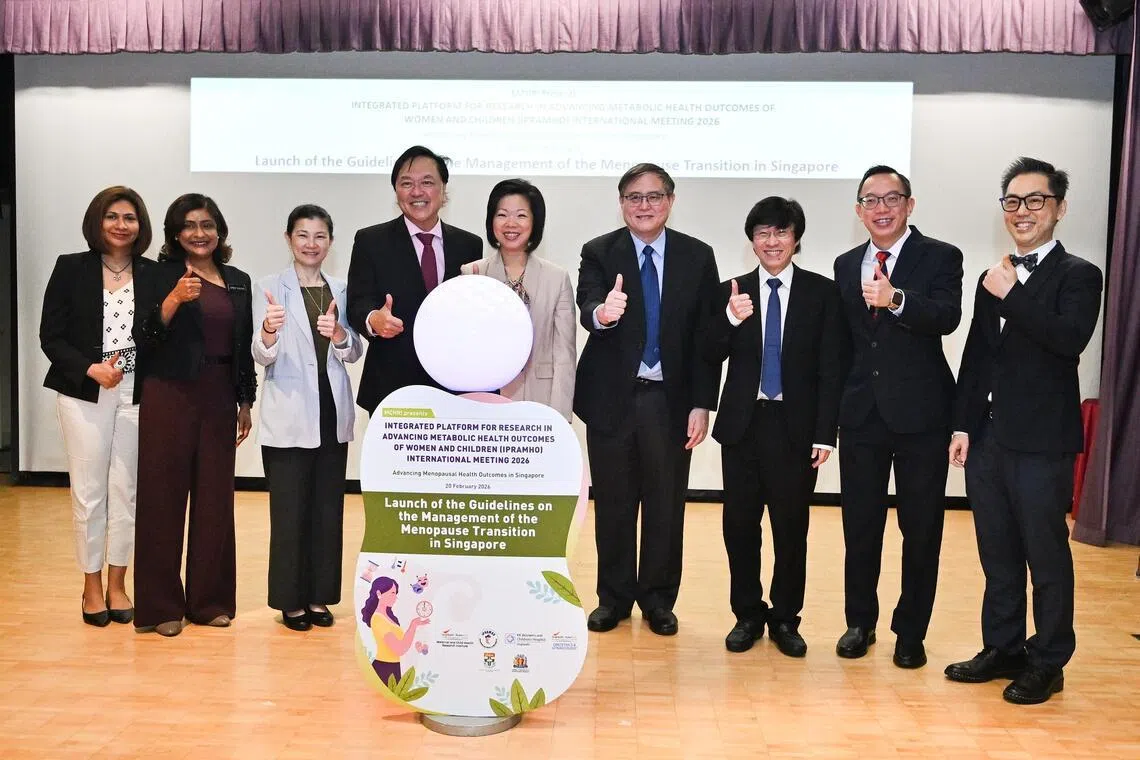
Senior Minister of State for Home Affairs and Foreign Affairs Sim Ann (centre) at the launch of Singapore’s first set of Guidelines on the Management of the Menopause Transition.
ST PHOTO: LIM YAOHUI
In her speech, Ms Sim, who is also adviser to the People’s Association Women’s Integration Network Council, said the guidelines recognise that menopause deserves greater medical attention and that effective treatments exist.
She cited a 2025 KKH study on about 1,500 women aged 45 to 65, which found that seven in 10 experienced moderate to severe menopausal symptoms, yet 70 per cent of them had not sought medical attention.
“More than clinical guidelines, we need a cultural shift… We need to normalise conversation about the full spectrum of menopausal experiences among women, their families, friends (and) communities,” Ms Sim said.
This set of guidelines will help doctors who deal with midlife women have a consistent set of updated practices for those with menopause symptoms, as many specialities were involved in its development, hence reducing confusion among the different fields.
Professor Yong Eu Leong, emeritus consultant in the Department of Obstetrics and Gynaecology at the National University Hospital and a member of the work group that came up with the guidelines, said: “We have attempted to consolidate all the recent updates in the field and localise it to Singapore women.”
In Singapore, the top five symptoms during the shift to menopause are
joint and muscle aches,
disturbed sleep, a decline in sexual health, physical and mental fatigue, and hot flushes. They differ from the Western population, where hot flushes are the most common symptom.
The set of guidelines reaffirmed that menopause hormone therapy (MHT) is safe and effective for treating symptoms such as hot flushes and menopause-related mood issues, and for preventing osteoporosis, a bone disease characterised by low bone mass and increased porosity, making bones weak, brittle and highly prone to fractures.
Associate Professor Rukshini Puvanendran, co-director of the KK Menopause Centre, said the misconception that MHT was not safe was the result of the Women’s Health Initiative, a 1993 landmark, long-term study of about 170,000 post-menopausal women that significantly shifted medical understanding of hormone therapy, diet and disease prevention.
“The study recruited women aged between 50 and 79. In practice, we never give women in their 70s who have never been on hormone therapy… No wonder the results showed that the therapy can be harmful and it caused worries.
“The US FDA (Food and Drug Administration) then placed a broad black box warning on all forms of hormone replacement therapy, prompting everyone to stay away,” she said.
The black box warning is the most stringent and serious safety warning mandated by the FDA for prescription drugs and medical devices to alert doctors and patients to the serious, life-threatening or permanently disabling risks.
Prof Rukshini said that when doctors relooked the study years later, they found that the younger group of women were doing well with hormone replacement and were actually benefiting from it.
She said the choice of MHT depends on why it is needed, and the risk factors and individual circumstances, which include age and personal preferences.
“For most women younger than 60 and with symptoms of menopause, or within 10 years of their last period, the benefits of starting MHT usually outweigh the potential risks,” said Prof Rukshini, who heads the Family Medicine Service at KKH.
Madam Lee, who is now 86, has made some lifestyle changes to ensure that she continues to lead a healthy life.
“I used to swim but I no longer do so. Now, I join my friends and do line dancing,” she said.