
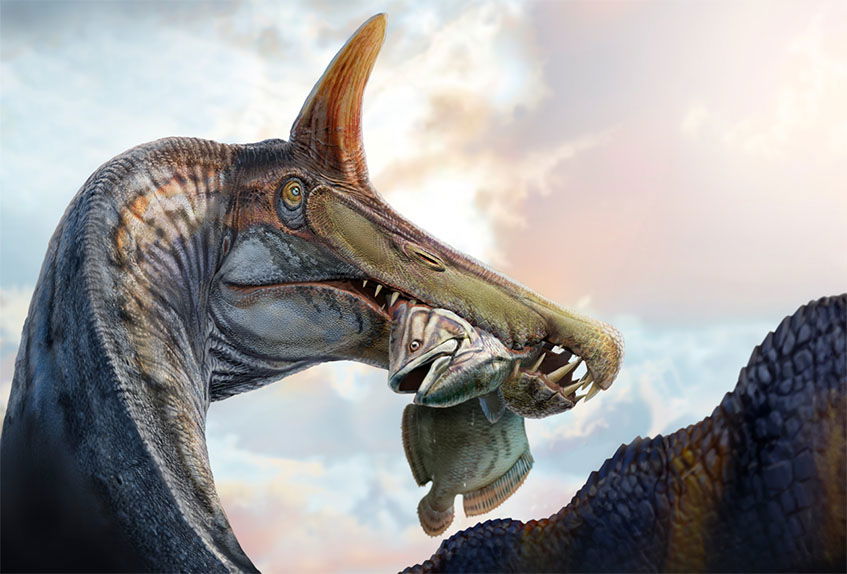
A new “scimitar-crested” spinosaurid, officially named Spinosaurus mirabilis, has been uncovered in the Sahara Desert, marking a major new fossil find and the discovery of an extremely unique-looking dinosaur.
The find was made in the African nation of Niger in 2019 and represents the late phase of spinosaurid evolution. Intriguingly, the journey to discovery began in forgotten historical writings and wound through motorcycle journeys into the deep desert before culminating in an exotic new dinosaur discovery.
An Under-appreciated Dinosaur
Initially, paleontologists failed to recognize the find’s significance, despite uncovering the first crest and jawbone on the initial dig. The massive dinosaur was simply too unexpected to be appreciated at the time. It was only with subsequent 2022 follow-up work, uncovering two more of these unique scimitar crests, that paleontologists began to realize what they had found.
“This find was so sudden and amazing, it was really emotional for our team,” said lead author Paul Sereno, PhD, Professor of Organismal Biology and Anatomy at the University of Chicago. “I’ll forever cherish the moment in camp when we crowded around a laptop to look at the new species for the first time, after one member of our team generated 3D digital models of the bones we found to assemble the skull — on solar power in the middle of the Sahara. That’s when the significance of the discovery really registered.”
 Two Spinosaurus mirabilis fight over a carcass of the coelacanth Mawsonia on the forested bank of a river, some 95 million years ago in what is now the Sahara Desert in Niger. (Artwork by Dani Navarro).
Analyzing a Saurian Discovery
By analyzing the crest, researchers have developed theories about what it would have looked like while the creatures were alive. The texture and the presence of interior vascular canals suggest that the bone was once covered in keratin. As with a peacock, they also believe the scimitar was likely a brightly colored display feature.
One of the most interesting features of the skull was not its crest, but instead its interdigitating teeth. This means that the lower teeth protrude through the gaps between the upper teeth, a feature common to fish-eating species such as crocodiles and pterosaurs, enabling them to more readily capture slippery fish.
Perhaps even more intriguing was the fossils’ location, far inland between 500 and 1000 kilometers from the coast. This is at odds with recent speculation that these fish-eating dinosaurs may be wholly aquatic. Co-located at the site were the remains of long-necked dinosaurs, herbivores that fed on leaves, suggesting that the area once supported a forest habitat with flowing rivers.
“I envision this dinosaur as a kind of ‘hell heron’ that had no problem wading on its sturdy legs into two meters of water but probably spent most of its time stalking shallower traps for the many large fish of the day,” Sereno said.
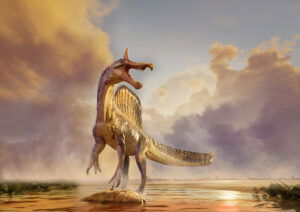 Spinosaurus mirabilis sp. nov. stands along the river’s edge over its prey some 95 million years ago. (Artwork by Dani Navarro).
A Dinosaur Hunt Through Time
The discovery also had unique historical roots, involving an event much more recent than these dinosaurs’ remote past. A discovery written down in the 1950s by a French geologist noted a saber-like tooth found in Egypt’s Western Desert at the turn of the twentieth century. Serrano and his team decided to follow up on this neglected discovery because the description resembled those of a giant predator, Carcharodontosaurus.
“No one had been back to that tooth site in over 70 years,” Sereno mused. “It was an adventure and a half wandering into the sand seas to search for this locale and then find an even more remote fossil area with the new species. Now all of the young scholars who joined me are co-authors on the report gracing the cover of Science.”

A local guided the team on a day-long trek into the deep Sahara, promising abundant fossils. That was the 2019 trip where they quickly discovered some teeth and a jawbone of the new species. From there, the follow-up journey yielded the fantastic discovery of a new dinosaur.
“I was attracted to the Sahara like a magnet once I set foot there 30 years ago. There’s nowhere else like it. It’s as beautiful as it is daunting.” Sereno said.
“If you can brave the elements and are willing to go after the unknown, you might just uncover a lost world.”
The paper, “New Scimitar-Crested Spinosaurus Species from the Sahara Caps Stepwise Spinosaurid Radiation,” appeared in Science on February 19, 2025.
Ryan Whalen covers science and technology for The Debrief. He holds an MA in History and a Master of Library and Information Science with a certificate in Data Science. He can be contacted at ryan@thedebrief.org, and follow him on Twitter @mdntwvlf.