
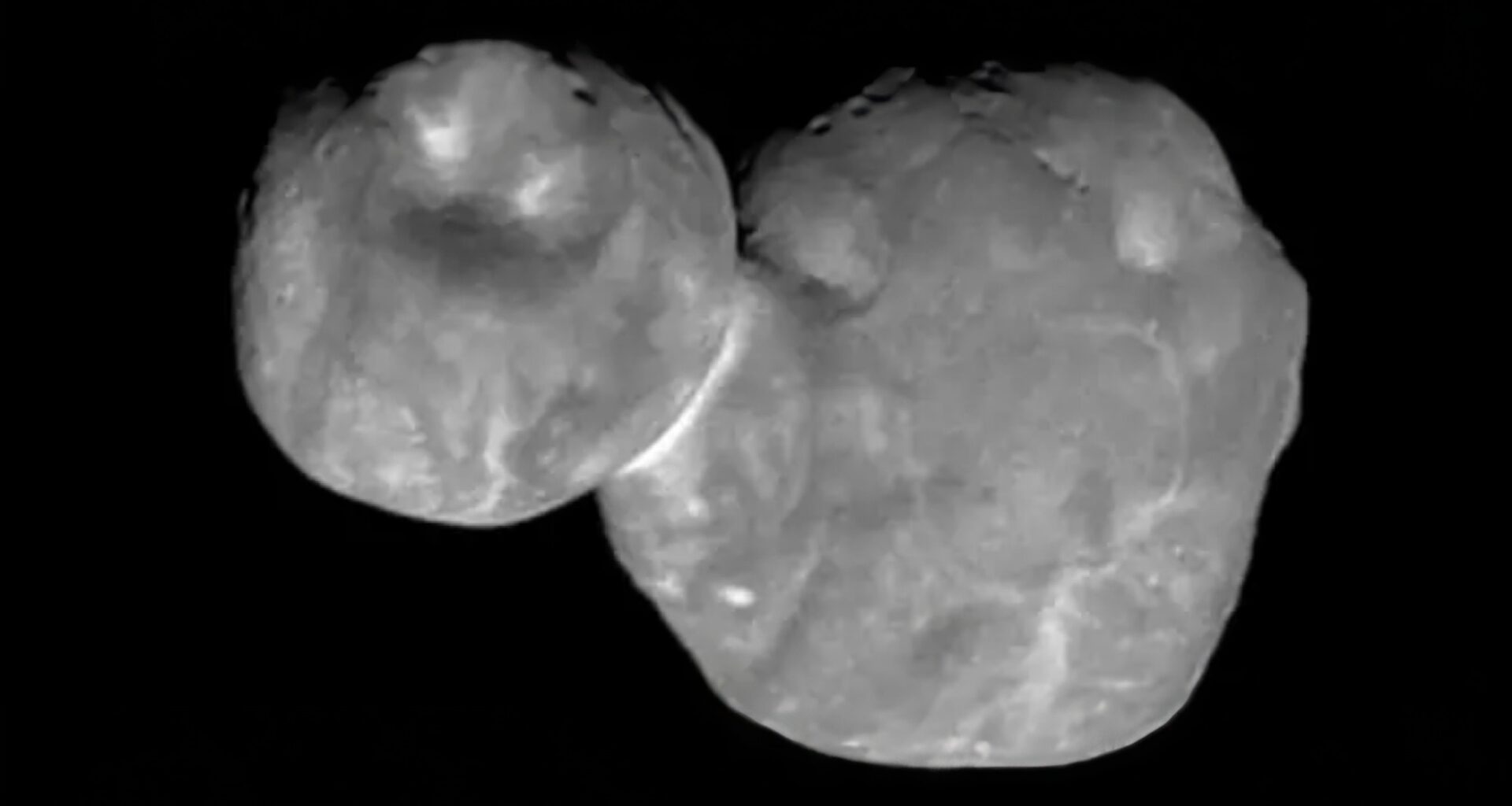
For years, scientists have debated how the Kuiper Belt’s “snowman” worlds formed. Did two separate bodies collide at just the right speed to stick together – or were they born as pairs from the start?
A new computer simulation now tips the balance toward a simpler answer. It shows that two-lobed Kuiper Belt objects can form when a collapsing debris cloud splits in two, then gently settles back together under gravity alone.

If that’s true, then the most famous example of a contact binary may not be a lucky accident at all – but a direct fossil of that early collapse.
Arrokoth sets the bar
Arrokoth, the small two-lobed body explored by New Horizons in 2019, preserves that process in plain view.
Working at Michigan State University (MSU), Jackson Barnes demonstrated that a spinning cloud can collapse, separate into two bound lobes, and then bring them back into contact without shattering either one.
Rather than melting into a single sphere, the paired bodies settle together at low speeds and retain their rounded halves joined by a narrow neck.
If that pathway holds, then many similar objects in the Kuiper Belt may have been born already joined, making their shapes direct records of planet formation rather than products of later chance encounters.
Where snowman worlds endure
Beyond Neptune sits the Kuiper Belt, a wide zone of icy leftovers where weak sunlight keeps surfaces cold. With fewer close passes and fewer collisions, many bodies there avoided the grinding that reshaped asteroids nearer the Sun.
Scientists call many of these chunks planetesimals, early building blocks that later clumped into planets and moons. Because that region stays so calm, delicate two-lobed shapes can survive long enough for telescopes to spot them.
In 2004, a careful analysis suggested that many Kuiper Belt bodies are actually stuck-together pairs. Astronomers call these contact binaries – two round lobes touching at a narrow neck, and that neck preserves a record of how they formed.
About 10 percent of known planetesimals appear to fit this category, which means the process behind them must be routine.
That routine origin likely traces back to the earliest collapse events, when the surrounding cloud still shaped how pairs evolved.
Gravity brings lobes together
Long before planets cleared their orbits, dust and ice swirled in a protoplanetary disk around the young Sun. As clumps grew dense, gravity pulled pebbles inward while repeated bumps bled away energy and slowed the motion.
Spinning faster during the squeeze, some clumps split into pairs that circled each other instead of forming one body. But to become contact binaries, those pairs still had to lose orbital energy.
In Barnes’ model, nearby debris tugged on each pair and traded energy until the orbit tightened. Each nudge stole a little motion from the binary and handed it to passing material in the same cloud.
Eventually the lobes met at low speed, fusing at the neck without smashing into a single lump. Because the contact was gentle, heating stayed minimal, allowing volatile ices to remain on the surface.
Why older simulations missed it
For years, planet-formation models may have been too tidy. Most earlier simulations treated colliding particles like soft clay, merging them into a single smooth blob.
That shortcut erased the very feature scientists were trying to explain – the narrow waist between two lobes.
Barnes took a different approach. Instead of blending particles together, he used a discrete element method that allows grains to push, slide, and rebound realistically.
Tiny friction forces and small bounces created natural pileups, preserving a visible seam instead of rounding it away.
“That’s what’s so exciting about this paper,” Barnes said, after the updated code finally allowed the lobes to stay distinct.
The math favors gentle merges
When the team ran the simulations dozens of times, a clear pattern emerged. Contact binaries only formed when the two lobes approached each other at less than about 13 miles per hour.
At those low speeds, the bodies didn’t shatter or melt into one sphere. They settled together gently, keeping their rounded halves intact and connected by a narrow neck.
After merging, many of the simulated objects rotated once every eight to 12 hours – strikingly similar to the slow spin rates astronomers observe in the Kuiper Belt.
That match makes the collapse pathway testable. If future telescope surveys find the same clustering of rotation speeds, it would strengthen the case that gravity, not rare collisions, built these Kuiper Belt worlds.
Gravity builds Kuiper Belt families
The simulations also produced surprises. In some runs, a third object remained in orbit around the newly formed pair. Instead of creating just a binary, gravitational collapse occasionally built small systems.
During the chaotic inward fall, gravity sometimes trapped an extra body into a stable orbit, hinting that the same process could explain triples and even more complex groupings already seen in the Kuiper Belt.
If that idea holds up, a single collapse event could shape not just one object, but an entire family of icy bodies.
Testing the role of gravity
Even with a better collision model, the simulation could not reproduce every detail seen on Arrokoth’s larger lobe. Computers still had to bundle countless pebbles into bigger stand-ins, which meant the code smoothed over much of the fine surface texture.
Later changes could also have played a role. Slow impacts over billions of years may have subtly tweaked the object’s spin and reshaped parts of its surface without disturbing its basic two-lobe structure.
But once gravitational collapse can already produce contact binaries on its own, those extra processes shift from required ingredients to optional refinements.
That shift points to a simpler origin story. One new set of simulations links this common outer solar system shape in the Kuiper Belt to ordinary gravity rather than rare, finely tuned collisions.
As telescopes sharpen their view and simulations grow more sophisticated, scientists will be able to determine how frequently gravitational collapse creates these paired worlds – and how many have endured, largely unchanged, since the solar system’s earliest days.
The study is published in the journal Monthly Notices of the Royal Astronomical Society.
Image credit: NASA
—–
Like what you read? Subscribe to our newsletter for engaging articles, exclusive content, and the latest updates.
Check us out on EarthSnap, a free app brought to you by Eric Ralls and Earth.com.
—–