
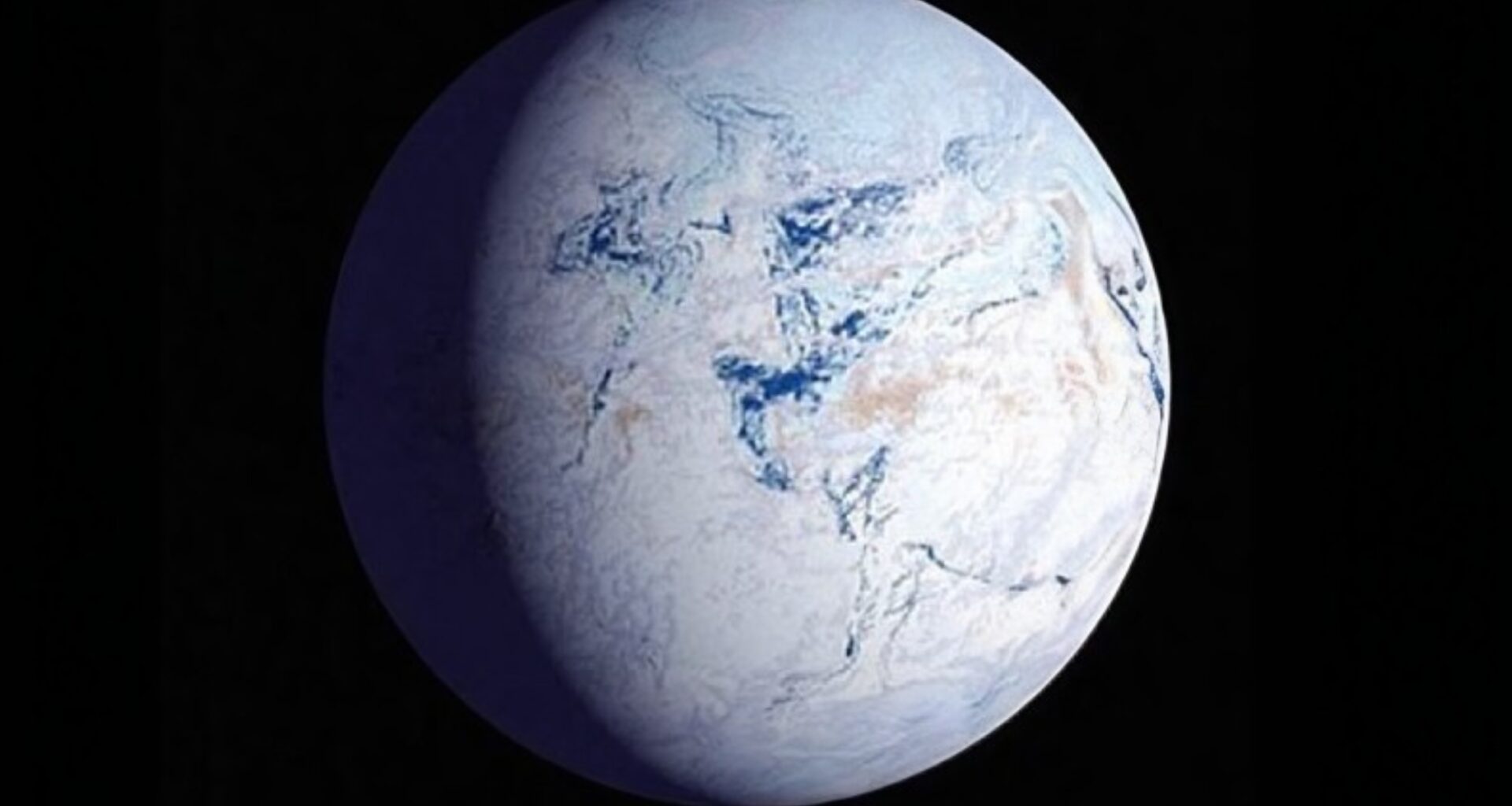
A chemical reaction on the ocean floor has emerged as the decisive factor that allowed one planet-wide ice age to last 56 million years while a later freeze ended after just 4 million years.
That result overturns the long-standing assumption that volcanic carbon alone set the clock on Earth’s most extreme climate states.
Comparing two ice ages

Rocks dating from more than 600 million years ago record two global freezes that lasted for dramatically different lengths of time.
By tracing how carbon moved between ocean and atmosphere, Trent B. Thomas at the University of Washington (UW) demonstrated that intensified seafloor weathering could hold greenhouse gases low enough to prolong deep freeze conditions for tens of millions of years.
In his simulations, volcanic carbon release remained within the same range for both episodes, yet only the scenario with accelerated ocean-floor reactions reproduced the prolonged glaciation.
That imbalance pointed away from the sky and toward the seabed, setting up the need to understand how the ocean floor gained such outsized control over Earth’s climate clock.
Why Earth stayed frozen
Geologists refer to these planet-wide deep freezes as Snowball Earth events, periods when ice spread across nearly the entire globe and reached close to the equator.
“Something should be very different in the carbon system between the two Snowball Earth events if you’re going to have such a dramatic discrepancy,” said Dr. Trent B. Thomas, a planetary scientist at UW.
Volcanoes vent CO2, while a stabilizing feedback speeds rock breakdown on warm, wet continents and slows it in cold times.
Once ice spreads, bright surfaces bounce sunlight back to space, and glaciers can keep advancing as the land-based thermostat stalls.
Ocean floor trapped carbon
With continents sealed under ice, land rock breakdown slowed to a crawl, but seawater still moved through cracks in ocean crust.
That process is called seafloor weathering, seawater reacting with seafloor rock and trapping carbon as minerals.
As these reactions released dissolved ions, carbon-bearing minerals precipitated, allowing the ocean to lock away more carbon while atmospheric CO₂ levels fell.
Although this process plays only a small role today, Thomas’s model indicates it could become the dominant carbon sink during global ice cover lasting millions of years.
Thousands of simulations tested
To test that idea, the team at UW ran 10,000 simulations of oceans, air, and rocks during a global deep freeze.
Across that study, carbon inputs from Earth’s interior stayed steady while seafloor reactions sped up or slowed down.
Only one setting held the long freeze: seafloor weathering ran about 25-53 times faster than today, far beyond values for the short freeze.
Because carbon release rates stayed within modern uncertainty in their tests, the results put most of the timing power on the seafloor.
Acidic oceans sped up reactions
High CO2 made seawater more acidic during the glaciations, so seafloor rock dissolved faster wherever water could reach it.
With ice choking rivers, much less mud reached the deep ocean, leaving older crust exposed to circulating seawater.
Reduced sediment meant fewer seals on seafloor cracks, which likely let more water flow through and react.
Those conditions could push the ocean floor into being the main carbon sink when continents froze into silence.
Rock cracks controlled flow
Rock texture mattered, because seawater could only react where it could enter and move through the crust.
Scientists call that openness porosity, the fraction of a rock made of connected open spaces.
Near hot seafloor vents, certain minerals can harden inside cracks, cutting off water flow and slowing reactions.
More open crust stays reactive longer, so changes in porosity can decide whether Earth remains frozen for ages.
Sulfate shaped ice duration
Ocean chemistry may have controlled crust porosity through the amount of sulfate, a dissolved sulfur compound in seawater, available near vents.
When sulfate is abundant, minerals form more easily in hot crust and clog cracks, limiting water-rock contact.
Geochemical evidence in the paper pointed to sulfate nearly absent during the long glaciation, then rebounding before the short glaciation.
If that timing holds up, small swings in seawater chemistry could decide whether a Snowball ends quickly or drags on.
Chemistry locked in global ice
Low sulfate and open pores could create a loop that keeps seafloor weathering high and delays thaw.
Fewer clogging minerals keep crust pores open, letting more seawater circulate through rock and sustain the reaction.
Longer ice cover can also keep oceans low in oxygen, which can keep sulfate levels low.
“This is just meant to get the conversation started,” said Thomas, after laying out how ocean chemistry might control seafloor reactions.
Ocean chemistry shapes planets
Planetary climates may depend on seafloor chemistry more than scientists assumed, especially when surfaces become hostile to ordinary rock breakdown.
On an ice-covered world, greenhouse gas can rise slowly for ages, yet ocean-floor chemistry can still decide when ice retreats.
Even without a full Snowball, colder oceans or seafloor cracks that stay open could tune how quickly carbon leaves the atmosphere.
Modern climate problems involve faster changes and living ecosystems, so this work mainly reshapes deep-time thinking, not near-term forecasts.
The new explanation links the duration of ancient global freezes to chemical reactions on the ocean floor that continue pulling carbon from the atmosphere.
Future research will need rock evidence and geochemical records to determine whether seafloor porosity truly shifted as the model predicts.
The study is published in the journal Geology.
—–
Like what you read? Subscribe to our newsletter for engaging articles, exclusive content, and the latest updates.
Check us out on EarthSnap, a free app brought to you by Eric Ralls and Earth.com.
—–