
For reasons that’ll remain forever murky, China’s leadership decided many years ago it wanted to become a player in the global auto sector. Electrical vehicles (EVs) were just becoming a thing and so China became a major EV producer. Along with that came a push for electrification and production of things like solar panels, which complement China’s push into autos.
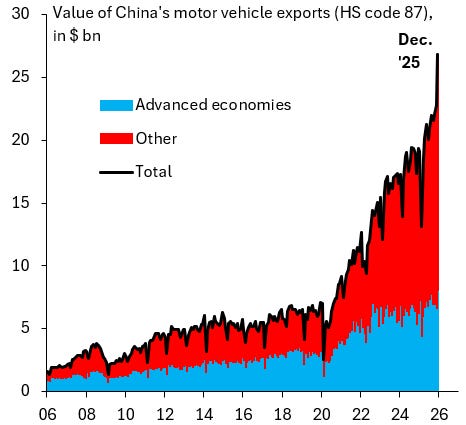
A few months ago, I wrote a post documenting how massively China’s auto exports have grown. The bottom line in that piece was that most of these cars aren’t going to advanced economies but to emerging markets (EM). The idea that tariffs will protect auto makers in Germany or France therefore misses the point that this isn’t where the battle is being fought. There’ll never be a phalanx of Chinese cars heading down the Autobahn. The battle – instead – is being fought in EM, where car manufacturers from across advanced economies are being squeezed out. EU tariffs can’t change that.
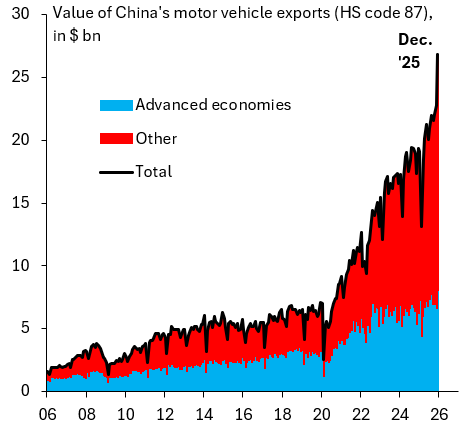
Since I made that point, China’s auto exports have gone totally nuts. As the black line in the chart above shows, auto exports in December 2025 went vertical. The blue bars in the chart show exports to advanced economies, while the red bars show exports to EM. The massive growth in December 2025 is all EM. China’s exports to advanced economies plateaued some time ago and – if anything – look like they’re falling back.
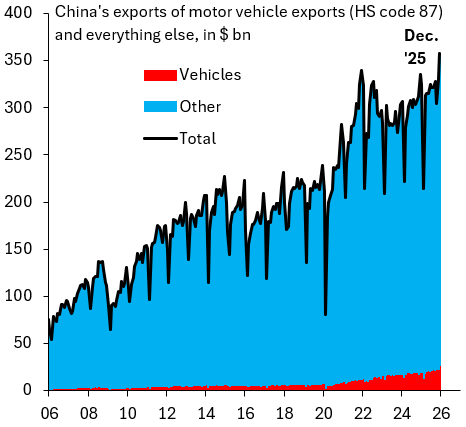
Of course, the surge in auto exports is nothing compared to China’s overall exports, which also went nuts in December 2025 and reached a new all-time high. The black line in the chart above shows China’s overall exports, while the red bars are the small role that auto exports play. China’s massive export machine is in overdrive in a broad sense, not just where autos are concerned. That’s a sign that China’s currency is very substantially undervalued, which gives it an unfair advantage on global markets and is a profoundly destabilizing force in the global economy.