
Finally, we got our hands on the new Sony a7 V. This camera features a new sensor and image processor combo, hence we were really looking forward to pushing it through our standard CineD lab test procedures. And guess what? We were really positively surprised! Curious to hear more? Then read on …
Well, the Sony Alpha line of cameras hasn’t seen many new models lately; the last one, the Sony A1 II, was unveiled in mid-November 2024. The predecessor to the a7 V, the Sony a7 IV, was announced back in October 2021 (please see our lab test here).
Meanwhile, Sony released the FX2, which we lab tested in November 2025 (lab test here). This camera already gave us a hint that Sony improved the signal processing pipeline, as we could see a much nicer noise pattern coming through the image, which also helped in the latitude test (previously, Sony cameras had larger blotches of chroma noise, which hampered image quality in the shadows).
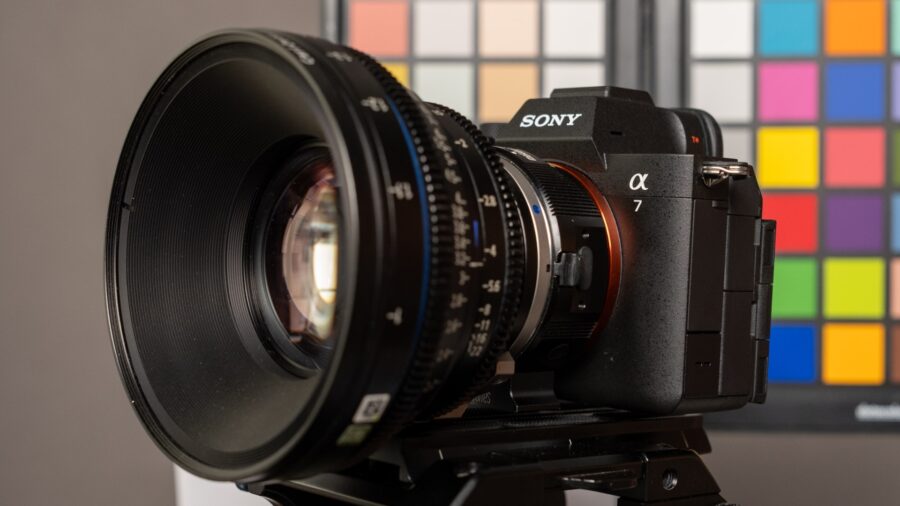 The Sony a7 V in our CineD Lab. Image credit: CineD
Hence, we were really curious to see how the new Sony a7 V would perform in our lab test. Specs-wise, it looks quite good, featuring an effective 33MP full-frame sensor downsampled to 4K for the video side of things, including a dual native ISO feature with two base ISOs of 800 and 8000. Frame rates go up to 4K 120 frames per second (fps) in APS-C mode. Unfortunately, no higher resolutions are available for video, and no internal RAW codecs are featured. Please read all about the specs here, or listen to our podcast episode 93 here to learn more about this new camera!
As usual, I would like to thank my colleague Florian for helping to shoot and analyze this test!
Rolling shutter of the Sony a7 V
As usual, we use our 300Hz strobe light to reveal the pattern of black and white bars – a typical artefact of rolling shutter sensors, which allows measuring the rolling shutter.
For full-frame 4K at 25 fps, we get 14.5ms of rolling shutter (less is better). This is neither particularly good nor bad; I would call it middle ground:
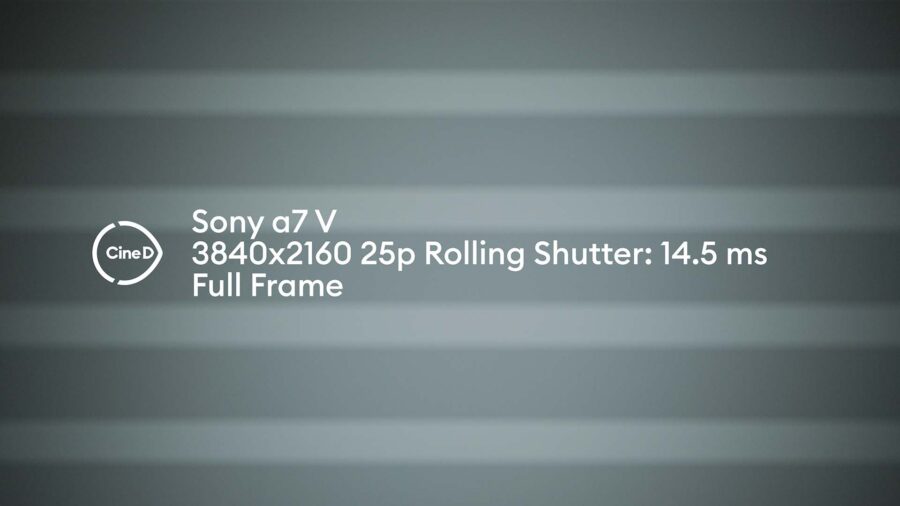
In 4K 25p APS-C mode, we get a slightly better result, 13.9ms.
In full-frame 4K 60p, there is a new option called 4K angle of view priority (AoVP) – if it is “OFF”, there is a ~16% sensor crop, and the rolling shutter value is 14.7ms. Interestingly, if AoVP is “ON,” the rolling shutter reduces to 13ms while retaining the full-frame field of view.
These are good but not exceptional results. More than 5 years ago, the Sony a7S III, for example, showed 8.7ms in 4K full-frame mode. However, we have to state that the Sony a7 V shows a massive improvement over last year’s Sony FX2, which also features a 4K image, also downsampled from a 33MP full-frame sensor, but with a really bad 27.5ms rolling shutter.
For more results of the various other modes in full-frame and APS-C, please visit our databases.
Dynamic range of the Sony A7 V
Before you continue, please make sure you have read our initial article on how we perform our dynamic range testing here.
Good, so let’s have a look at a waveform plot of 4K 25p in SGamut3.Cine / SLog3 at ISO800 full-frame on a 4K timeline (internal 4K 10-bit 4:2:2 XAVC codec):
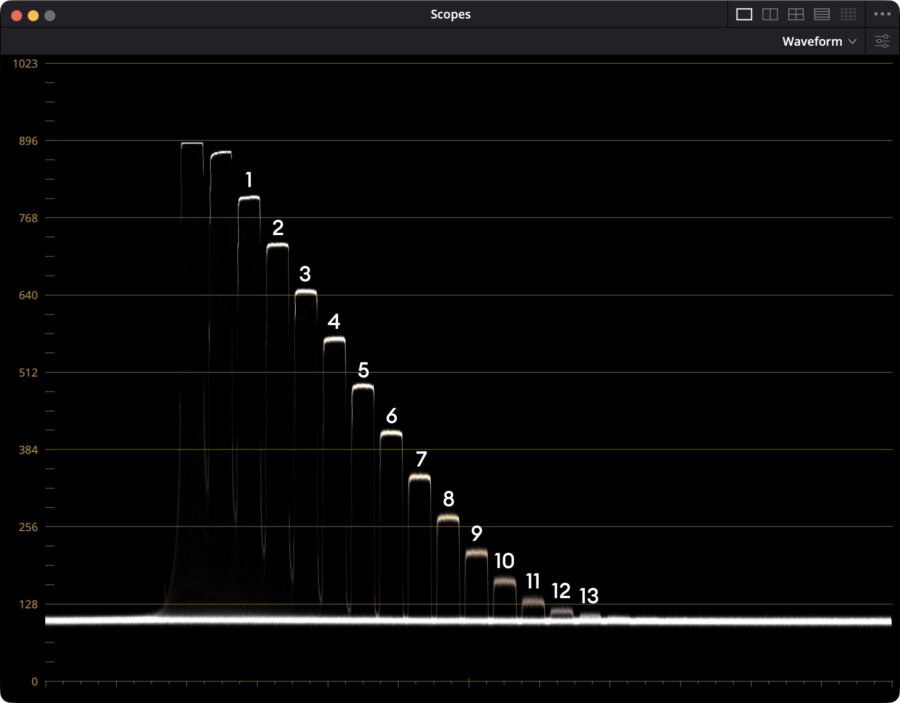 Waveform plot of the Sony A7 V in 4K FF SG3.cine/Slog3 at ISO800. Image credit: CineD
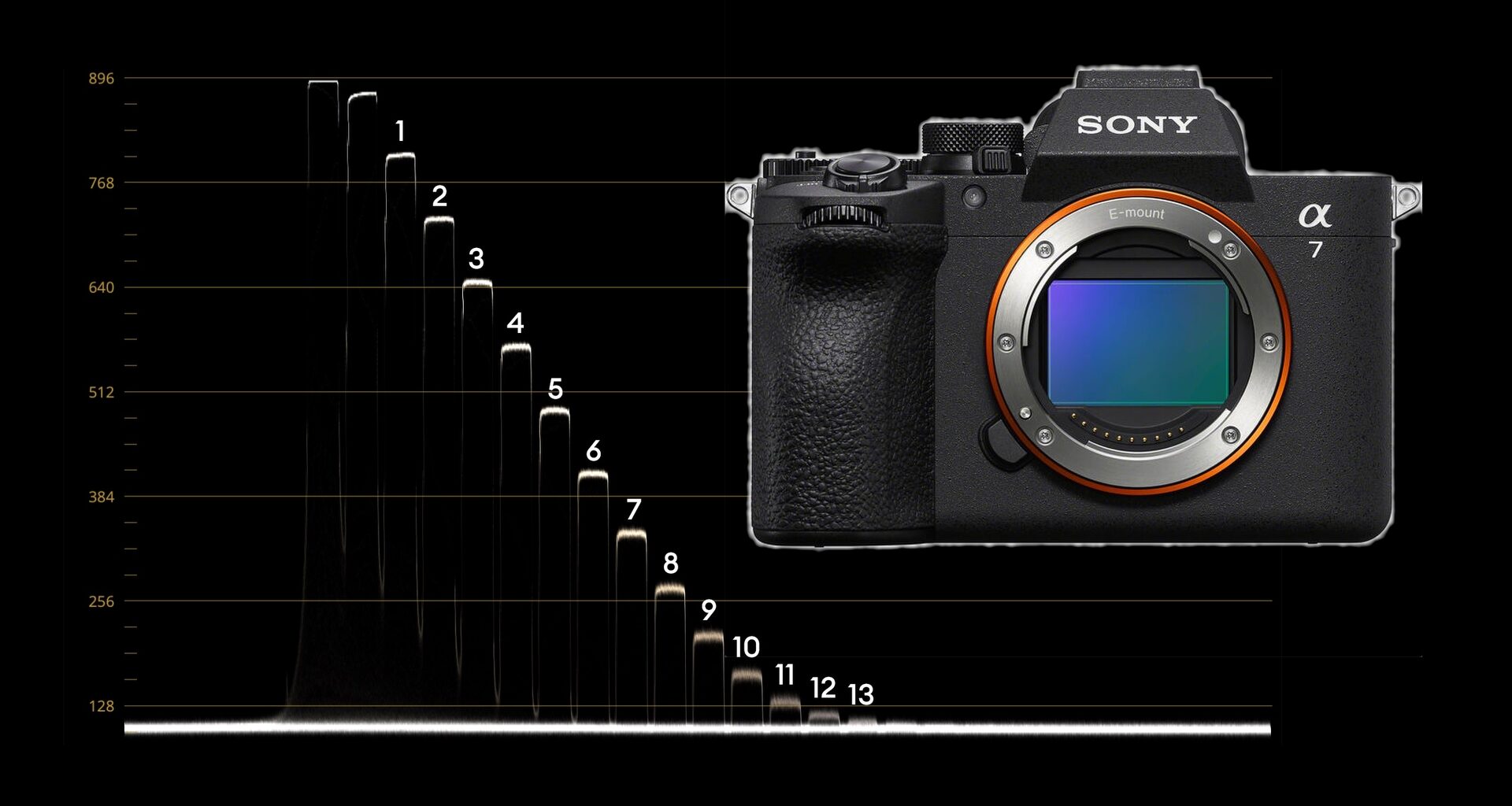
We can see a solid 13 stops above the noise floor! The noise floor looks rather clean hinting at a lot of internal noise reduction, but we will see in the latitude section that this is a very fine, good looking noise – as opposed to previous Sony Alpha cameras which just had too much of internal noise reduction (that you couldn’t turn off), with the remaining noise being blotchy and rather ugly in nature.
IMATEST reveals a solid 12.4 stops at a signal-to-noise ratio (SNR) of 2, and 13.5 stops at SNR = 1.
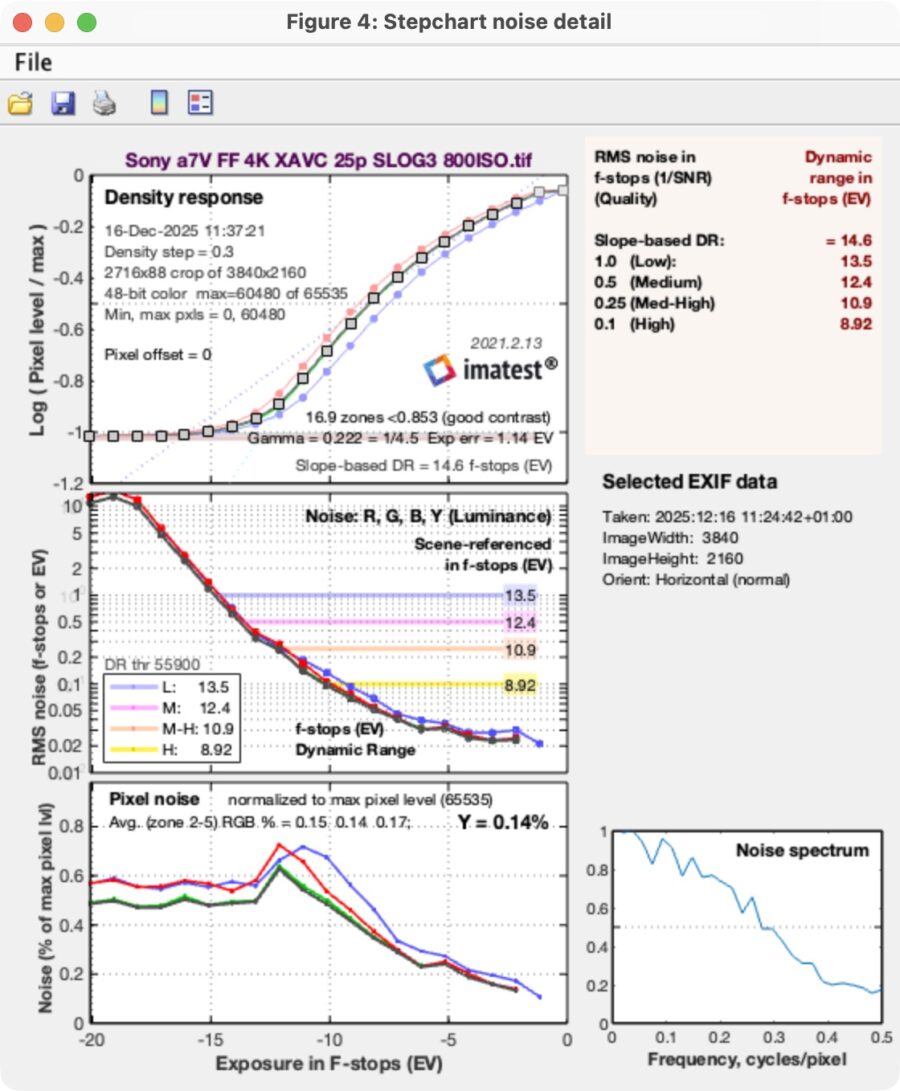 Sony A7 V SG3.C/Slog3 ISO800 4K full-frame result. Image credit: CineD
Also, signal amplitudes (in the lower-right-hand “Noise spectrum” graph) remain rather high throughout the higher frequencies and only drop at the very end. A good sign!
At ISO8000, the second native ISO, we get 11.1 / 12.7 stops at SNR = 2 / 1. Hence, about 1 stop is lost.
A quick note on the full-frame 4K 60p angle-of-view priority mode: the dynamic range with AoVP “ON” reveals 12.4 / 13.4 stops at SNR = 2 / 1 (retaining the full field of view), whereas the AoVP “OFF” mode reveals 12.5 / 13.5 stops at SNR = 2 / 1. Hence, very little difference, although Sony claims that “OFF” also involves more noise reduction. Even at the second native ISO of 8000, the difference is negligible; we get 11 / 12.4 stops at SNR = 2 / 1 (“OFF”) and 10.9 / 12.3 stops at SNR = 2 / 1 (“ON”).
Please have a look at our database for all the other modes of the Sony a7 V.
Exposure latitude of the Sony A7 V at ISO800
As mentioned in previous articles, latitude is the camera’s ability to retain detail and colors when over- or underexposed and pushed back to a base exposure. This test is very revealing, as it pushes every camera to its absolute limits – not just in the highlights but mostly in the shadows.
Besides charts and IMATEST, which provide absolute (objective) mathematically obtained values, this latitude test is our “real world” experiment on how usable the images are using a carefully crafted studio scene.
All latitude shots were done at ISO800 full-frame with 4K 10-bit 4:2:2 XAVC compressed codec using SGamut3.Cine / SLog3. Using a color space transform (CST) on the first node to DaVinci Wide Gamut, then an adjustment node, and at the end another CST from DaVinci Wide Gamut to Rec.709, the files were transformed into the Rec.709 space. Noise reduction was always done on the first node.
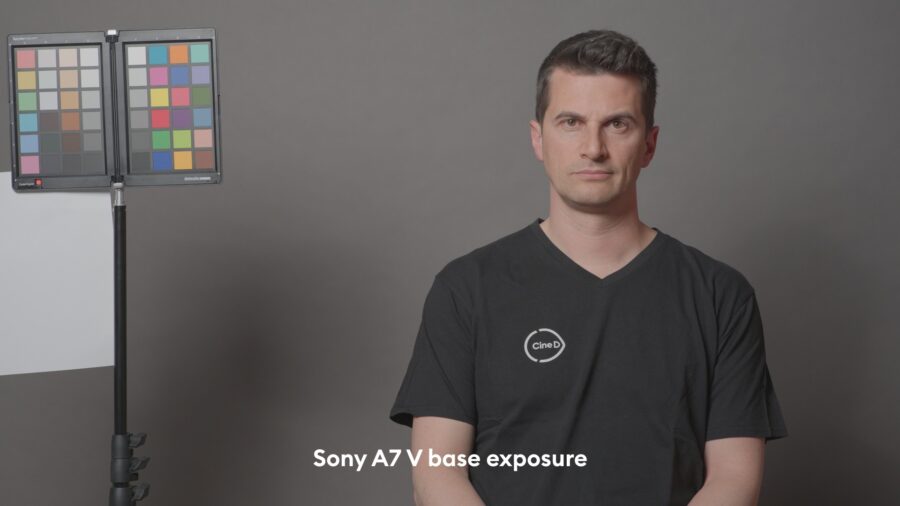
Our studio base exposure is (arbitrarily) chosen as having an (ungraded) luma value of 60% on the forehead of our subject on the waveform monitor. In this case, my colleague Nino:
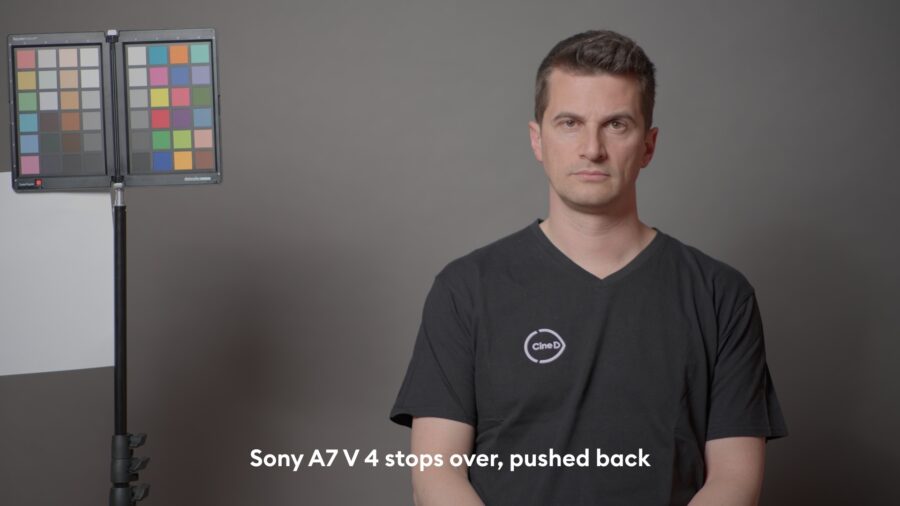
From here, we can overexpose 4 stops and still bring everything back to base exposure:
And now, we are closing down the iris of our trusted Zeiss 85mm T1.5 CP2 lens in one-stop increments until T8, and from there, we double the shutter values.
The first time that significant noise is showing up is at 4 stops of underexposure, brought back to base:
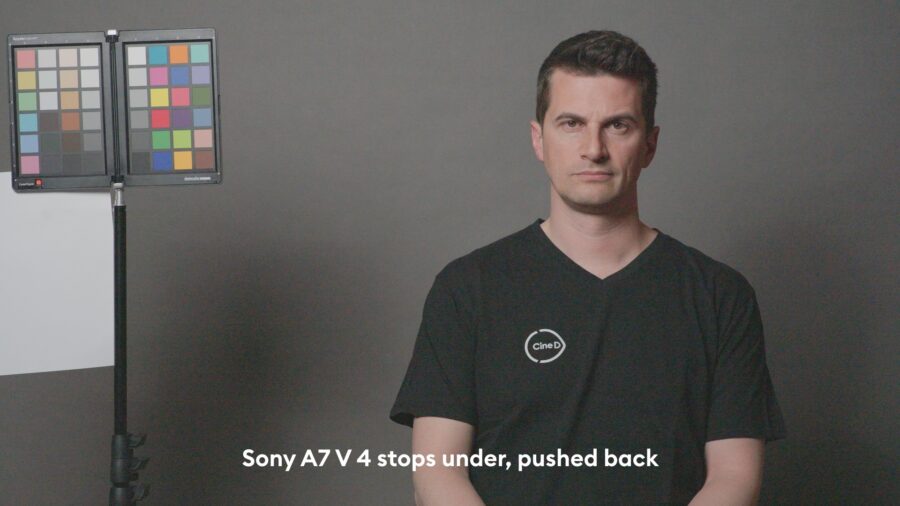
Which is quite remarkable, as we are already at 8 stops of exposure latitude (4 over to 4 under)! The predecessor, the Sony A7 IV, showed only 7 stops of latitude before the image fell apart. Let’s see how far we can push it further!
At 5 stops underexposure, the image looks like this:
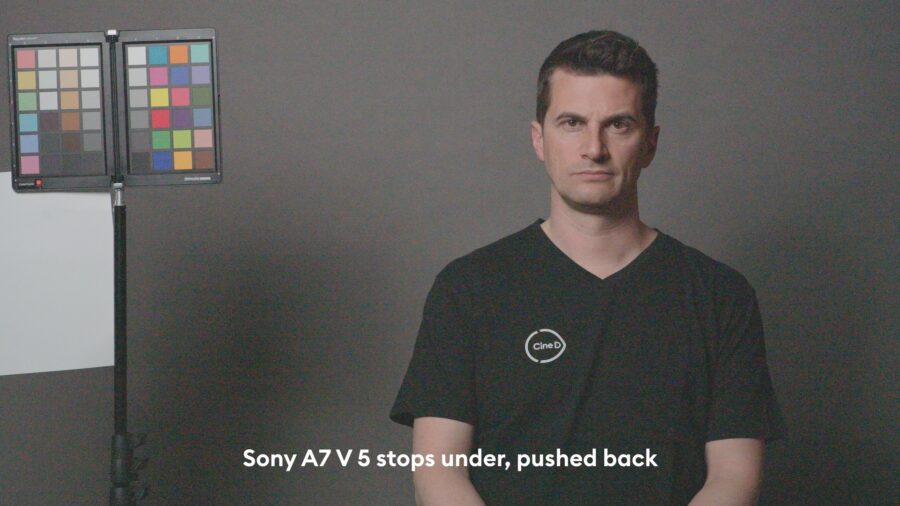
This definitely needs some noise reduction, which nicely cleans up the noise at rather low settings (see below):
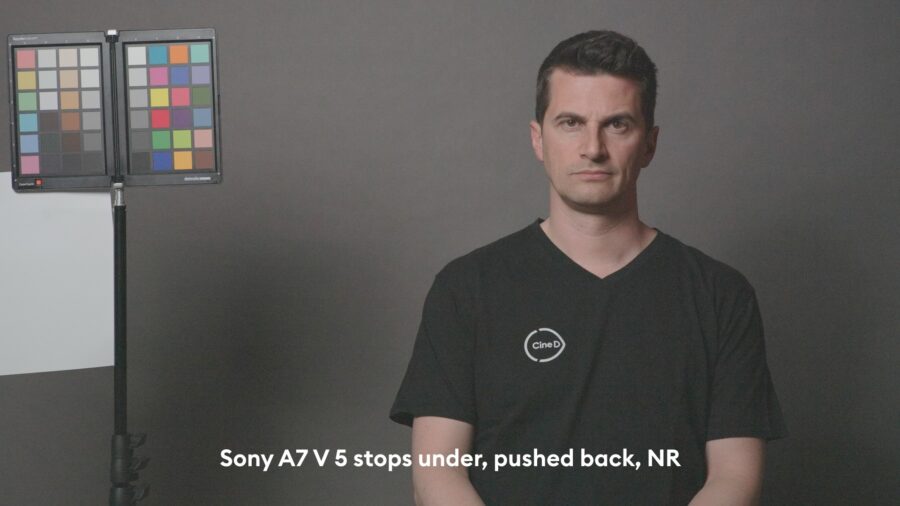
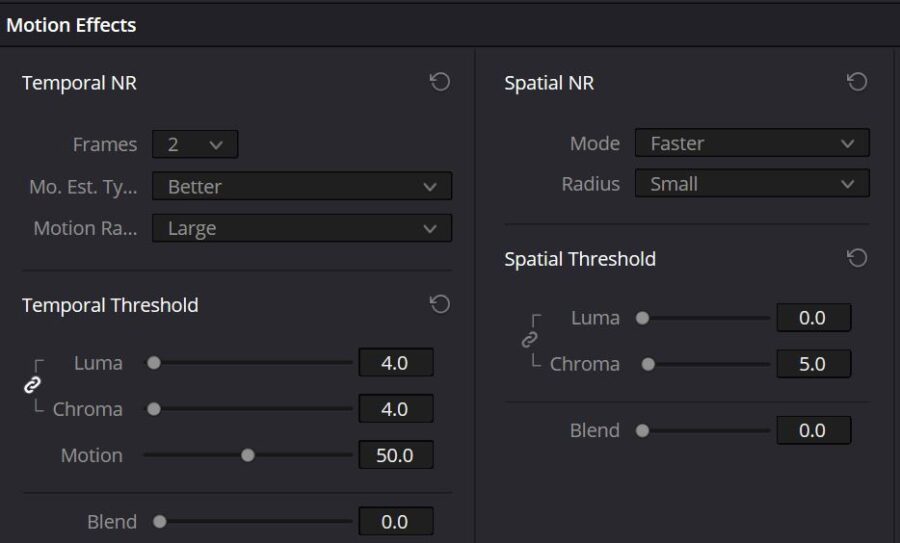
One of my criteria is always the shadow side of the subject’s face, if the skin tones are still intact. And yes, they are! The other criterion is whether horizontal or vertical line artefacts appear, as well as the presence of larger chroma noise blotches across the image, which is not the case here. Very good, we are at 9 stops of exposure latitude! The first Sony Alpha camera to reach that was the Sony A9 III with the global shutter sensor that we tested here.
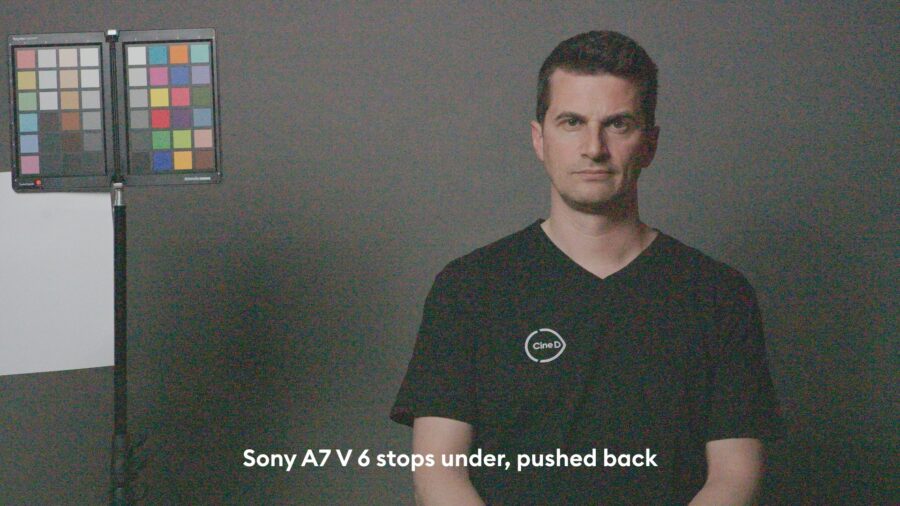
Now let’s move to 6 stops underexposure:
And here is the noise-reduced version:
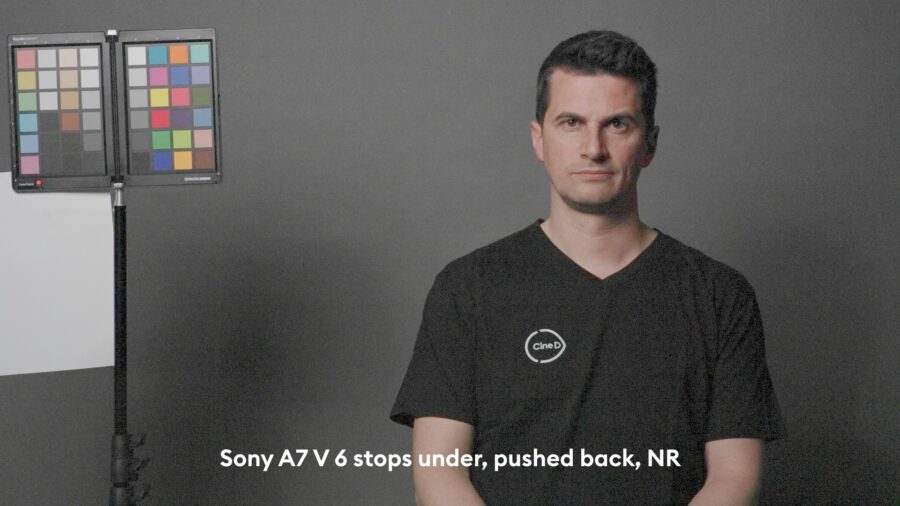
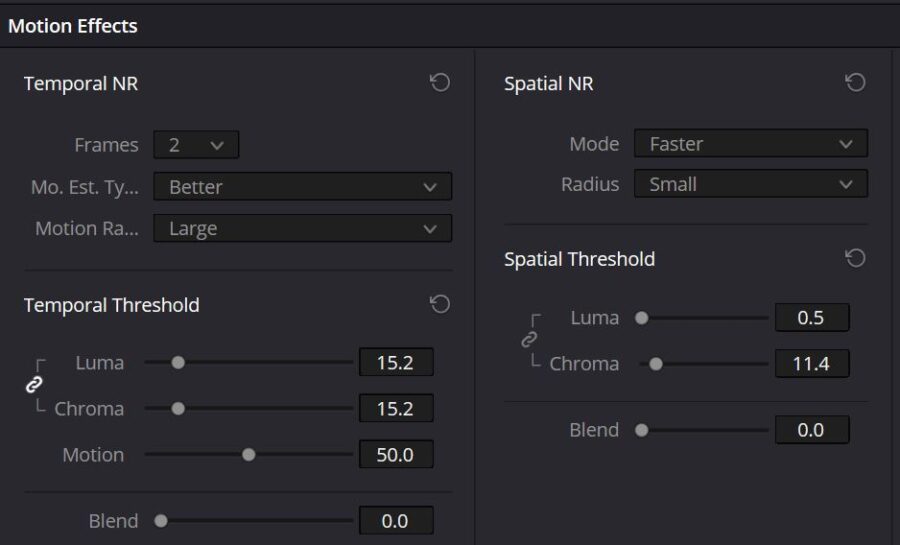
Now we can see that the image falls apart – at 10 stops of exposure latitude! The shadow side of Nino’s face is gone, shadows show a greenish/purple cast, and there are individual red pixels showing up erratically. Still, there are no horizontal or vertical line artefacts, and the image still looks somewhat OK-ish. In comparison to the Sony FX2, we get 2 full stops better latitude results (mainly due to a horizontal image splitting line, which ruins the image of the Sony FX2).
All of that, despite having to use the internal 10-bit compressed codec because no RAW option is available. Typically, internal RAW flavors from other cameras have 12-bit color depth, which greatly helps retain color accuracy when lifting shadows.
This result is on par with the Sony A9 III, and 1 stop better than the Nikon ZR that we tested here. Also, the Canon EOS R1 showed 9 stops of exposure latitude (lab test here). However, the Panasonic LUMIX S1II with its internal ProRes RAW codec was able to break the 10-stops of exposure-latitude barrier, which no consumer full-frame camera has been able to do so far (lab test here).
For full-frame, the ARRI Alexa Mini LF is still our benchmark, showing a solid 10 stops of exposure latitude with some wiggle room towards 11 (lab test here). The absolute benchmark so far is the ALEXA 35, which showed 12 stops of exposure latitude (lab test here).
Summary
The Sony a7 V shows very solid performance in our lab test, despite the fact that it has no internal RAW codecs, only compressed 4K 10-bit 4:2:2 XAVC. The rolling shutter is middle ground, but OK, around 14ms in full-frame and APS-C mode, the dynamic range in IMATEST shows a solid 12.4 stops at SNR = 2, and exposure latitude shows a strong 9 stops with some room towards 10. And I have to mention it again, somehow the noise processing is much more pleasing than with previous Sony Alpha cameras – Sony is allowing some noise to come through, which is very welcome from my side.
Which leads to a clear recommendation from my side: please choose the Sony a7 V over the FX2 when it comes to image quality!
Have you shot with the Sony a7 V? What is your experience? Let us know in the comments section below.