
(Bloomberg) — The dollar erased earlier declines Monday as traders considered the impact of President Donald Trump’s latest plan for global tariffs on US imports.
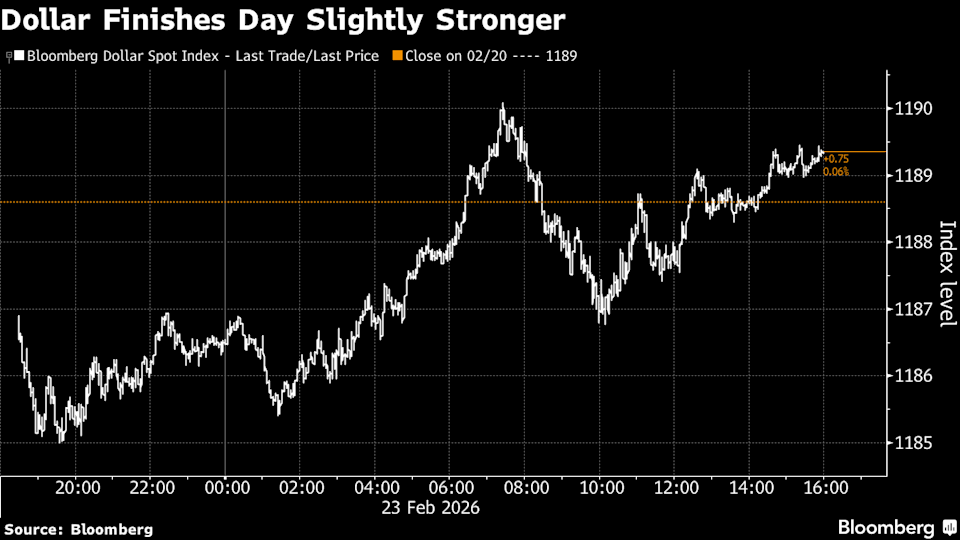
A Bloomberg gauge of the greenback ended the day 0.1% higher in New York after falling as much as 0.3% earlier in the session. Meanwhile, US Treasuries rallied pushing yields lower.
Most Read from Bloomberg
While the Supreme Court’s ruling last week struck down many of the tariffs that Trump put in place, the US president has shown no sign of backing down from his signature economic policy. The administration has said it plans to replace the prior tariffs with a new global levy of 15%, injecting fresh uncertainty into US trade deals.
“We see the new path for the dollar as lower and think that last year was just the start of a multi-year trend,” said Hugh Gimber, global market strategist at JP Morgan Asset Management, in an interview with Bloomberg TV.
While the economic impact won’t show up immediately, Gimber added. “There’s just a lot more now that businesses and investors are going to have to be grappling with.”
Traders are closely watching how other world leaders are responding to the latest tariff developments for cues on their next market bets. In Europe, officials are poised to freeze the ratification process of its trade deal with the US.
The Japanese yen and Swiss franc were among best performers in the Group of 10 against the greenback Monday, supported by safe-haven flows as US-Iran tensions and global trade concerns increase.
The Supreme Court ruling on tariffs “reinforces our structural bearish dollar view because it threatens to worsen US fiscal credibility,” said Elias Haddad, global head of markets strategy at Brown Brothers Harriman. “Although alternative measures may cushion the hit to customs revenue,” overall it creates “uncertainty” over future revenues.
The greenback has been under pressure over US fiscal concerns and from expectations of monetary easing from the Federal Reserve when many other major central banks have ended their interest-rate cutting cycle or even signaled hikes. The dollar gauge lost more than 1% this year, adding to last year’s drop of about 8% — its worst year in eight.
It will also be important to monitor any developments in the Trump administration’s stance on the dollar, said Derek Halpenny, head of global markets research at MUFG Bank. The president often suggests that he wants the dollar to weaken against other major currencies, seeing it as a way to boost demand for US goods.