
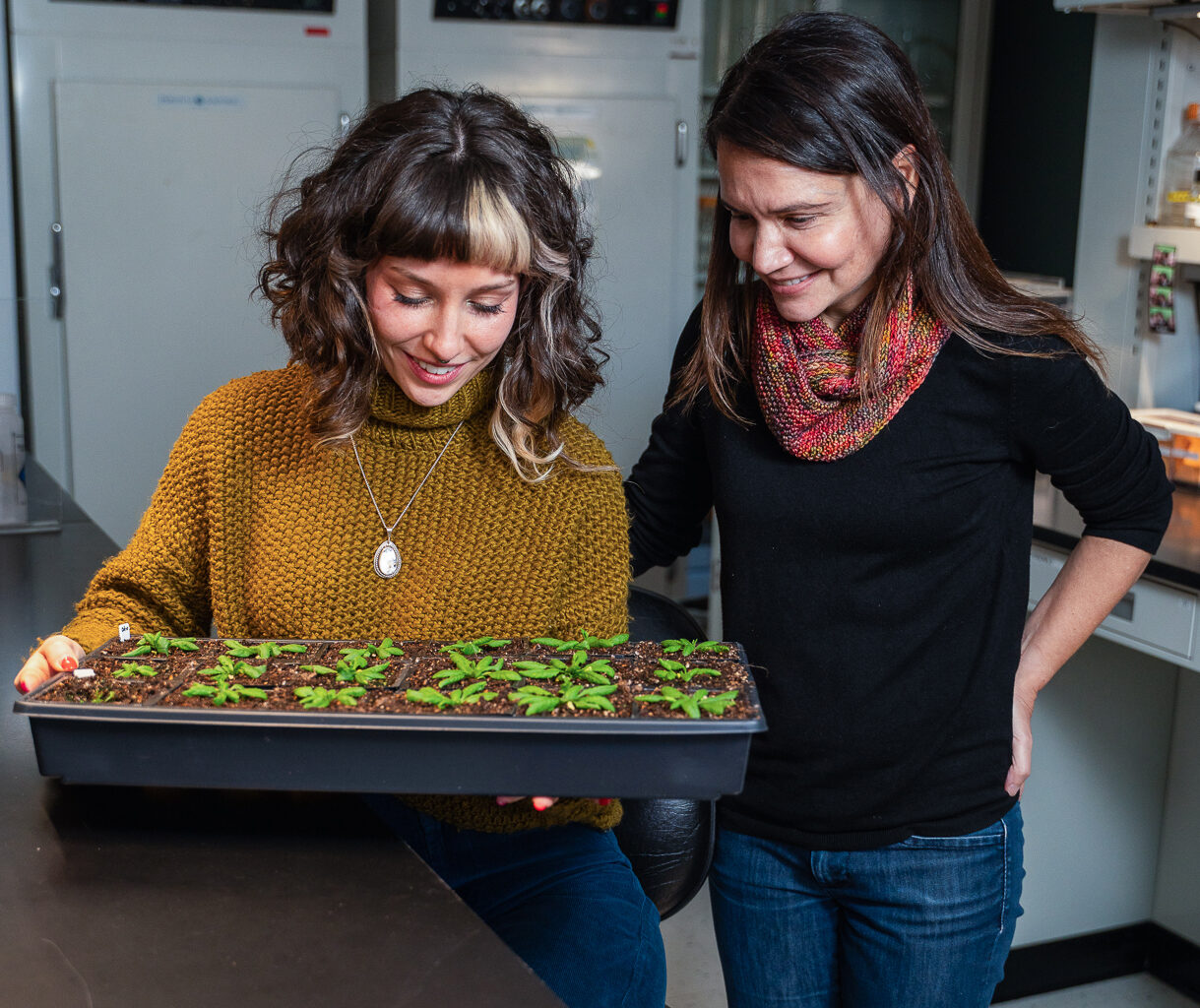
The study was funded by the National Science Foundation and led by Grace Johnston, who conducted the research as a student. Johnston was recruited into Argueso’s lab as an undergraduate biology student and wrote the paper as her master’s thesis. She is now a research associate in the lab.
“I did not know I wanted to do plant science,” said Johnston, who credits Argueso’s mentoring for her achievement and love of plant biology. “By the time I was done with my undergrad degree, we still didn’t know enough about these plants, and I just couldn’t let it go.”
Johnston received prestigious fellowships from the National Science Foundation and the American Society of Plant Biologists to support her work while earning her undergraduate and graduate degrees.
“This is a CSU research success story,” Johnston said. “Cris took me on when I didn’t know anything about science, and here we are eight years later, and we have the opportunity to actually impact food security.”
Argueso is passionate about inspiring young researchers like Johnston. Students from her lab have gone on to receive important national and international awards, and currently three undergraduate researchers are part of her team.
Second author Hannah Berry was a CSU Cell and Molecular Biology graduate student in Argueso’s lab; she is now a scientist at Pairwise, a plant biotechnology and gene-editing company. Co-author Hitoshi Sakakibara, a plant science professor at Nagoya University and the RIKEN Center for Sustainable Resource Science in Japan, is one of the top plant hormone quantification experts in the world. Mikiko Kojima, a scientist at the RIKEN Center for Sustainable Resource Science, also contributed to the study.