

Get insights on thousands of stocks from the global community of over 7 million individual investors at Simply Wall St.
Multiple securities fraud class action lawsuits have been filed against Oracle (NYSE:ORCL), focusing on its disclosures around AI infrastructure and related financial risks.
Law firms claim Oracle issued materially false or misleading statements about AI driven capital expenditures, partner exposure and the risk profile of these investments.
The cases highlight potential financial and reputational pressures for Oracle at a time when its AI infrastructure strategy and reliance on OpenAI are drawing close investor attention.
Oracle, best known for its database software and cloud services, is heavily promoting AI infrastructure as a core part of its growth story. The new lawsuits arrive just as the wider tech sector is pouring large sums into data centers, chips and cloud capacity to support AI workloads. For investors, this ties Oracle’s AI positioning directly to questions about disclosure quality and risk management.
As these cases progress, investors will likely see closer scrutiny of how Oracle explains its AI related capital spending and dependence on key partners. The outcomes could influence how the company frames future guidance, risk factors and project commitments, and may shape how investors compare Oracle’s AI exposure with that of other large software and cloud providers.
Stay updated on the most important news stories for Oracle by adding it to your watchlist or portfolio. Alternatively, explore our Community to discover new perspectives on Oracle.
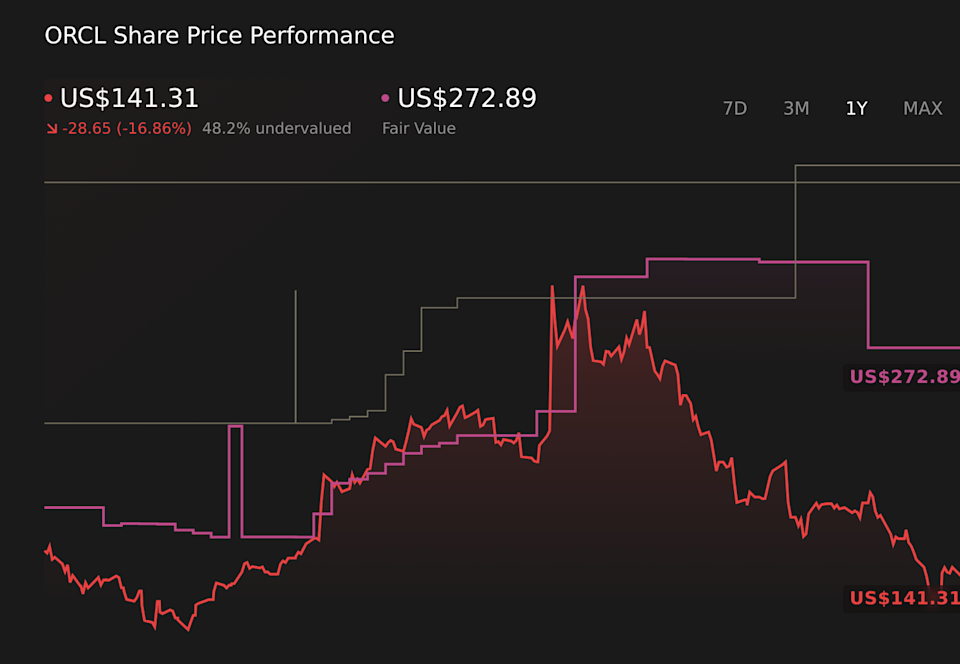 NYSE:ORCL 1-Year Stock Price Chart
See which insiders are buying and buying and selling Oracle following this latest news.
For investors, the class actions add a legal layer to concerns that were already building around Oracle’s aggressive AI-driven capital spending and reliance on partners such as OpenAI. The complaints focus on whether disclosures around the company’s AI infrastructure strategy, debt-funded data center buildout and remaining performance obligations accurately reflected the risk to cash flow, credit rating and project timing. That sits directly alongside recent market worries about stalled data center initiatives like the Stargate project, questions over OpenAI’s funding, and commentary from high profile investors about the sustainability of Big Tech AI spending. At the same time, Oracle continues to sign AI-related government and enterprise deals and expand AI agents across healthcare, supply chain and customer experience, so the core AI thesis is still central to how many shareholders view the company. The lawsuits do not resolve the debate, but they sharpen it around disclosure quality and execution risk, which can influence how investors compare Oracle with peers such as Microsoft, Amazon Web Services parent Amazon and Alphabet’s Google Cloud when deciding where to take AI infrastructure exposure.
The litigation directly tests a key narrative catalyst, which is that large AI contracts and a growing backlog can support multi year growth in cloud and AI-infrastructure revenue.
The allegations around debt, free cash flow pressure and concentration in OpenAI challenge the idea that Oracle can scale AI infrastructure spending without materially increasing financial risk.
The possibility of disclosure related findings, settlement costs or changes in reporting around AI contracts is not fully captured in the growth focused narrative and could affect how investors view remaining performance obligations.
Knowing what a company is worth starts with understanding its story. Check out one of the top narratives in the Simply Wall St Community for Oracle to help decide what it’s worth to you.
⚠️ Legal outcomes or extended proceedings from multiple class actions could create additional costs and keep disclosure concerns in focus for a long period.
⚠️ Heavy, debt-funded AI capital expenditure and reliance on a financially uncertain partner such as OpenAI increase the risk that underused capacity or contract changes could pressure free cash flow.
🎁 Oracle continues to win AI-related cloud and application deals in healthcare and the public sector, which supports the case that its AI products are gaining traction with large customers.
🎁 Analysts have highlighted very large cloud and AI related backlogs and see Oracle as one of several major providers targeting long term enterprise AI workloads alongside Microsoft, Amazon and Alphabet.
From here, investors may want to track any court filings or management commentary that clarify how Oracle described its AI contracts, debt plans and exposure to OpenAI, as these details go straight to the heart of current sentiment. Upcoming earnings and guidance will also be important for seeing how quickly AI-related backlog converts into recognized revenue and cash, and whether additional funding steps or asset sales are required to support the data center buildout. Finally, watch how customers such as U.S. federal agencies, healthcare providers and large enterprises adopt Oracle’s AI-powered tools, since contract wins and renewals can either reinforce or weaken the market’s willingness to look past short term legal and funding headlines.
To ensure you’re always in the loop on how the latest news impacts the investment narrative for Oracle, head to the community page for Oracle to never miss an update on the top community narratives.
This article by Simply Wall St is general in nature. We provide commentary based on historical data and analyst forecasts only using an unbiased methodology and our articles are not intended to be financial advice. It does not constitute a recommendation to buy or sell any stock, and does not take account of your objectives, or your financial situation. We aim to bring you long-term focused analysis driven by fundamental data. Note that our analysis may not factor in the latest price-sensitive company announcements or qualitative material. Simply Wall St has no position in any stocks mentioned.
Companies discussed in this article include ORCL.
Have feedback on this article? Concerned about the content? Get in touch with us directly. Alternatively, email editorial-team@simplywallst.com