
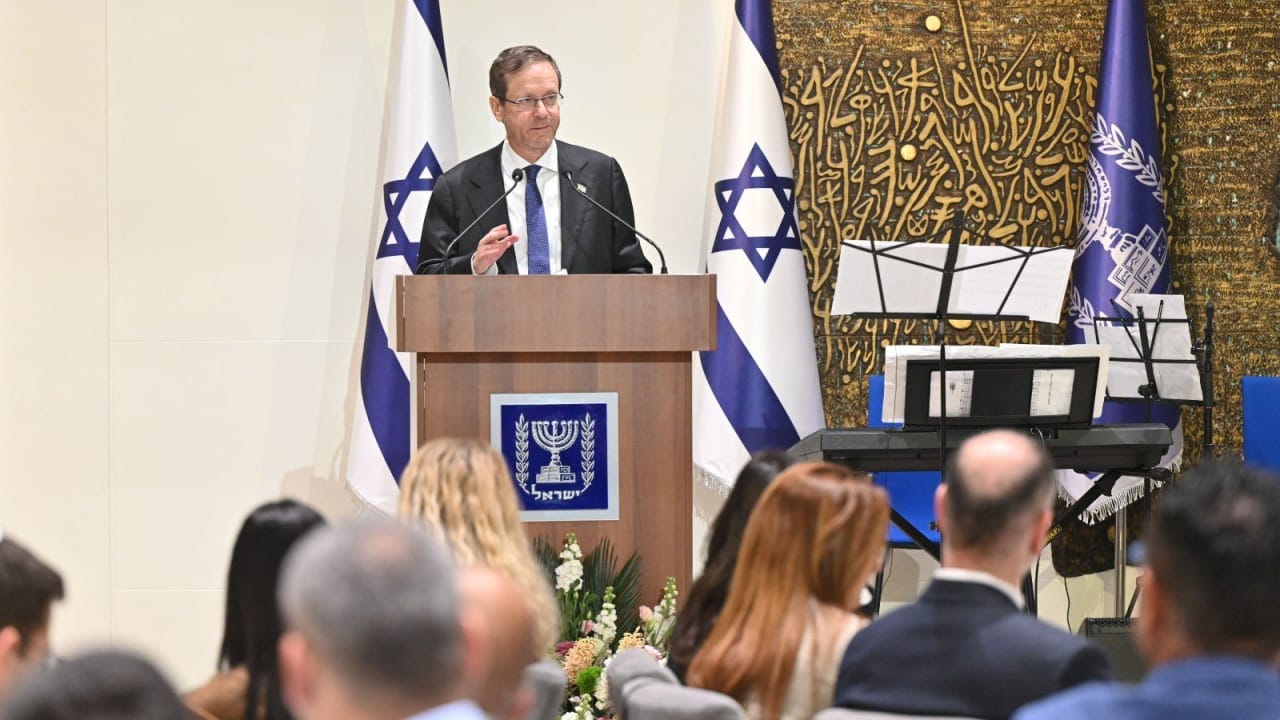
Violence and an unprecedented number of killings of Arab citizens by other Arabs were the key focus on Monday evening at the annual Iftar dinner hosted by President Isaac Herzog to break the Ramadan fast.
Herzog spoke of his deep concern over the situation, as did Ihab Abu Ghosh, director of the Sharia Courts, as well as Rahma Mahamid, a University of Haifa researcher who primarily collects data on violence in ageing Arab families, with particular emphasis on violence against women.
Abu Ghosh, referring in his address to the rising number of fatalities in the Arab sector since the beginning of the year, called for a national emergency to combat the scourge of killing, which he said instills fear and deprives ordinary, law-abiding Israeli Arabs of a sense of security.
Speaking of the sanctity of human life, Abu Ghosh compared the Koran and the Talmud. Quoting the Koran, he said, “He who takes a single life is as one who killed all, and he who saves a single life is as one who saved all.” The Talmudic quote is “One who saves a single life is as one who saved a whole world (Jerusalem Talmud, Mishna Sanhedrin 4:5).”
Abu Ghosh regretted that there are those in the Arab sector who ignore the teaching about the sanctity of life, saying that to those who kill, life is no longer sacred. “So many died through acts of terror,” he said, noting that not only men have been the victims, but also women and children.
Implying that the victims were mostly men, he noted: “There are too many widows and orphans. We have to declare a national state of emergency to save lives.”
Mahamid, raised by a widowed mother, did not have an easy time as a child, but her mother taught her that women must be strong and educated because education leads to knowledge, and knowledge leads to understanding, with the implication being that well-educated women can do much to stave off violence.
Education as a pillar in Arab Israeli society
The importance of education was another topic raised by speakers, including four Arab high school students who spoke of peace, coexistence, and their desire to attend university to be better educated and to acquire the qualifications needed to pursue a good profession within Israeli society.
Herzog, who was the final speaker, recalled his meeting a few days earlier with representatives of Arab families who had suffered bereavement due to acts of terror and murder. He had been shocked by their stories. “This is a stain on the State of Israel. We are in a state of emergency,” he said.
Herzog called on decision-makers belonging to and outside the Arab sector to provide the police with as much help as possible and to raise their voices “against this terrible phenomenon. Forget your egos and open your hearts,” he said.
Addressing regional peace and cooperation, Herzog urged the expansion of the Abraham Accords, which he said was in the interests of all people in the region.
He was pleased that guests at the dinner, in addition to prominent figures in Arab society, included the Abraham Accords ambassadors from the United Arab Emirates (UAE) and Bahrain, as well as the ambassadors to Israel of Azerbaijan, Kazakhstan, Uzbekistan, Ivory Coast, and Tanzania, along with diplomatic representatives from Chad and Nigeria, and the United Nations special envoy to the Middle East.