
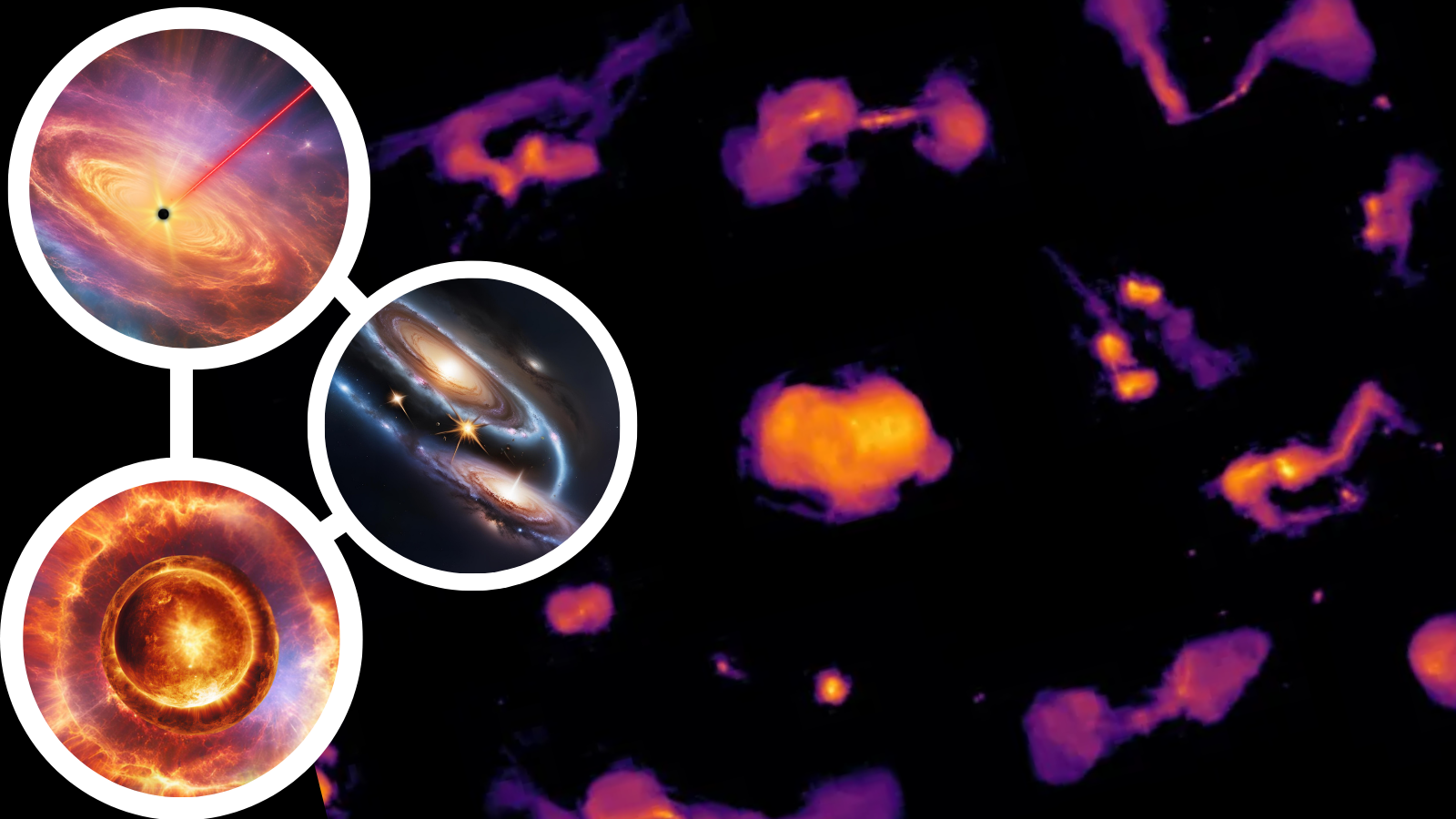
Astronomers have used the world’s largest and most sensitive low-frequency radio telescope array LOFAR (or Low-Frequency Array), to create the largest radio survey of the cosmos, revealing 13.7 million cosmic objects and events. These include jets erupting from feeding supermassive black holes, colliding galaxies, and supernova explosions that mark the deaths of massive stars and the births of unimaginably dense neutron stars.
The so-called LOFAR Two-meter Sky Survey (LoTSS-DR3) provides an impressive demonstration of how our view of the universe changes when astronomers switch from the wavelengths of light that our eyes have evolved to see to invisible radio waves. As such, LoTSS-DR3 could revolutionize our understanding of the massive jets and associated radio emissions that rip out from active supermassive black holes and our knowledge of how these outflows can shape entire surrounding galaxies.
You may like
“We can study a diverse population of supermassive black holes and their radio jets at different stages of their evolution, showing how their properties depend not only on the black hole itself, but also on the galaxy and environment in which it resides,” Martin Hardcastle of the University of Hertfordshire in the UK said in a statement.
Black hole jets and so much more
Supermassive black holes with masses of millions, or even billions, of times that of the sun are found at the hearts of all large galaxies, but not all of them are defined as being active. When these cosmic titans are surrounded by a swirling cloud of matter called an accretion disk, which gradually feeds them, they are said to sit in a region called an Active Galactic Nucleus (AGN).
The immense gravity of the central supermassive black hole causes the accretion disk to glow brightly across the electromagnetic spectrum. This isn’t the only phenomenon that makes AGNs stand out, however.
Black holes are notoriously messy eaters, meaning much of the material that swirls around them isn’t fed to them but is rather channeled to their poles by strong magnetic fields. Here, these charged particles are accelerated to near light-speeds and blasted out as parallel twin jets that can stretch out far beyond the limits of the supermassive black hole’s host galaxy.
Much of the emissions detected by LOFAR arose from these high-speed particles moving through magnetic fields, generating radio waves. This allowed astronomers to trace supermassive black hole jets, which could be important in understanding how this injection of energy influences the evolution of host galaxies, while also uncovering some of the largest and oldest radio-bright AGNs, also known as radio galaxies.
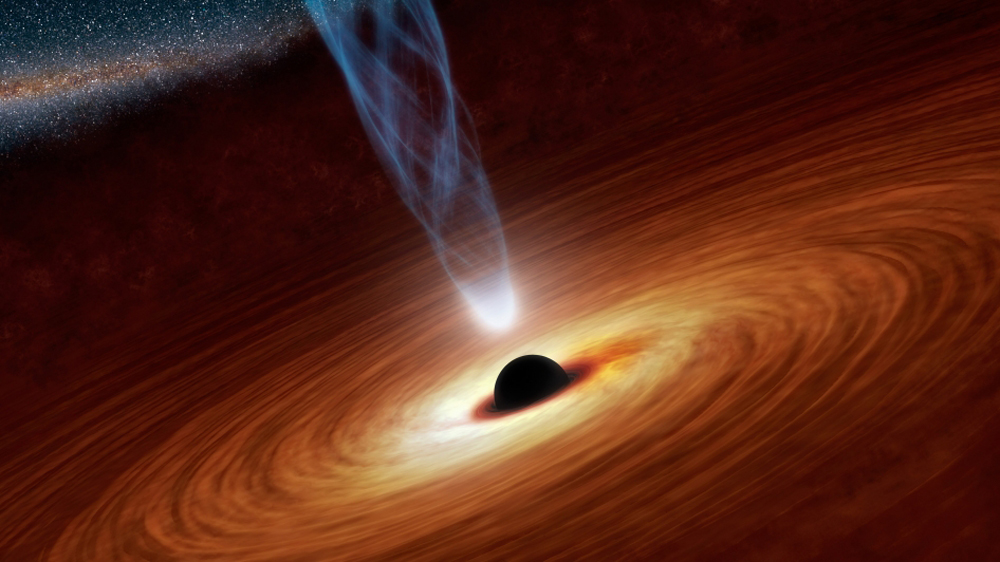
Artist’s illustration of a supermassive black hole at the heart of a galaxy. (Image credit: NASA/JPL-Caltech)
These emissions weren’t limited to supermassive jets, however. The LoTSS-DR3 also traces radio waves from merging galaxies, supernovas and other powerful cosmic events that are capable of accelerating particles to near the speed of light, or “relativistic speeds.” One aspect of the universe this approach allowed the team to study was the rates of star birth in millions of galaxies.
“By studying many galaxy clusters, we can show that giant shocks and turbulence drive particle acceleration and strengthen magnetic fields across millions of light-years, something we now see to be happening far more than previously anticipated,” team member Andrea Botteon of Italy’s National Institute for Astrophysics (INAF) said in the statement.
You may like
Closer to home, the LOFAR data also revealed previously hidden aspects of the Milky Way.
“This new data set also provides a unique view of magnetic fields in our Milky Way galaxy,” team member Marijke Haverkorn of Radboud University said. “As we are located inside the Milky Way, we need data in large parts of the sky to map out these magnetic fields. LOFAR’s unique wavelength range allows us to do that with unprecedented accuracy.”
LoTSS-DR3 also revealed radio emissions that seem to arise from interactions between extrasolar planets, exoplanets and their host stars.
The team now plans to build upon LoTSS-DR3, an endeavor that will benefit from the upcoming upgrade to LOFAR. It is hoped that the upgraded LOFAR 2.0 will have twice the survey speed of the current instrument, which, coupled with improved data processing, should lead to vastly improved high-resolution data.
“LoTSS-DR3 is not an endpoint, but a major milestone,” Square Kilometer Array Observatory scientist Wendy Williams said. “New facilities such as LOFAR 2.0 will allow us to map the radio universe with even greater sensitivity and resolution, extending the legacy of this survey well into the future.”
The team’s results are published in the journal Astronomy & Astrophysics.