
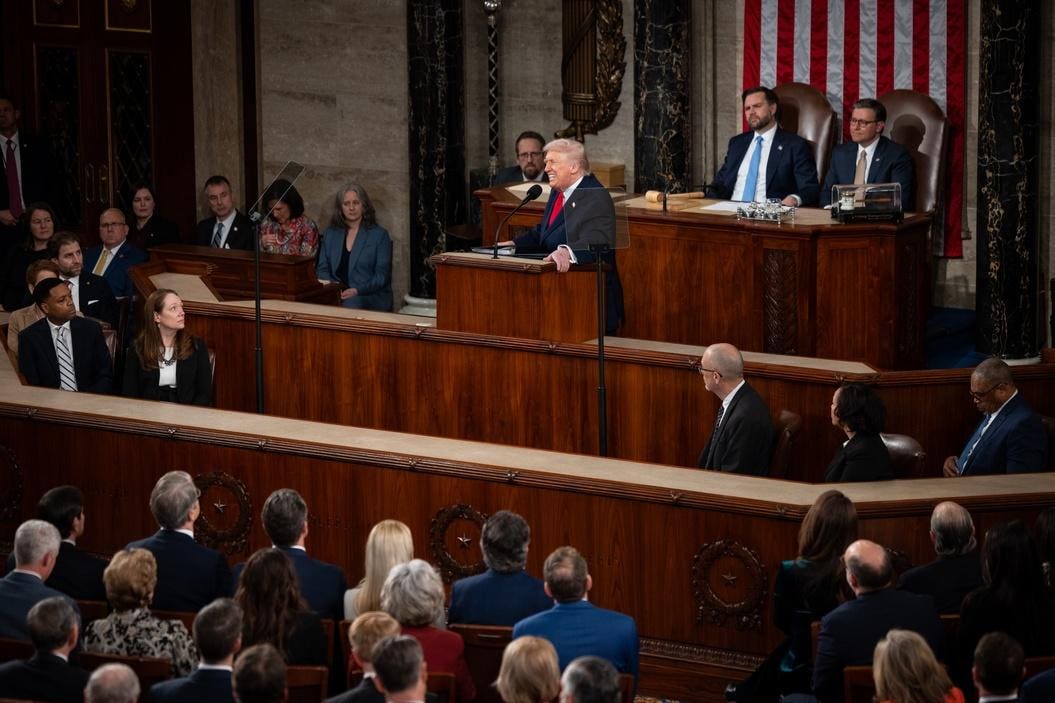
Last night was President Donald Trump’s State of the Union Address, and he had a marketing challenge on his hands: Convince skeptical Americans that the economy is on the right track, that his strategies focusing on immigrants are the right thing for the country, and that his foreign military involvements have well-reasoned policy aims.
Less than 24 hours after the speech, it’s unclear if he convinced anyone of anything they didn’t already believe. After all, his speech was the longest State of the Union on record, clocking in at about an hour and 48 minutes, so most of the people who watched it (at least on the East Coast) likely didn’t get to bed until close to midnight. A CNN poll conducted by SSRS and posted online hours after the speech said nearly two-thirds had a somewhat positive reaction to the address—though the story noted that people who decide to watch the State of the Union often tend to be bigger fans of the president and party in office, which was the case with these results. So far, journalists have said they mostly got what they expected: Trump fans thought it was a masterful performance, while his detractors found it boring, xenophobic and too long. And fact checkers highlighted many questionable claims from the speech.
However, Trump has always been known as a showman, and he used his platform on the national stage to honor and award American heroes. The gold medal-winning U.S. men’s hockey team made an appearance and basked in thunderous applause, while Trump promised to award goalie Connor Hellebuyck with the Presidential Medal of Freedom at a later time.
Unsung Korean War hero Navy Capt. E. Royce Williams, now 100, received the Congressional Medal of Honor from First Lady Melania Trump for his heroics in an aerial battle. (“I’ve always wanted the Congressional Medal of Honor, but I was informed I’m not allowed to give it to myself,” Trump said about this award.) Other military and civilian honors were doled out during the speech to a soldier who led the operation that captured Venezuelan President Nicolás Maduro last month, two National Guard soldiers who were shot on the streets of Washington, D.C. last year, and to the Coast Guard swimmer who rescued 164 girls from the deadly floods at Camp Mystic in Texas last July.
It will be a matter of time before we know if these feel-good presentations will be the most remembered part of the speech—or if Trump’s overall marketing plan worked, making Americans feel better about the economy or supportive of his immigration crackdown. (According to polls before the speech, he has some way to go in both of these areas.)
In these days of AI and varying degrees of truth, it seems that what consumers want the most from brands is authenticity. I talked to Shannon Langrand, founder and CEO of Langrand, an agency specializing in innovation and branding, about how to find that authenticity. An excerpt from our conversation is later in this newsletter.
This is the published version of Forbes’ CMO newsletter, which offers the latest news for chief marketing officers and other messaging-focused leaders. Click here to get it delivered to your inbox every Wednesday. SOCIAL MEDIA
Meta CEO and Chairman Mark Zuckerberg arrives at Los Angeles Superior Court to testify last week.
Frederic J. Brown / AFP via Getty Images
This month, social media is quite literally on trial over claims that it was designed to be too addictive for young people. In a Los Angeles courtroom, testimony is painting a picture of social media companies that knew preteens and teens were able to access content harmful to them: posts promoting unhealthy body imagery, self-harm and negative self worth. Meta and Google, plaintiffs argue, did not take adequate measures to block access or make their social platforms less addictive. (TikTok and Snap were included in the initial lawsuit, and those companies settled out of court.)
Forbes senior contributor John Brandon writes that while there have been previous lawsuits over whether social media platforms are too addictive, this is the first case that could have far-reaching consequences. Witnesses at trial have included some of the top executives in the social media world, including Meta CEO Mark Zuckerberg, who testified last week. In his testimony, the Facebook founder said he doesn’t agree that scientific research has proven a link between social media and young people harming themselves, according to the AP.
Testimony in the case is scheduled to continue over the next several weeks. And while much evidence has not yet been presented—the case also implicates YouTube, and CNN writes there has been very little testimony about the video platform so far—many observers are comparing this case to the infamous tobacco litigation in the 1990s, in which companies were forced to pay millions in settlements and change their marketing model because their products were found to be targeting children.
ARTIFICIAL INTELLIGENCE
LIONEL BONAVENTURE/AFP via Getty Images
As AI becomes more entwined in the fabric of society, deep chasms are emerging between different companies developing major applications. Anthropic debuted an ad during the Super Bowl that skewered OpenAI for its plans to bring paid advertising to ChatGPT—which succeeded in bringing more attention and users to Claude, writes Forbes contributor Roger Dooley. Incidentally, the ad also added to a rift between Anthropic CEO Dario Amodei and OpenAI CEO Sam Altman, who refused to join hands in an awkward moment at a recent AI summit in India.
But Elon Musk is also pushing forward with his Grok chatbot. Last week, the billionaire rolled out a public beta of Grok 4.2, decrying all other chatbots as being “too woke.” Musk’s equivocation comes from Grok’s tendency to give answers that align with the Republican Party’s current way of thinking on topics around race. According to Reuters, Grok’s market share has grown to more than 17% of U.S. chatbot users, but it still lags behind OpenAI’s ChatGPT and Google’s Gemini. One area in which Grok doesn’t agree with Musk’s views: The world’s richest man wants people to upload medical information to the chatbot to get a second opinion—something Grok says is a bad idea.
Many AI companies are united in one area: They’re spending much more to try to influence the Trump Administration. Forbes’ Phoebe Liu writes that most AI companies spent a great deal more on direct federal lobbying last year than in 2024.
BIG DEALS
Pavlo Gonchar/SOPA Images/LightRocket via Getty Images
For decades, eBay has been known as the internet’s best place to sell old stuff. With the $1.2 billion acquisition of clothing reseller Depop announced last week, the website is trying to position itself as a destination for fashion merchandising as well. Forbes senior contributor Pamela Danziger writes that the peer-to-peer secondhand fashion selling site, previously owned by Etsy, has a user base of 7 million customers—nearly 90% of whom are under 34—and more than 3 million active sellers. Last year, Depop’s gross merchandise sales increased 60% and approached $1 billion.
Danziger writes that the acquisition helps bring eBay into a rapidly growing category, especially among target consumers. It also brings eBay’s knowledge of the peer-to-peer resale market to new users.
ON MESSAGEHow To Find Your Authentic Brand Message
Langrand CEO and founder Shannon Langrand.
Langrand
Today, with so many conflicting messages, varying versions of the truth and different voices speaking up, what consumers really want in marketing is authenticity. But how does a brand discover an authentic voice and message that will resonate with consumers? I talked to Shannon Langrand, CEO and founder of authenticity and strategy-focused brand and innovation agency Langrand, about discovering and sharing this message.
This conversation has been edited for length, clarity and continuity.
With all of the noise going on right now, how do brands figure out where they want to be, what they want to signal, and how they want to speak about things?
Langrand: We’re at a moment where trust is an ever-evolving premium. So if you think about what’s happening in this landscape of AI and everything else, we’re being flooded with information. There’s so much out there. It’s like, ‘What can I trust? What’s true? What’s real?’ What we’re seeing is that consumers are getting more and more savvy about what they listen to and pay attention to.
More than anything, being able to be authentic to who you are, what your brand is, and to lead with purpose is an incredibly powerful [idea] that we have to be thinking about much more.
We’ve always talked a lot about brand promise. We’re at this moment of [going] from brand promise to proof. To real versus theater. It’s not so much, ‘How can I go into this place?’ It’s like, ‘Do I belong in that place to begin with?’ And choosing those places carefully, and being authentic.
We work a lot with legacy brands, and I think we’re at a moment where there’s a lot of potential for a revitalization when it comes to being able to enter into those conversations. That Maxwell Apartment campaign that Maxwell House did is a great example of a legacy brand stepping into a cultural narrative that’s evolving around the difficulties of affording housing, being able to enter into that in a way that felt authentic. They changed their brand for the first time in 133 years.
I feel like legacy brands have this stability and history that can be a great signifier of trust in this kind of world that we’re in, but at the same time, entering into cultural narratives that are out there and that are evolving: affordable housing and what it is to rent, and the challenges of money.
How does the brand figure out which conversations it should be involved in, and which might make it seem tone deaf?
It’s dangerous territory, without question. There’s a couple things that come to mind. One is—and I can’t say it enough—have a strong sense of who you are and the natural places for your brand to be.
Number two is really doing deeper and more qualitative research, because it’s not one community. It’s not one place. One of the things happening in this world that’s changing so much, where people are feeling so much stress and pressure, is people are creating communities in different ways. Understanding those communities: We’re doing really in-depth research right now with a major healthcare institution to understand how people are thinking about health and the communities they‘re going to, and who they’re looking to for advice and counsel.
It requires a real instinct for what are those evolving narratives, the symbols and the things that are changing. How does that fit with a strong purpose that we have, and is a natural place for us to be? And how do we talk about that?
We’ve been seeing this tension between short-term performance versus what’s required longer term in this changing world. We actually started a new position in our organization we call ‘brand futurist,’ who’s really looking at the signals of change. What are the things that are happening? What are those emerging narratives? What is gaining cultural currency? Where are their stresses and pressures? And being able to use the kinds of insights of the future that is becoming to allow people to make smarter investments, campaigns and brand positioning in that way.
I think a time where brands that can deliver on that can really be more powerful than ever, but it’s going to be harder than ever.
How can brands get their authenticity back and return to resonating well with consumers?
The first thing is getting back to why people have earned business in the first place and what they’re really about, because what consumers are picking up in many ways is what’s happening internally in that organization.
Brand can be a source of transformation for companies, right? This sense of, ‘God, we used to be big in this way or that, and people aren’t listening to us anymore.’ When you start going into a company and digging down and talking with them, you realize that they’ve lost their way. Part of that is having a trusted agency that can help you understand your DNA, and how that DNA connects to communities that are natural fits for you. Once you do that and you have that insight, the magic can start happening again.
Again, why are we here in the first place? That sounds like a really basic thing, but really getting into that is a pretty powerful place to be. We have this great expression in Texas: All hat and no cattle. You can’t be a cowboy just by wearing a cowboy hat, right? You have to be authentically who you are. When companies can do that kind of self-inventory and get back to where they are, number one, their employees start to love working there again and get excited about what they’re doing. Then that becomes the foundation of something bigger out in the world with consumers.
COMINGS + GOINGSConcierge healthcare firm MDVIP appointed Alyssa Schaefer as its new chief marketing officer, effective February 2. Schaefer previously worked as general manager and chief experience officer at Laurel Road, and she has also held senior leadership roles at American Express.Buy now, pay later financial company Sunbit hired Shachar G. Scott as its new chief marketing officer. Scott most recently worked as vice president of global marketing for Meta’s Reality Labs, and worked in senior leadership for Bumble and Snap prior to that.Onsite power solutions provider Enchanted Rock selected Niki Herr to be its chief marketing officer, effective February 17. Herr brings leadership experience from Interpublic Group agencies, Gensler and Stem.FACTS + COMMENTS
Consumers respond the most positively to contextual creative messaging, a new study by Vistar Media found.
58%: Percentage of people who prioritize real, credible voices—far more than the 4% who prefer celebrities
69%: Percentage of people who said humor, emotion or entertainment helped an ad be memorable
‘Consumers show some hesitation toward end-to-end AI-generated content,’ Vistar Media U.S. SVP & GM Lucy Markowitz said
STRATEGIES + ADVICE
Actual leadership storytelling is more important for your brand than anything AI can do. Leaders have experiences, while AI just recognizes patterns.
In the age of AI, a “smart” leader has intellectual savvy and knows how to use AI well.
QUIZ
Which of the following artists became a nominee to the Rock & Roll Hall of Fame this week?
A. Britney Spears
B. Cyndi Lauper
C. Mariah Carey
D. Lady Gaga
See if you got it right here.