
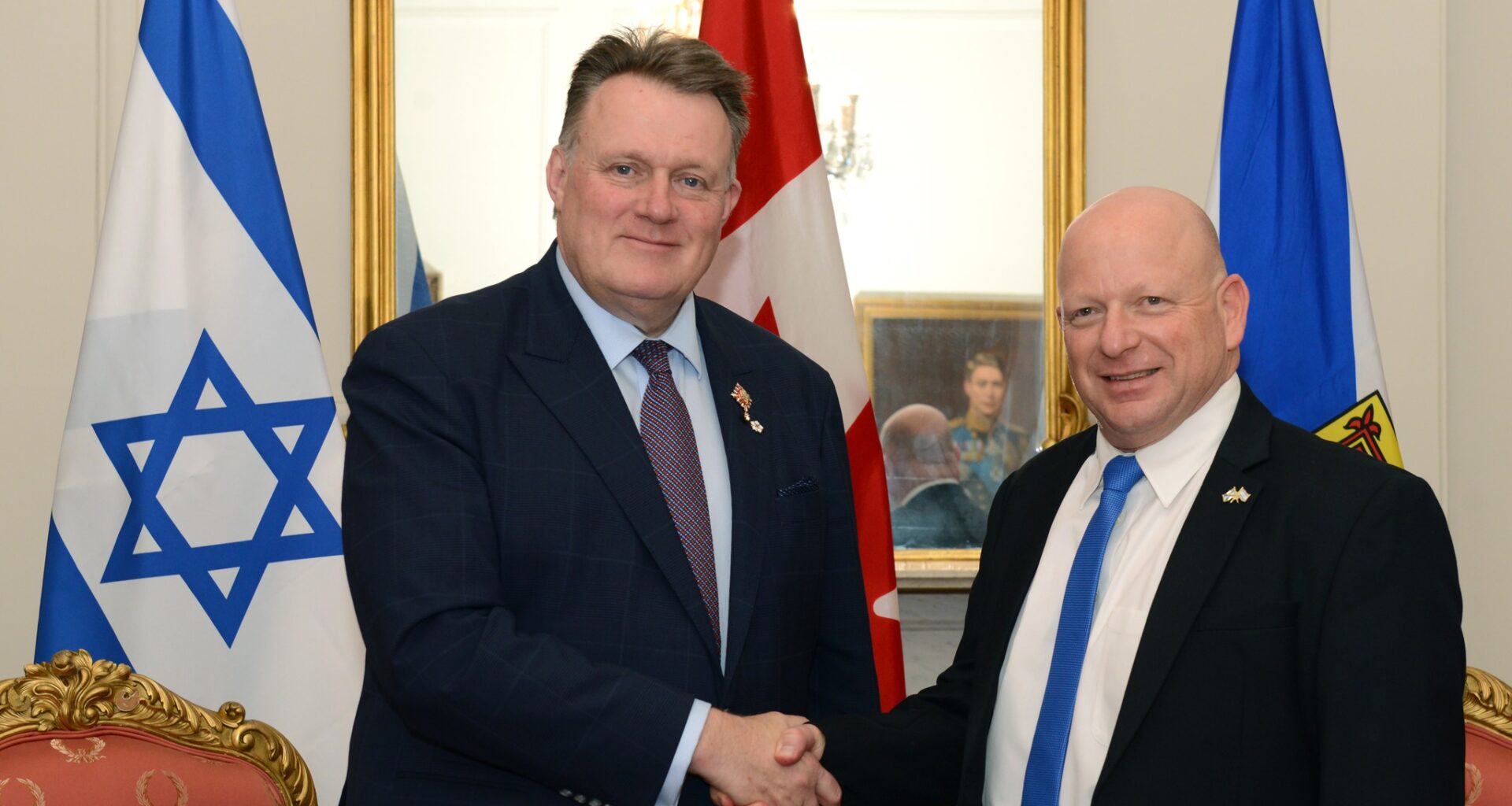
Eliaz Luf brought more than luggage and 30 years of diplomatic and government experience to his post in Montreal. He also toted along optimism.
The new Israeli Consul-General for Quebec and the Atlantic Provinces arrived last August, succeeding Paul Hirschson. Not unfamiliar with the landscape, from 2010 to 2014 Luf was deputy head of mission at the Embassy in Ottawa, with prior stints in Poland, Mexico City, at Foreign Affairs headquarters, and the Ministry of Innovation, Science and Technology.
“The last two consul-generals faced difficult challenges,” said Luz, noting severe travel and logistical restrictions due to Covid and the Gaza-Israel war after the terrorist attack in Israel on Oct. 7, 2023. Despite the challenges, he says the opening of the Quebec office (BQTA) in Tel Aviv in March 2024, “remains a great achievement. (Quebec bureau director) Alik Hakobyan is doing a great job in Tel Aviv.”
In November, Quebec Solidaire (QS) MNA Haroun Bouazzi called Quebec’s first office in the Middle East “an unspeakable scandal. The (Israeli) prime minister is a wanted criminal who… if he comes to Canada, will be arrested.” QS tried unsuccessfully to block Quebec’s 35th foreign office, and in December, QS MNA Guillaume Cliche-Rivard tabled a new petition with 14,305 signatures, demanding the Government “immediately and unconditionally close” the BQTA, citing “genocide.”
Rejecting the demand
Quebec City rejected the demand, International Relations and Francophonie Minister Christopher Skeete writing earlier this month that the government is following International Court of Justice proceedings and welcomes the conclusion of a ceasefire agreement between Israel and Hamas. “Our decision to keep the Québec Government Office in Tel Aviv in operation is in no way an endorsement of a position in the Israel – Hamas conflict.”
Ministry spokesperson Camille Jobin told The CJN that despite the geopolitical context, the BQTA already demonstrated its relevance and strategic value, laying a foundation for lasting partnerships. “Quebec and Israel share complementary strengths and a common interest in concrete collaborations, particularly in innovation and economic development.”
For Luf, diplomacy, and the diplomacy of business, can’t be overstated and the Quebec-Israel relationship has much room to grow, as Israelis’ current knowledge about Quebec is limited. “They know Canada and Montreal, there’s a large French-speaking community, and we have a Montreal-born MK, Dan Illouz. But ask the general public about Quebec, and ‘where they speak French in Canada?’ is the most you will get.”
What he sees here, however, is “very healthy and rooted democratic engagement. Quebecers have an identity, a sense of nationality, a flag, and a language. You know what you belong to. There is a cultural baseline, which is very similar in a way to Israel.”
He recognizes Quebecers have long felt surrounded, if not by hostile violent adversaries, by overwhelming and persistent cultural pressures: “A different language in an island of English, and a different culture in a sea of other cultures. I think Quebecers can understand, maybe sometimes better than other Canadians, the complexity of being Israeli,” in a region dominated by a different ideology, identity and worldview. (Quebec government documents cited cultural similarities and the presence of a strong Jewish diaspora in Quebec as reasons to choose Israel for their new office.)
That’s why Luf says the partnership makes sense, noting Quebec’s rapid socio-economic rise. “They bridged an enormous gap over decades. It bears similarity to Israel: do things quickly, innovate, think outside the box. Once Quebecers and Israelis meet each other, they will discover a lot in common, with great potential.”
Quebec trade soars, prioritizes collaboration
Jobin told The CJN economic exchanges have soared since opening the BQTA; exports to Israel reached CDN $228 million in the first three quarters of 2025, 123 per cent more than 2024’s total. While fourth-quarter data is not yet available, bilateral trade is expected to exceed CDN$500 million.
Quebec prioritizes collaboration in high-tech, artificial intelligence, life sciences, agri-food and climate technologies, with partnerships in research and development and views Israel as “one of the most advanced innovation ecosystems in the world.” Israeli practices in commercialization and transition from lab to market “represent a valuable source of learning for Quebec start-ups,” and a gateway to new markets.
There are still some ongoing local issues, including recognizing Israeli driver licenses and simplifying taxation for Israelis working in Quebec, but Luf is eying more growth. “We are just beginning to discover the potential,” highlighting aerospace and innovation, with the Montreal-based headquarters of the UN’s International Civil Aviation Organization (to which he is a representative), Air Canada, Bombardier and other companies.
“We’re not making cars or planes, or heavy industrial things; our economic leader is high-tech and innovation. It’s not about producing per se, but about producing the best.” That he says, is the pitch. “I’m not a businessman and I’m not an expert of high-tech, but my job is to find the right matches. We are matchmakers; get the right people together and they move on.”
His comments happened to follow a February Quebec – Israel business conference in Tel Aviv, linking startups and investors across sectors, focusing on AI, ag-tech, aviation, space, entertainment, and others.
“The event’s goal was to introduce startups, investors, corporate leaders, and ecosystem builders,” particularly those exploring new opportunities in North America, to Quebec, Israel missions director for the Centre for Israel and Jewish Affairs, Myriam Azogui-Halbwax, told The CJN. Despite shared strengths, Quebec remains underexplored by Israeli firms, she said. “The conference aimed to change that by positioning Quebec as both a strategic partner and a practical gateway into the North American market.”
For all the accomplishments and enthusiasm for Quebec, Luf also wants to renew focus on Atlantic Canada, he told The CJN. “I visited Halifax, and there is a lot to discover there, especially dealing with blue-tech, an area where Israel has a lot of startups and ideas.” (Blue technology refers to technologies, businesses, and innovations focusing on industries that depend on oceans and water resources and was one of five R&D priorities signaled to the Israeli government by its National Council for Civilian Research and Development last fall.) “We also began, with the Embassy in Ottawa, to look at possibilities in New Brunswick, which has a very large port.” Luf says trips to P.E.I. and Newfoundland will also happen. “I’m sure we can find a lot of opportunities.”
“Zero effect on Israel”
Discussing other recent business news affecting Israel, Luf discounts Scotiabank’s divestment of Elbit Systems shares. “It was a stupid move, done for political purposes and they harm their own investors.” Scotiabank’s asset management firm dumped its remaining holdings of the Israeli defense contractor after largely reducing its shares during the Gaza-Israel war. As of February 2026, it had fully divested of its estimated 150,000-plus remaining shares. Scotiabank thus missed out on a major rally given the recent surge in Elbit’s value. (With 25% annualized growth, the company offered an approximate 850% return over 10 years. The typical share price was around US$470 in December 2025 surging to a February high breaching US$740.)
It’s no surprise Luf says, noting Elbit has massively outperformed market indexes, and the move has zero effect on Israel. It’s just anti-Israel activism, which is also ever-present within educational institutions, he says, calling the Montreal campus situation “complicated, particularly at the two English-language universities (Concordia and McGill). Between them, Concordia is definitely the worst. Too many people think they’re harming Israel, but they’re harming the Canadian academy much more.”
In 2023-2024 there were a number of joint research projects between Quebec and Israeli universities, research institutions, and private companies, including on Alzheimer’s, rare earth science, and climate change. Even amid heightened sensitivities, Concordia’s John Molson School of Business again hosted an international competition which included an Israeli team from Ben-Gurion University. “They were part of the team under the flag of Israel. No drama, and it went really well. When you talk about real stuff and not politics, you can do things together… It’s not all bad.”
Luf finds the local Jewish community “very pessimistic and it’s a shame. There are difficulties, but we should stand up for what we believe in. Most of those protesters and activists are bullies, and you stand up against bullies. They understand they cannot win against Israel on the ground so they try to win against Israel in Concordia?” He echoed the response of former imprisoned Soviet refusenik-turned Israeli cabinet minister Natan Sharansky, whose advice at a 2024 Montreal Hillel gathering to students confronting antisemitism on campus, was: “Why are you asking me? You’re young, fight!”
With Quebec elections this fall, the Parti Québécois (PQ) buoyed by several by-election wins is polling well ahead of the ruling CAQ, as the Liberal opposition tries to recover from a scandal-stained leadership race and weak support among the francophone majority and beyond Montreal.
In 2024, PQ leader Paul St-Pierre Plamondon said Quebec’s Tel Aviv office should suspend work until a ceasefire and criticized the government on transparency about its timeline. The separatist party, which supported recognition of Palestinian statehood, has since said little, while continuing decades-long efforts to bolster its international profile.
Luf won’t comment on partisan politics, but praised Quebecers’ engagement, and “deep democratic knowledge, understanding how powerful you are as a voter. Quebecers from one election to the other, think about what will serve them best. They are not like sports fans voting for their team no matter what.”
He also reported that the Israeli Ministry of Tourism has appointed a new representative for Canada who should arrive within a few months to reopen its office in Toronto. “That’s great news. The ministry made the calculation and decided there is potential, and it’s not only about the Jewish community, which promotes Israel anyway. They can do more to explore new pathways and markets.”
“Instead of standing for what’s right”
Closer to home, Luf praised Côte Saint-Luc Mayor David Tordjman, who with his council recently adopted a resolution in support of the Iranian people and diaspora, and raised the pre-Islamic Republic flag outside city hall. “I was very proud to see the Iranian flag being raised by the new Jewish mayor of Côte Saint-Luc, it was very brave and a very strong statement.”
Luf agrees there’s a challenge at the federal level, something all Israeli missions in Canada are working on, “because some governments, like the Canadian government, instead of standing for what is right, go after some votes internally and ruin relations with the State of Israel, which was attacked. Sometimes we need to tell the Canadian government where they’ve done wrong, at least from our point of view.”
That also means more exposure to Israel’s story in both French and English media, and he’s unsurprised by criticism of a recent junket of independent journalists and other media personalities recently visiting Israel. “There’s always criticism, but the easiest thing is to do nothing. Then you’re not criticized for anything.”
He says BDS and other anti-Israel activism targeting Canadian Jews “is pure antisemitism. There’s no other way to call it,” citing anti-Israel protests against local Jewish communities. “They say ‘I’m not against Jews. I’m against Israel.’ What about targeting kids’ camps? It’s the old antisemitism used for the cause of Palestine.”
That echoed French Prime Minister Sébastien Lecornu’s message to French Jews this month, condemning Jew-hatred masked as anti-Zionism. “Exactly. said Luf, “He sees exactly what’s going on and there is no other reaction but to be strong, fight it, and not be afraid.” He cited the 19th century Auto-Emancipation discourse by Leon Pinsker, who described attacks on Jews as pathological and irrational, “a sickness, hating Jews is like a virus.”
As for anti-Zionism, “When I hear Israel has no right to exist,” he says, “my answer is ‘Who asked you?’”
“When they [Israel’s detractors] start thinking positively about their own future, for their family, kids and grandkids, in the next 10, 20, and 100 years, we’ll be there, and we’ll talk. We can do tremendous things together. But it’s up to them.”
Joel has spent his entire adult life scribbling. For two decades, he freelanced for more than a dozen North American and European trade publications, writing on home decor, HR, agriculture, defense technologies and more. Having lived at 14 addresses in and around Greater Montreal, for 17 years he worked as reporter for a local community newspaper, covering the education, political and municipal beats in seven cities and boroughs. He loves to bike, swim, watch NBA and kvetch about politics.