
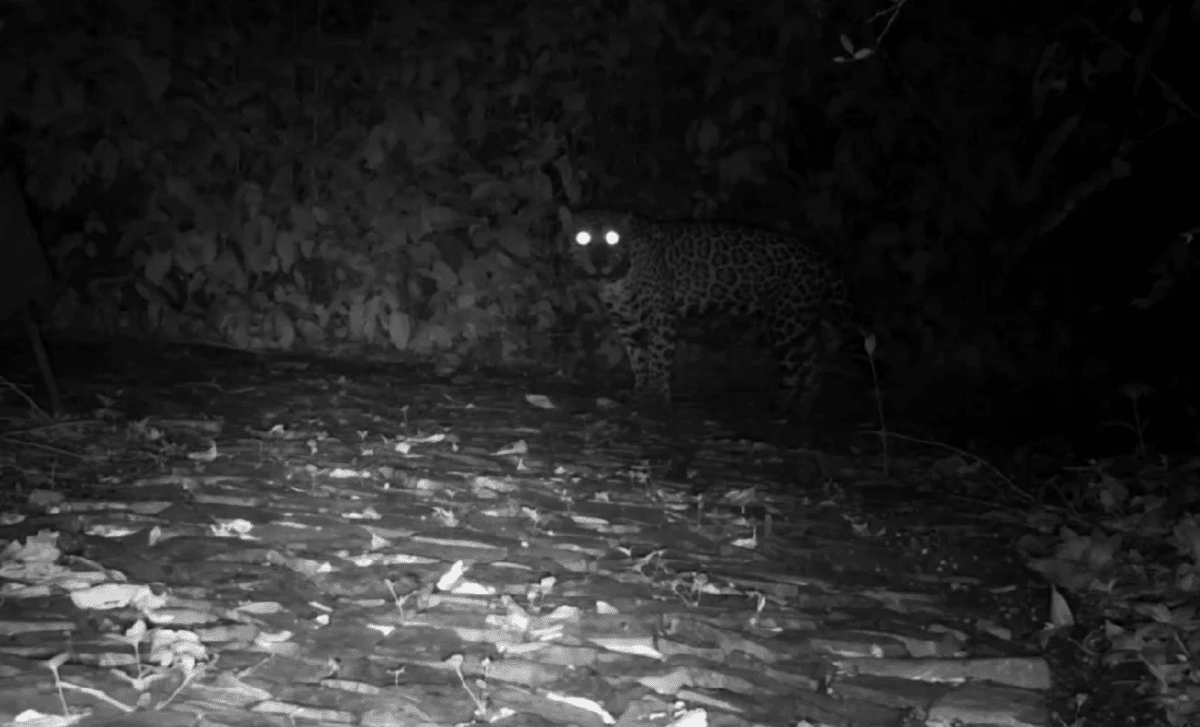
Camera traps in Brazil’s Iguaçu National Park have captured a stunning discovery: jaguars making sounds strikingly similar to meows. This unexpected behavior challenges long-held beliefs that big cats like jaguars could not vocalize in such a way due to their anatomy. While lions, tigers, and leopards have been known to growl or roar, the sight of jaguars meowing, caught on camera for the first time, has opened up new questions about their communication methods.
The Surprising Discovery: Jaguars Meowing Like House Cats
The revelation that jaguars can meow like domestic cats came as a surprise to many. Previous research suggested that due to their larger vocal cords, big cats like jaguars could not produce the same vocalizations as smaller felines. Jaguars were thought to be restricted to growling and roaring to communicate. However, the footage recorded by camera traps in Iguaçu National Park challenges this assumption. The cameras, strategically placed across the park to monitor the wildlife, captured several jaguars making vocalizations that closely resemble meowing. This unexpected discovery is providing researchers with new questions about how jaguars interact with each other in the wild.
“As far as we know, this is the first time that jaguars have been recorded using this kind of communication, which we are incredibly excited about,” said Dr. Marina Duarte, Research Fellow at the University of Salford, who was involved in the study published in Behaviour. This is an important finding, as it not only expands our understanding of jaguar behavior but also opens the door for future studies on how big cats communicate and interact.
Understanding the Purpose of Meows in Jaguars
While the discovery of jaguars making meow-like sounds is exciting, the next step is understanding why these vocalizations are occurring. Dr. Duarte suggests that the meows could be used by jaguars to communicate with their young, possibly to help locate them in the dense forests where visibility is limited.
“We think they are making these sounds to help locate their young but they could also be using them for reproductive purposes too, to find a mate perhaps. It does sound very cute to our ears!” Duarte remarked.
The fact that jaguars are using such vocalizations at various stages of their lives suggests that these sounds may serve multiple functions beyond just communication with offspring.
Further studies are needed to determine the full scope of these vocalizations’ purpose, but the evidence points to a deeper, more complex form of communication than previously thought. The finding also raises questions about how other big cats may use vocalizations to interact with their environment and kin, which could have broader implications for conservation strategies.
Camera Traps: A Game Changer for Wildlife Research
The use of camera traps has revolutionized the way researchers study wildlife, providing a non-invasive method of monitoring species in their natural habitats. In the case of jaguars, camera traps set up in Iguaçu National Park have been instrumental in capturing rare footage of these elusive animals. The 29 cameras, placed 0.6 to 1.2 miles apart, allowed researchers to track jaguar movement and behavior over a long period.
“These results highlight the value of long-term monitoring efforts for this iconic Atlantic Forest species and show that there is still much to learn about how jaguars interact and communicate in their natural environment,” said Vania Foster, Head of Research for the Project Jaguars of Iguaçu.
This long-term monitoring is critical for understanding the health and behavior of jaguar populations, which are facing significant threats due to habitat loss and human-wildlife conflict.