

Key Insights
One hundred years ago, the physicist Erwin Schrödinger came up with an equation that rewrote the rules of matter.
The equation transformed chemistry, providing tools for interpreting spectroscopy and launching new fields such as chemical modeling.
The equation is expected to continue shaping the future of chemistry by playing a major role in quantum computing and machine learning algorithms for chemical design.
Modern chemistry does what seems to be impossible, running at unimaginable scales. Researchers predict reactions on screen before a flask is ever filled; they design molecules atom by atom and watch slo-mo movies of bonds rearranging within a millionth of a billionth of a second. These futuristic feats, which seem more like science fiction than reality, are enabled by an equation that turns 100 this year.
Early in 1926, the Austrian-Irish physicist Erwin Schrödinger returned from vacation in the Swiss Alps with a notebook containing a handwritten equation that would permanently change how we understand reality. While Schrödinger may have had unusual ideas about what qualifies vacations, his contemporaries found his equation to be far more radical.
“Pretty much all of chemistry and materials science ultimately emerges from the Schrödinger equation.”
Ryan Babbush, director of quantum algorithms and applications research, Google Quantum AI
The Schrödinger equation rewrote the rules of matter and forever changed the field of chemistry. Donald Truhlar, a chemist at the University of Minnesota, calls it the “greatest advance of the 20th century,” along with Albert Einstein’s theory of relativity.
Until Schrödinger formulated his equation, quantum mechanics existed as a collection of creative fixes to baffling observations of the microscopic world. The universe of the tiny is very different from the one we see with our eyes. Back then, scientists noticed naturally occurring patterns they couldn’t explain. They struggled to understand why atoms absorbed and emitted various colors of light and how electrons seemed to zip around atoms in fixed orbits without expending energy.
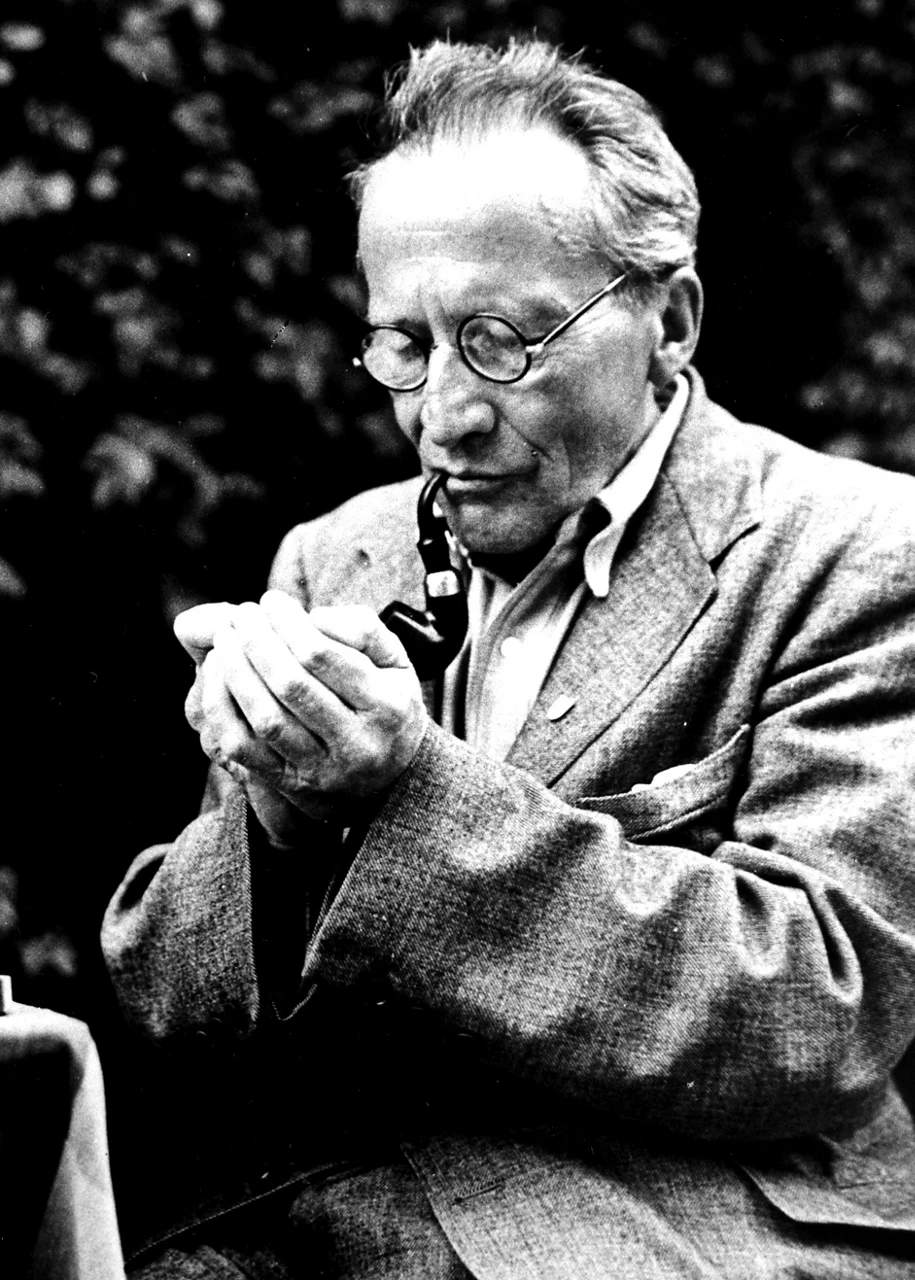
A photograph of a man smoking a pipe
Austrian-Irish physicist and Nobel laureate Erwin Schrödinger researched wave mechanics and theorized the Schrödinger equation (photograph taken in 1956).
Credit:
Alamy
They also found that light sometimes behaved like particles and that some particles acted like waves. Scientists measured these phenomena and invented mathematical rules that reproduced the results, but those rules were disconnected from each other.
Schrödinger changed that by introducing a new way of describing microscopic reality. In his mathematical description, tiny particles do not sit in exact locations or move in well-defined paths the way regular, macroscopic objects do. Instead, they exist as quantum states that capture all possible outcomes and how likely each one is. In this view of matter, the position of a particle is more of a blurred heatmap than a dot marking an exact location. Electrons in an atom occupy orbitals. They don’t move along fixed orbits but rather exist as probability clouds that indicate where they are most likely to exist.
Schrödinger’s equation describes the state of a particle and how it evolves through time based on the forces acting on it, like a complex form of Isaac Newton’s equations of motion for electrons and other tiny particles. Scientists applied this equation to the atomic structure and found that it stitched all the seemingly disconnected, strange patterns of light emissions and atomic structures together into a predictable understanding of the inner workings of atoms and molecules.
“The Schrödinger equation is the basis for all chemical thinking.”
Donald Truhlar, chemist, University of Minnesota Twin Cities
“Pretty much all of chemistry and materials science ultimately emerges from the Schrödinger equation,” says Ryan Babbush, director of research at Google Quantum AI.
Molecular orbital theory was one of the most consequential results of the equation. As chemists put together atomic structures, they realized that bonds in molecules were not localized sticks between atoms and that the electrons were spread out over the entire molecule. This new, truer picture explained many chemical mysteries, including why some molecules such as benzene were unusually stable and why some reactions happen easily and others don’t.
“The equation dictates the motion and the behavior of all molecules, atoms, materials, and catalysts involved in chemistry,” says Alán Aspuru Guzik, a chemist at the University of Toronto. It changed how chemistry was viewed as a science from a set of rules with some irregularities to a grounded description of matter itself.
The theory also made it possible to predict how chemicals behaved before synthesizing them, creating the foundation for computational chemistry. Truhlar calls it “the basis for all chemical thinking.”
“Today, chemistry without the Schrödinger equation is simply unthinkable”
Laura Gagliardi, chemist, University of Chicago
Using the Schrödinger equation to track the state of every electron when dealing with molecules with many electrons is an impossible task even for modern computers. So, researchers came up with clever ways of approximating the equation to predict reaction pathways before running experiments, screen thousands of catalyst candidates on a laptop, and model how proteins fold and bind to drug molecules.
In materials chemistry, researchers use Schrödinger-based calculations to design semiconductors, superconductors, and battery materials with targeted properties. Even the color of a pigment can be traced back to outcomes calculated from this equation.
“Predictions made with the Schrödinger equation are often much more powerful than any available experimental technique,” Truhlar says. “An example is atmospheric chemistry.” The reaction rates of highly reactive compounds in the atmosphere are important for climate modeling. But these molecules have fleeting lifetimes, which makes them difficult to measure experimentally. “More is understood about these reactions from theoretical calculation based on the Schrödinger equation than from experiment,” Truhlar says. Mathematical predictions derived from the equation have changed experimentation. Chemists often do experiments only when the Schrödinger equation suggests that an experiment is worth trying. That type of screening saves resources, time, and research funds in every area of chemistry.
“The more recent and exciting trend has been the development of quantum technologies.” Babbush says. “With these machines, we can harness the power of the equation without surrendering to its complexity.” Guzik explains that, unlike a classical computer, a quantum computer can simulate molecules exactly, without approximations. “It will make a new way of doing chemistry,” he says.
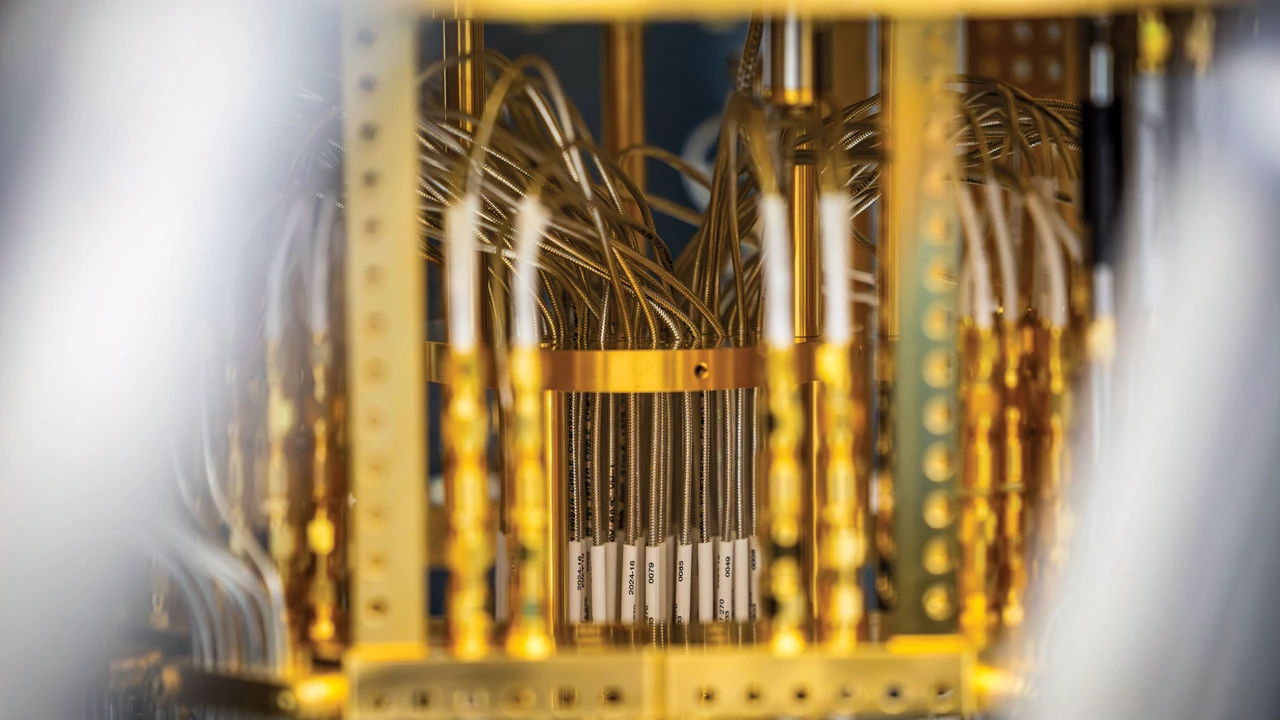
Gold colored device with bundles of thin wires and metallic components arranged vertically.
Quantum computers can harness the power of the Schrödinger equation to model chemicals like drugs, fuels, and materials.
Credit:
Associated Press
Spectroscopy is another field transformed by the equation. Since the 19th century, chemists had been measuring and cataloging the sharp pattern of colored lines emitted by elements with little understanding of their origin.
Schrödinger’s equation turned the spectra into barcodes. As chemists began matching measured lines to equation-calculated energy levels, spectroscopy shifted from an observational craft to a quantitative probe of atomic and molecular structure. The equation improved chemical analysis and laid the groundwork for technologies such as nuclear magnetic resonance and the related magnetic resonance imaging.
“Today, chemistry without the Schrödinger equation, directly or indirectly, is simply unthinkable,” says Laura Gagliardi, a chemist at the University of Chicago. She thinks that in the future, the equation will only be amplified with the development of quantum computing and machine learning for chemistry.
Beyond reshaping theoretical and experimental chemistry, the equation has enabled sweeping advances in engineering. The equation revealed how matter works at the smallest scales, letting scientists develop the technology that now structures our daily life—the pure crystals inside transistors that power computers, the quantum dots that give bright colors to TV screens, and the signals in medical imaging tools. Most of the modern world rests on this century-old mathematics.
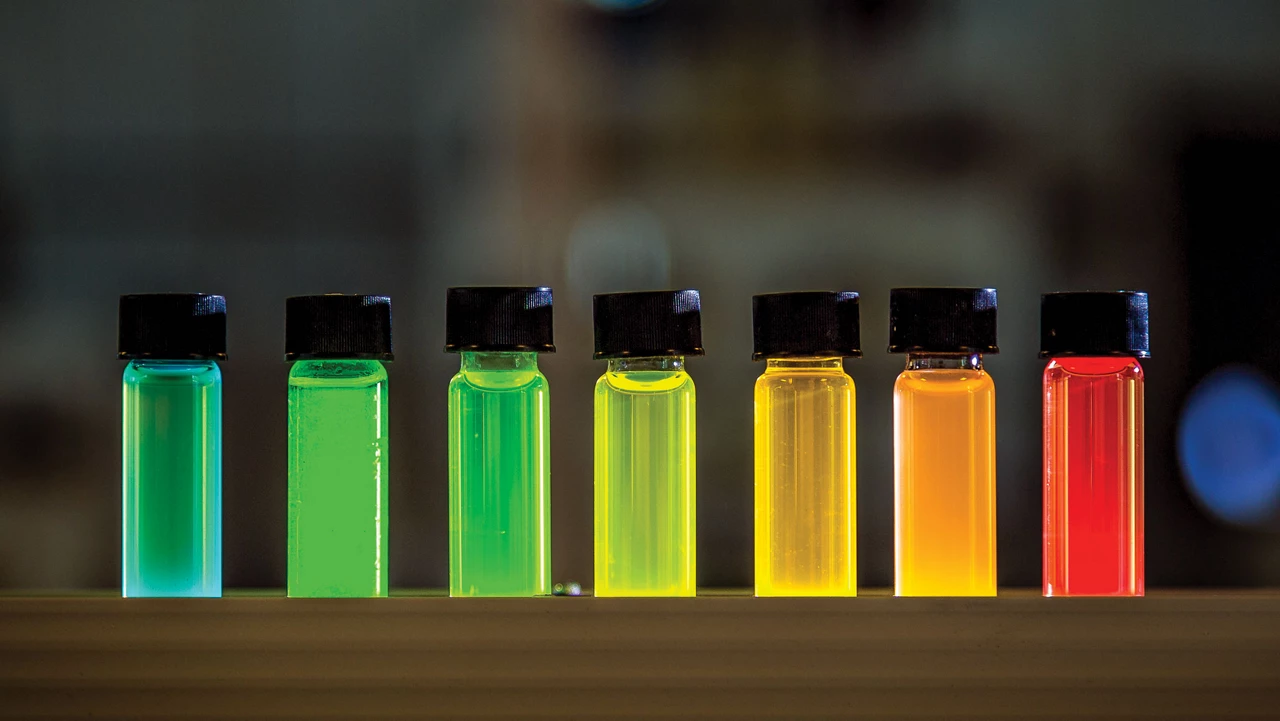
7 small vials filled with brightly colored liquids
Quantum dots that give bright colors to TV screens are a result of the Schrödinger equation.
Credit:
Shutterstock
Some of chemistry’s most powerful ideas are a result of this equation. What makes it remarkable is its reach. The equation provides answers to fundamental questions such as why atoms don’t collapse, enables the technology we use today, and shapes the entire future of chemical design. Schrödinger set out to fix a problem in atomic theory. He ended up rewriting the rules of reality and giving scientists the tools to build the modern world on top of them.
Chemical & Engineering News
ISSN 0009-2347
Copyright ©
2026 American Chemical Society