
Real estate photography has long been one of the most consistent forms of paid work for photographers. Add video, floor plans, and immersive drone-style marketing content, and you quickly become that one trusted professional who can handle everything with reliable, high-quality results.
Over recent few months, I’ve been testing the Giraffe PRO Camera, Giraffe360’s latest professional-grade system designed specifically for property imaging. Alongside hands-on use, I also spoke with Mikus Opelts, co-founder and CEO of Giraffe, to understand how and why this camera exists—and who it’s really for. What became clear very quickly is that this isn’t an AI tool designed to replace photographers. Quite the opposite.
What Is the Giraffe PRO Camera?
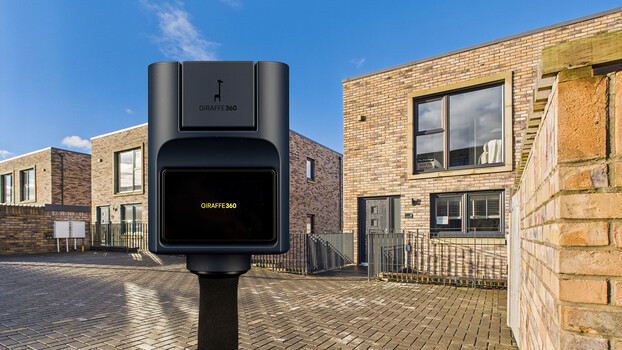
The Giraffe PRO Camera is an all-in-one real estate capture system that produces:
all from a single on-site visit.
Key Tech Specs
Sensor: 20.3 MP HDR, Sony Exmor 1” sensor
Lens: 16mm wide angle lens
LiDAR 2.0: 750,000 sample rate, with 20× denser scans than the original Giraffe360 Camera
Build weight: 3.7 lbs (1.7 kg)
Storage: 1 TB SSD
Battery power: 100+ property scans per charge
Powered Tripod and Automated Dual-Height Scanning
A core part of what enables the Giraffe PRO’s advanced capture workflow is its powered, motorized tripod. Rather than being considered an accessory, the tripod is an integral part of the system and is what makes automated dual-height scanning possible. Dual-height capture improves LiDAR accuracy, floor plan precision, and the quality of fly-through videos. During a scan, the tripod automatically raises and lowers the camera between two calibrated heights, allowing the system to capture significantly more spatial data without the operator having to manually adjust the setup.
In practical terms, this automation keeps the workflow smooth and consistent. There’s no need to stop, adjust tripod legs, re-level the camera, or risk uneven capture heights between scan points. On larger properties or multistory homes, that consistency adds up quickly—both in time saved and in the reliability of the final outputs.
The powered tripod reinforces the idea that the Giraffe PRO is designed as a complete capture system, not just a camera with software attached. It assumes professional use and builds automation around tasks that would otherwise be slow, repetitive, or prone to inconsistency.
A Camera Designed for Photographers, Not Agents
One of the most interesting parts of my conversation with the CEO and co-founder of Giraffe, Mikus Opelts, was his explanation of how the PRO differs philosophically from earlier Giraffe models. The original Giraffe360 cameras were deliberately designed to be simple enough for agents to use themselves. The PRO, however, is different. “The PRO is our first product where we’ve been deliberately thinking about photographers as the core user,” Opelts explained. “Instead of optimizing for simplicity, we’ve been optimizing for flexibility.”
That flexibility shows up in features like single- vs. dual-height scans, scan spacing, and how much data you choose to capture in different parts of a property. This is crucial for advanced outputs like fly-through video, but it also means longer appointment times. That factor alone makes the Giraffe PRO far better suited to photographers than real estate agents. Agents generally want to get in and out as efficiently as possible. Photographers understand that spending a little longer on-site often leads to dramatically better results.
The Giraffe Pro Camera in Practice
Through local-to-me agent Angel Homes, I was granted access to some stunning properties to test this camera. One such property was the show home for a development in the Fieldings: a collection of townhouses on the outskirts of East Kilbride, in the west of Scotland.
In practice, the Giraffe PRO feels less like a camera and more like a complete capture system. The menu and interface are very easy to understand, even on first use. You can choose between still images and scanning, as well as single-height scans or dual-height scans. You can also indicate which floor of the property you are on for multilevel homes. Each image is automatically bracketed, producing HDR photos with excellent dynamic range, including interiors with bright exterior views through windows—something that’s often a challenge in property photography.
Scanning and Battery Life
Dual scans are required for the cinematic video outputs, and this does increase battery usage. On longer shoots, I use an external power bank—in my case, a CUKTECH 15 Ultra—which is probably larger than most would use, but the included strap system holds it securely to the tripod and makes it workable in the field. The tripod holds its charge well and would easily keep up with daily property visits.
Fly-Through Video: The Standout Feature
The fly-through video is where the Giraffe PRO really separates itself. Built entirely from LiDAR 2.0 and image data, the result looks like a carefully planned drone or gimbal shoot, even though no video was filmed in the traditional sense. The professional output of the fly-through “video” is astounding. This kind of output makes marketing materials look expensive, and it’s surprisingly easy to get clients to agree it’s worth including once they see an example.
AI That Works With Photographers, Not Against Them
Giraffe describes the PRO as “AI-native,” which isn’t just a buzzword. According to Opelts, the platform uses around 50 in-house machine-learning models to handle everything from floor plan rendering to legally compliant processing and image adjustments. Historically, tasks like floor plans required significant manual input; now they’re almost entirely AI-driven. The result is speed and efficiency.
“On average, projects are now coming back in around two hours,” Opelts said. “As a photographer, speed could become your new USP.” In practical terms, that means a property can be scanned in the morning and be fully ready to list by the afternoon. I’ve tested this myself and have now photographed multiple properties from start to finish with the Giraffe PRO Camera. Once back home after completing the marketing appointments, the images were usually ready within one hour of upload, and the floor plan, videos, and tours came back a few hours later. These won’t always come back the same day if, like me, you upload once you’re back at your workspace, but uploading as you drive from property to property would certainly maximize efficiency. It’s reassuring to note that even with this speed, all projects still pass through human quality-assurance processes, so automation doesn’t come at the expense of reliability.
What I Liked
All-in-one capture: Photos, floor plans, virtual tours, and cinematic fly-through videos from a single device in a single visit.
Powered tripod automation: Smooth dual-height scanning without manual adjustment, saving time and improving consistency.
AI workflow: Fast, reliable floor plan rendering and media processing without sacrificing quality, enabling quick project turnaround.
Support and training: Responsive online support and initial training sessions help shorten the learning curve.
What I Didn’t Like
Lens fogging in cold conditions: Moving between warm interiors and cold exteriors can cause the lens to fog, which takes time to clear. Avoid this by working from cold to warm environments, not the other way around.
Artifacts with strong lines: Strong linear patterns (for example, a wire table) can cause issues in fly-through video capture.
Manual/documentation gaps: The printed manual could be more detailed, particularly around troubleshooting.
Learning Curve and Support
Despite the increased flexibility, the PRO isn’t difficult to use, but it does benefit from at least one full practice project to understand how different scan choices affect outputs. Opelts’ advice was simple: don’t expect perfection on the first job. “Do one property just to understand the system,” he said. “Then on the next one, you’ll know exactly what you want to do.” I took this advice and tested the functionality in an empty commercial space prior to the first residential property visit.
Training from Giraffe is available from the beginning of the subscription, and I’d strongly recommend taking it before your first large commercial job. If you want a structured refresher on real estate fundamentals alongside a new workflow, Fstoppers’ How to Photograph Real Estate and Vacation Rentals is a solid, job-focused companion.
Who Is the Giraffe PRO Camera For?
The Giraffe PRO Camera is not designed for quick, minimal capture. It’s built for professionals who want to deliver more from a single visit:
Real estate photographers
Media teams working with multiple listings
Agencies with in-house marketing departments
Anyone looking to upsell unique, eye-catching video, tours, and floor plans alongside photography
Pricing and Business Considerations
The Giraffe PRO Camera is not sold as a one-off purchase. Instead, it’s offered through a subscription model that includes the camera hardware, the AI-powered processing platform, software access, hosting, and ongoing support.
At the time of writing, pricing starts at around $360 per month for a single-operator plan. This covers the full Giraffe PRO workflow with HDR photography, floor plans, virtual tours, cinematic video outputs, and delivery-ready media with no per-project or per-asset fees. For working photographers, this shifts the conversation away from individual deliverables and toward complete media packages. Rather than charging separately for photos, floor plans, and video, the Giraffe PRO makes it easier to bundle everything into a single offering. In practice, many photographers will find that one or two property shoots per month can cover the subscription cost, with additional jobs contributing directly to profit.
Final Thoughts
The Giraffe PRO Camera represents a different way of thinking about AI in real estate photography. Instead of trying to replace photographers, it assumes their expertise—and builds AI around it. The result is a system that rewards thoughtful capture, offers exceptional flexibility, and produces outputs that feel premium without multiplying post-production work. For photographers willing to invest a little more time on-site in exchange for richer deliverables, faster turnaround, and stronger differentiation, the Giraffe PRO Camera is one of the most impressive tools currently available for the real estate market.