
In the southern region, “the climate models actually don’t show any increasing trend in rainfall on the wettest days.” For that reason, “we can’t quantify the effect of climate change on extreme rainfall in that southern area,” Barnes added, but stressed: “This does not mean that climate change didn’t contribute to the extreme rainfall in the southern region as well, just that it’s difficult to detect overall trends over time.”
Hotter oceans, heavier rain
In particular, the researchers also found that the succession of storms was driven in part by a so-called atmospheric river, a long band of wind and water vapor that transports moisture across vast distances.
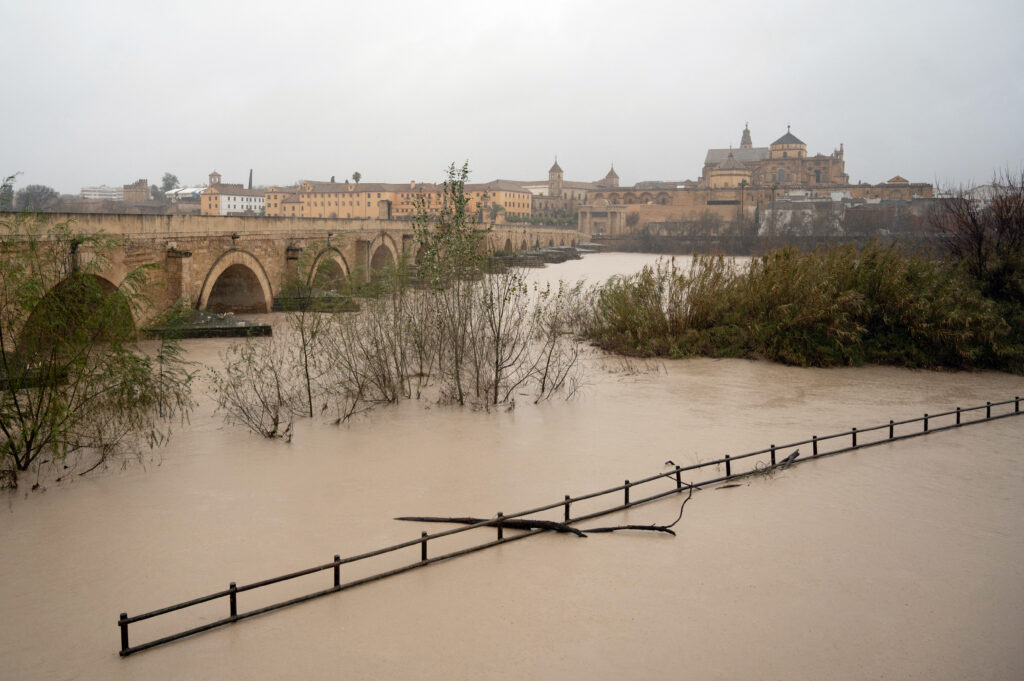 Nine destructive winter storms hit the Iberian Peninsula with extensive flooding between mid-January and mid-February. | Jorge Guerrerp/AFP via Getty Images
The atmospheric river was “intensified by passing over a very strong marine heatwave in the Atlantic on its way up to Spain,” said Barnes. This increase in sea temperatures, she added, was found to have been made 10 times more likely to happen as a result of climate change.
“The storm … is carrying moisture from the Atlantic up towards Iberia, up towards northern Morocco, and because this atmospheric river passed over this very warm patch of ocean, it was able to pick up more moisture than it would have if the ocean had been cooler, and that means that when that rain makes landfall … there is more water to fall,” she said.
A so-called blocked weather pattern — describing a high-pressure area that diverts winds around it — also influenced the extreme weather by channeling storm after storm toward Iberia for a month. Scientists are still investigating whether climate change is increasing the occurrence of blocking patterns.
The authors noted that at an estimated 49 fatalities across the three countries, the death toll remained relatively low, thanks to concerted early-warning and evacuation efforts.