
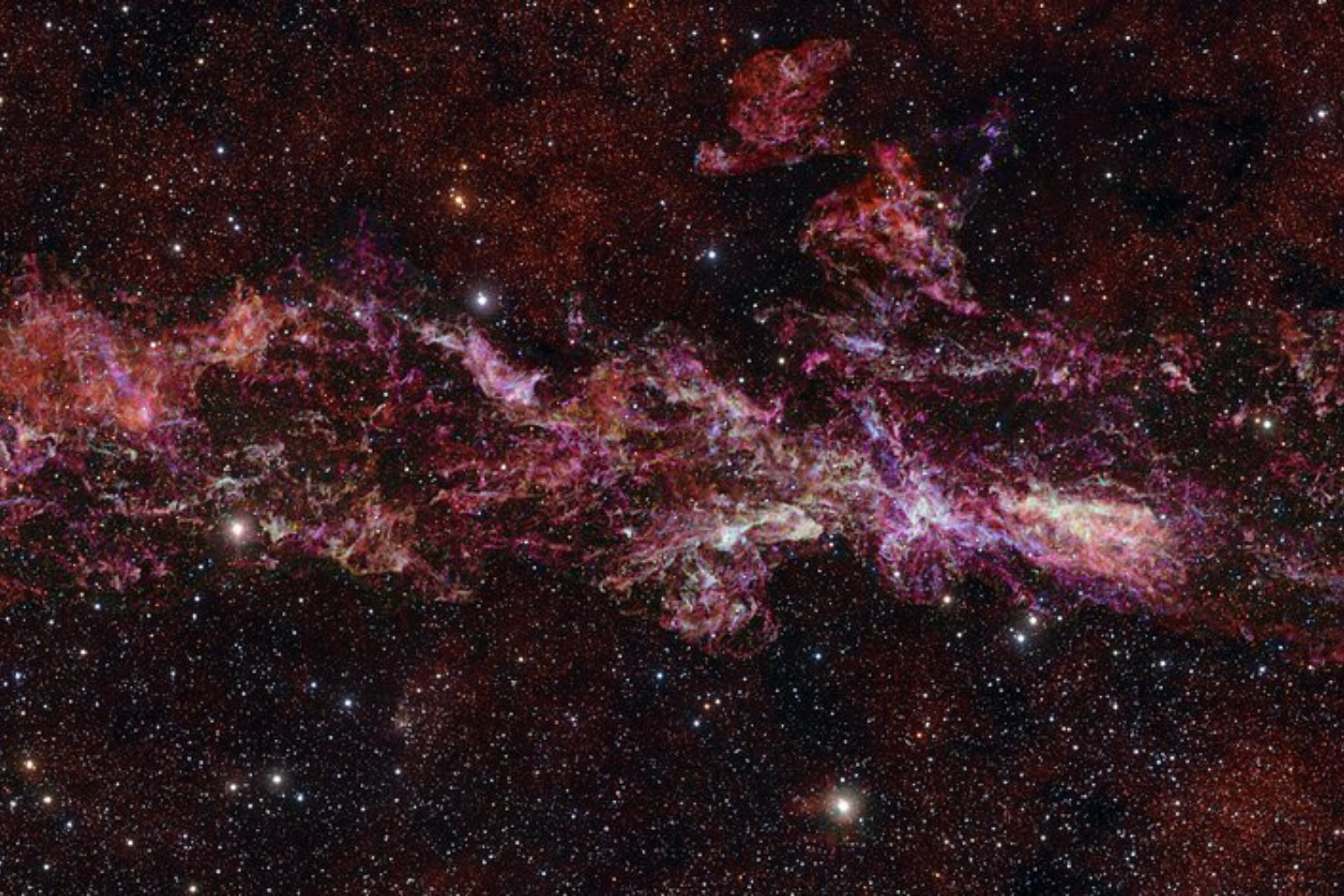
Astronomers have just created the most-detailed map of the Milky Way’s chaotic center ever.
For the first time, the cold gas—the raw material from which stars form—of the 650-light-year-wide region known as the Central Molecular Zone (CMZ) has been documented in unprecedented detail thanks to a giant telescope. The CMZ is packed with an intricate network of cold gas that flows along filaments, often collapsing into clumps of matter that are capable of forming stars, according to a press release.
The Atacama Large Millimeter/submillimeter Array (ALMA), an international astronomy observatory located in northern Chile’s Atacama Desert, produced the striking image. Situated at an altitude of 5,000 meters, it uses 66 high-precision antennas to study the coldest, most distant regions of the universe in submillimeter and millimeter wavelengths.
Credit:
Courtesy of ALMA(ESO/NAOJ/NRAO)/S. Longmore et al. Stars in inset: ESO/D. Minniti et al. Milky Way: ESO/S. Guisard
This is the largest image ALMA has ever captured, and it could help scientists investigate how stars live and die in the environment around the Milky Way’s supermassive black hole.
The resulting image was stitched together using smaller, individual observations and covers an area of the sky that’s about as wide as three full moons. The ultra-detailed view includes everything from gargantuan clouds of supersonic gas to individual stars and could take years to analyze.
“It’s a place of extremes, invisible to our eyes, but now revealed in extraordinary detail,” Ashley Barnes, an astronomer at the European Southern Observatory (ESO) in Germany who is part of the team that obtained the new data, said in the statement.
The international ACES team, which is short for the ALMA CMZ Exploration Survey, is composed of over 160 scientists working at more than 70 institutions across Europe, North and South America, Asia, and Australia.
So far, the survey has identified more than 70 types of molecules in the galactic center, including both simple molecules, such as silicon monoxide, and more complex organic ones like ethanol and methanol.
“The CMZ hosts some of the most massive stars known in our galaxy, many of which live fast and die young, ending their lives in powerful supernova explosions, and even hypernovae,” ACES leader Steve Longmore, a professor of astrophysics at Liverpool John Moores University, explained in the statement. “By studying how stars are born in the CMZ, we can also gain a clearer picture of how galaxies grew and evolved.”