
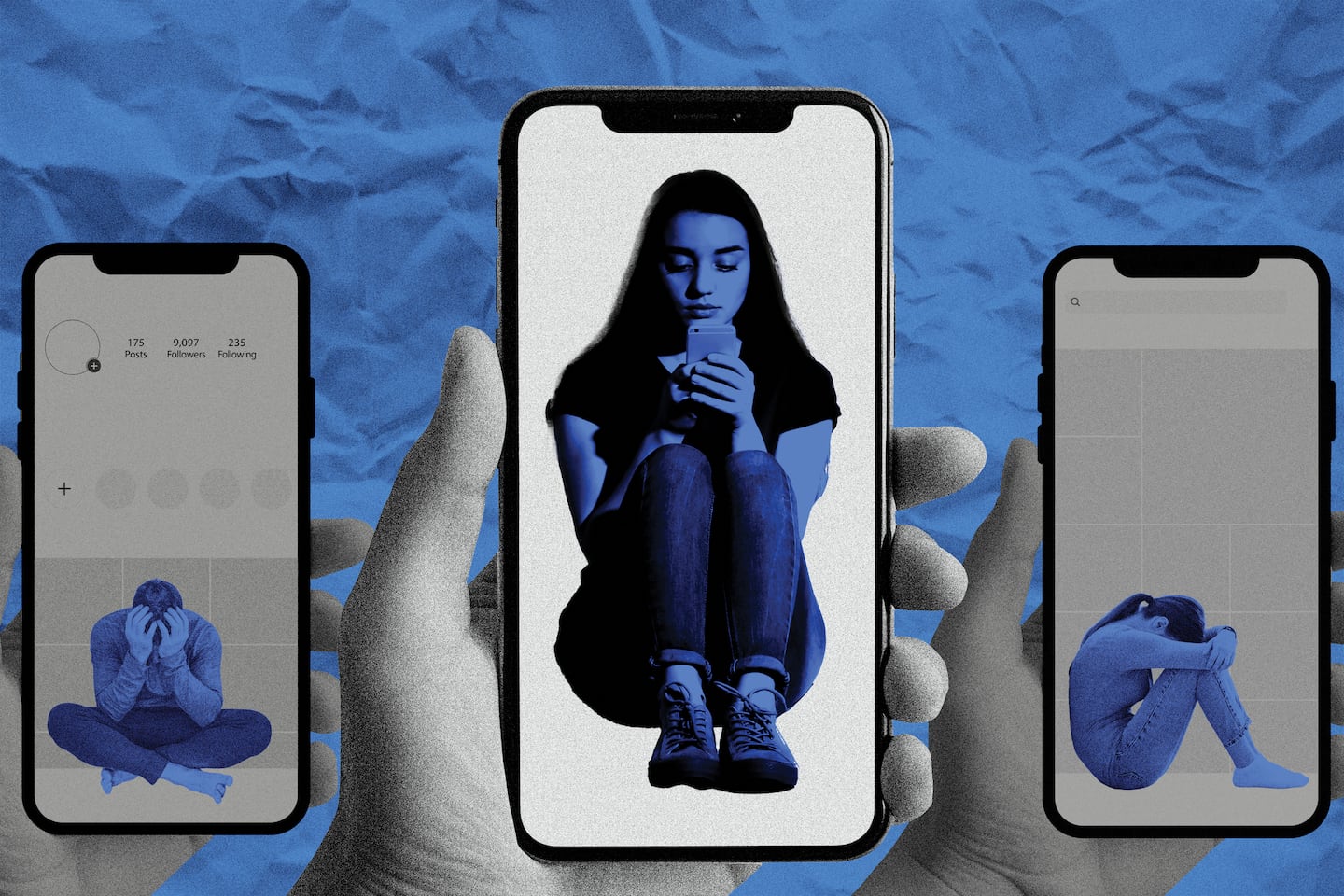
Christine’s screen addiction intensified in college. She would watch comedy clips on YouTube for hours on end in her dorm room instead of studying or hanging out with friends. She wouldn’t eat, wouldn’t sleep, wouldn’t take breaks to go to the bathroom. She pushed herself to the verge of getting physically ill. Even when the dopamine rush of starting a new video wore off, when she wasn’t having fun anymore, she couldn’t stop. The next morning, her eyes would burn and her head would ache, but the worst part was the self-loathing and fear that she couldn’t change.
“My life was really not very functional,” said Christine, now a graduate student in Cambridge. “I felt ashamed that I couldn’t stop using, even though I knew I was hurting myself.”
At a time when tech executives and psychologists are debating whether technology really is addictive, some New Englanders have banded together to find salvation from the internet. Twice every week, the Cambridge chapter of Internet and Technology Addicts Anonymous — made up of people from across Greater Boston in their early 20s to their 50s — convenes to confront the screens they say have taken over their lives. Members recalled previous meeting attendees who dropped out of college, lost jobs, or even ended marriages because of their uncontrollable scrolling habits. They desperately want it to stop.
There’s no doubt many people have grown increasingly reliant on technology for social connection and daily life, especially after the pandemic. Americans spend more than five hours, on average, on their phones per day, according to a survey last year, and more than half said they wanted to cut back.
Hundreds of plaintiffs in state and federal courts, including Massachusetts’ attorney general, are suing major social media companies in several class-action lawsuits, alleging they intentionally designed addictive algorithms to keep people on the platforms, contributing to a growing mental health crisis. In a trial unfolding in California, jurors will determine whether the apps were engineered to be addictive and whether companies such as Meta, the parent company of Facebook and Instagram, were at fault in the depression and anxiety that young people said resulted from their addictions.
 Mark Zuckerberg, center, Meta’s chief executive, departs California Superior Court of Los Angeles County in Los Angeles on Feb. 18. Zuckerberg, who founded Facebook in his college dorm room in 2004, testified in a landmark tech addiction case against Meta and YouTube.MARK ABRAMSON/NYT
Christine had tried just about everything to limit her tech usage — downloading blocker apps, putting her phone into grayscale mode to make it less engaging, reading books on tech addiction. Nothing worked.
The Globe agreed to identify Christine and other tech addicts only by their first names to protect against personal and professional repercussions.
“I was addicted to it,” Christine said. “I was actually incapable of stopping it.”
Christine doesn’t need to wait for a court ruling, or the psychology field to agree on official diagnostic criteria, to confirm the mental and physical pain she feels after binging online videos or endlessly scrolling news sites.
“Tech use, and tech addiction even, is very normalized in society. If you say you can’t drink, people will take that seriously, and people realize that alcoholism is a very serious, potentially fatal, health condition,” Christine said. “I don’t think people take tech addiction as seriously outside of [this group].”
Many members of Internet and Technology Addicts Anonymous found the organization through the internet, like an alcoholic getting treatment advice from a bartender.
They said those searches were moments of desperation, a scream for help into the nonjudgmental void of a screen.
Trish, a 50-year-old sculptor in Waltham, became deeply engrained in Instagram and Facebook where she would debate others on politics, then addicted to short-form videos, in the years before she turned to the tech addicts group. Now, she spends most of her time watching content on YouTube — her drug of choice. She looked at her phone usage and was shocked to see the totals: some weeks, she spent between 40 and 50 hours scrolling.
Less and less of Trish’s time was spent creating sculptures, and more and more was spent going down video rabbit holes. It took the time and energy of a full-time job.
“It’s hard to accept that I actually spent 50 hours a week doing it. I can’t even admit it to myself,” she said. “If I hadn’t looked at the time, I wouldn’t have any awareness that it actually was that bad.”
In the nearly 90 years since alcoholics first turned to 12-step programs to support their sobriety, people suffering wide-ranging addictions have adopted the format to find community and accountability. As with other spinoffs for drug addicts, food addicts, and others, the tech addicts group, which started in Washington in 2017, features open meetings and allows experienced members to become sponsors.
Every meeting of Internet and Technology Addicts Anonymous begins with the recitation of the 12 steps, the mantric guideposts of the program that are slightly edited from those used by Alcoholics Anonymous.
Step One: “We admitted we were powerless over internet and technology — that our lives had become unmanageable.”
 Twice every week, the Cambridge chapter of Internet and Technology Addicts Anonymous convenes in the First Church in Cambridge to confront the screens they say have taken over their lives.Craig F. Walker/Globe Staff
At the twice-weekly meetings at First Church in Cambridge, which is unaffiliated with the group, each member gets about five minutes to speak about their struggles and their successes. They admit to relapses and temptations. At the end of each turn, nearly everyone’s shoulders relax, free of the burden of their addiction for at least that moment.
It’s impossible to be “sober” from technology, at least in the traditional sense. Tech is a necessity for participation in modern society. The members compare it less to drugs or alcohol and more to a binge-eating disorder or a shopping addiction — you can’t live without ever eating or buying things. Almost everyone at the meeting had a smartphone — some had two.
The group uses “lines” — top, middle, and bottom — to define behaviors along a spectrum of damage.
Bottom lines are absolute no-gos. For Christine, that’s viewing any short videos, news websites, or social media, among others.
Top lines are beneficial behaviors, such as exercise, which promote avoiding unhealthy tech use.
Middle lines are actions that can be done in moderation, but should be limited to avoid falling into bottom lines. For Christine, this includes email, text messaging, and online shopping.
Members announce how long they’ve been sober from their bottom lines.
“I’ve been sober since August,” said Christine, who has been in the group since 2019. She relapsed last summer when, for a two-week period, she binged videos with such intensity that she barely ate or slept.
Another member had been sober for three days. A third had been sober from scrolling for an hour.
Serious confessions were interspersed with smiles and laughter. One member said she was trying to replace screen time with exercise and had taken to roller skating around her house amid the frigid winter. Trish regaled the group with her account of a recent trip to Mexico, where she swam, relaxed in the sun and felt momentarily free from her phone.
After each meeting, the group picks a restaurant in Harvard Square. Over dinner, they sometimes discuss addiction and sometimes chat about anything but.
There’s no consensus among mental health experts about screen addiction.
You can’t physically overdose, like with heroin or alcohol.
Screens come in ubiquitous forms. Phones. Laptops. TVs. Tablets. Watches.
 There’s no consensus among mental health experts about screen addiction. Jenny Kane/Associated Press
Kyle Faust, a psychologist and director of the Digital Addiction and Gambling Treatment Program at Mass General Brigham, said he has seen an increasing number of cases. He defines a screen addiction using a modified version of internet gaming disorder: difficulty controlling the frequency, intensity, and duration of screen use; increasing priority of screens over other activities; and continuing those habits despite negative consequences. Someone has to experience these symptoms, alongside severe distress in their lives, for a year to be considered an addict.
There should be a formal definition for screen addiction, Faust said, so more people can receive help.
“Unfortunately, progress in these areas moves at a fairly slow rate,” Faust said.
Dr. Michael Rich, Boston Children’s Hospital pediatrician and codirector of the Clinic for Interactive Media and Internet Disorders, said he, too, is seeing more patients and their families seeking help.
He argues the label of screen addiction ignores the undercurrent of other mental health conditions that need addressing.
Compulsive tech use in kids, Rich said, often offers an escape for other issues that are not being adequately treated — without confronting the root of the problem.
“The real issue is the problematic use of these technologies, not the technologies themselves,” Rich said.
There are four psychological conditions that can often drive youths to lose control of their screen use, Rich said: ADHD; anxiety, particularly social anxiety; autism; and depression.
It’s difficult to measure prevalence of screen addiction. One meta-analysis published in 2022 in the journal Clinical Psychology Review estimated that 27 percent of people worldwide were addicted to smartphones.
“Someday it’ll be like smoking,” Trish said of how future generations will look back on today’s addictive internet culture. “There was a time when every restaurant had an ashtray, every airplane had an ashtray, every car had an ashtray. It was so normalized.”
Building a community, members of Internet and Technology Addicts Anonymous found, is at least part of the solution.
That’s why Christine is there, in the church storage room, every Tuesday and Wednesday evening.
“Coming to these meetings gives me that reminder of how serious this disease is and how much I need help,” Christine said. “One of the main reasons that I keep coming is to give back what was given to me.”
Marin Wolf can be reached at marin.wolf@globe.com.