

Find your next quality investment with Simply Wall St’s easy and powerful screener, trusted by over 7 million individual investors worldwide.
Visa (NYSE:V) has completed its acquisition of Prisma Medios de Pago and Newpay in Argentina, expanding its presence in a key Latin American market.
The company has also agreed to act as a cornerstone investor in PayPay’s planned U.S. IPO, committing capital to a large digital payments listing.
These moves reflect Visa’s push into digital wallets and local payment infrastructure across high growth international markets.
Visa runs a global payments network that connects consumers, merchants and financial institutions, and it has been steadily building out its capabilities in digital and mobile payments. The acquisitions in Argentina bring more of the local processing stack in house, while the PayPay stake adds exposure to a scaled wallet operator in Asia. Together, they give investors more detail on how Visa is working to remain central as cash usage changes and digital payment methods broaden.
For investors, these actions are less about individual transactions and more about how Visa positions itself in the broader ecosystem over time. The key considerations now include how effectively Visa can integrate its new Argentine assets, how influential it can be within PayPay’s platform and how these moves might affect its competitive position relative to other global and local payment providers.
Stay updated on the most important news stories for Visa by adding it to your watchlist or portfolio. Alternatively, explore our Community to discover new perspectives on Visa.
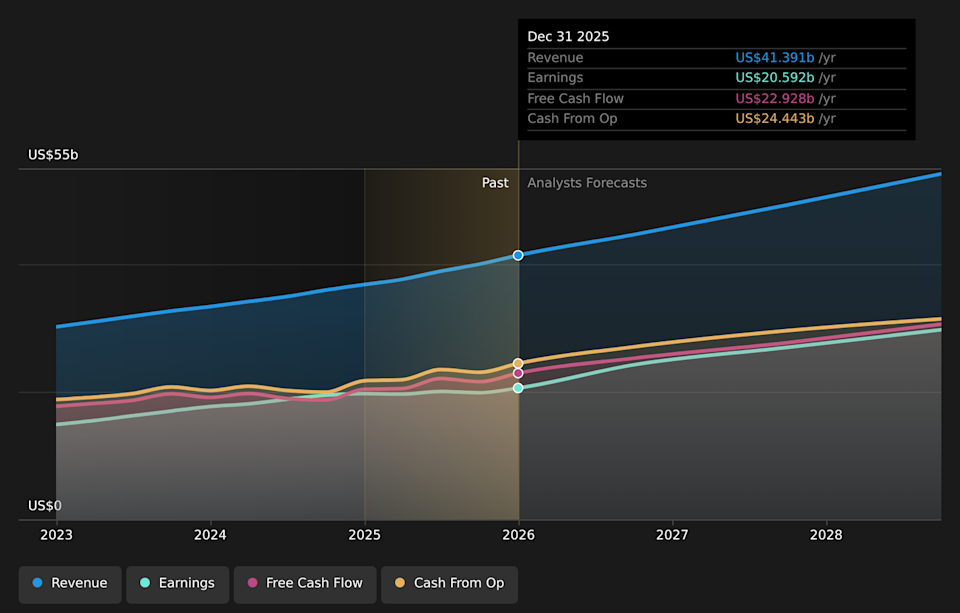 NYSE:V Earnings & Revenue Growth as at Feb 2026
📰 Beyond the headline: 0 risks and 4 things going right for Visa that every investor should see.
For you as a Visa shareholder or watcher, the key thread across these moves is control over where and how digital payments happen. Owning Prisma Medios de Pago and Newpay gives Visa more say over card and debit processing in Argentina, a market where regulators and local players have historically shaped the rules. That can matter for how quickly new products like tokenization, contactless and real-time payouts reach banks and merchants. On the PayPay side, coming in as a cornerstone investor ties Visa more closely to one of Japan’s largest digital wallets at the point where it is opening up to global capital. That can help Visa stay plugged into wallet-based commerce, which is important as AI agents, stablecoins and local real-time schemes increasingly sit between consumers and traditional card rails. The common question for you is whether these steps keep Visa central as payment flows digitize, or simply spread its exposure across more models that also carry regulatory, technology and integration risk.
The Argentina deal and the PayPay stake both support the existing narrative that Visa is leaning into emerging markets and cross-border flows, which have been highlighted as key drivers for digital payment volumes and value-added services.
At the same time, bringing more on-us processing in house and linking to a large third-party wallet could challenge the idea that Visa’s traditional card-fee model remains the default, as more revenue may depend on local economics and partnership terms.
The investment role in PayPay, and the infrastructure influence in Argentina, may not be fully reflected in broader discussions that focus on stablecoins and real-time account-to-account schemes, even though these types of partnerships could shape how such technologies are adopted.
Knowing what a company is worth starts with understanding its story. Check out one of the top narratives in the Simply Wall St Community for Visa to help decide what it’s worth to you.
⚠️ Integration and regulatory execution in Argentina could prove complex, especially if pricing, routing rules or interchange structures differ from other markets where Visa, Mastercard and American Express operate.
⚠️ A cornerstone position in PayPay ties Visa to the fortunes of a single wallet operator, so shifts in Japanese regulation, competition from local banks or big tech, or changes in SoftBank’s strategy may affect the value of that exposure.
🎁 The Prisma and Newpay acquisition gives Visa closer access to transaction data and local infrastructure in Argentina, which can help it refine risk tools, value-added services and product offerings for banks and merchants.
🎁 Participating in PayPay’s US$14b-target IPO as a cornerstone investor can strengthen Visa’s relationships in Asia and keep it closely involved as AI-driven and wallet-based commerce grows alongside traditional card-based payments.
From here, you might want to watch how quickly Visa rolls out new products and services through Prisma and Newpay in Argentina, and whether that translates into deeper bank and merchant adoption. On PayPay, the key signposts are how the IPO is received, whether user activity on the platform expands, and what form Visa’s commercial agreements around cards, tokenization or cross-border payments take over time. It is also worth tracking how these moves sit next to broader pressures on card networks from AI agents, real-time payment schemes and policy conversations around fees and credit costs, where Visa, Mastercard and other players are all under closer scrutiny.
To ensure you’re always in the loop on how the latest news impacts the investment narrative for Visa, head to the community page for Visa to never miss an update on the top community narratives.
This article by Simply Wall St is general in nature. We provide commentary based on historical data and analyst forecasts only using an unbiased methodology and our articles are not intended to be financial advice. It does not constitute a recommendation to buy or sell any stock, and does not take account of your objectives, or your financial situation. We aim to bring you long-term focused analysis driven by fundamental data. Note that our analysis may not factor in the latest price-sensitive company announcements or qualitative material. Simply Wall St has no position in any stocks mentioned.
Companies discussed in this article include V.
Have feedback on this article? Concerned about the content? Get in touch with us directly. Alternatively, email editorial-team@simplywallst.com