
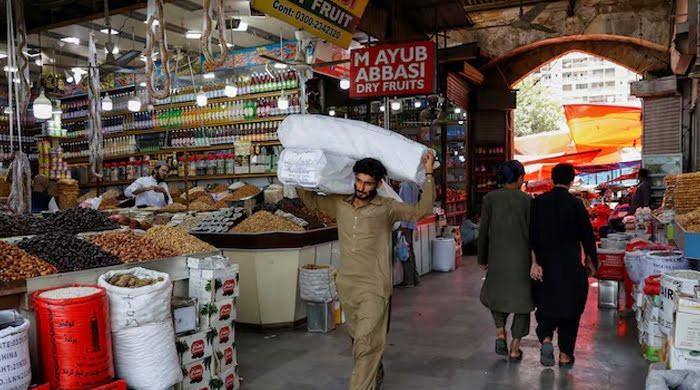
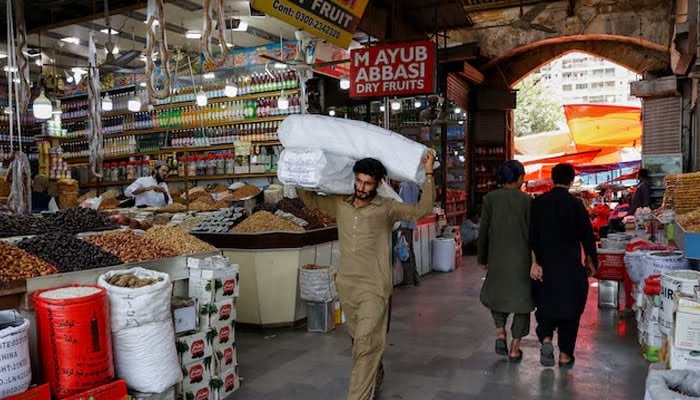
A man walks with sacks of supplies on his shoulder to deliver to a nearby shop at a market in Karachi, June 11, 2024. — Reuters
Pakistan is an investment-starved country. The ways and means to attract investment are not working well.
The Board of Investment (BOI) has utterly failed to attract investment into the country. The Special Investment Facilitation Council (SIFC) has also miserably failed to boost investment. It is quite surprising that the government has failed, despite its best efforts, to boost FDI and achieve significant economic growth.
Apparently, Pakistan fully qualifies to attract substantial investment from foreign and domestic investors, given its abundant resources and the potential to attract Foreign Direct Investment (FDI). But the most surprising question is: why, and what factors are hindering economic growth and investment in the country?
Pakistan ranks among the lowest in Asia, with investment stuck at 13.8% of GDP, compared with other regional economies including India, Vietnam and Bangladesh at more than 30% (India and Vietnam) and 22% (Bangladesh), respectively. This is despite our best relations with the US, China, Russia and the vital economies of the Muslim world, including Turkey, Saudi Arabia, Qatar, Indonesia, Malaysia and the UAE.
The malady apparently entails multiple issues and factors disturbing our investment climate and ecosystem, ranging from terrorism, lack of facilitation and ease of doing business, a weak judiciary and accountability system, political instability, extortion and corruption, the burden of high tax rates and super tax, excessive government borrowing, regulatory hurdles and trade gaps disturbing the balance of payments. These are the major factors and hurdles discouraging international investors from investing in the country, thereby hurting economic growth. This is despite the IMF’s EFF-anchored and sponsored short-term stabilisation of the economy.
The so-called robust macroeconomic indicators and stabilisation are neither substantial nor sustainable in the long run, as external loans and debt liabilities have crossed $138 billion. The IMF review mission is to assess compliance and actions in accordance with the agreement. It is, however, pleasant to hear IMF officials appreciating Pakistan’s policy reforms and efforts to stabilise the economy.
But this appreciation seems at odds with reports circulating on social media that quote 125 foreign companies leaving Pakistan. The list is reportedly based on sources from the Securities and Exchange Commission of Pakistan (SECP). This is quite mind-boggling and reminds one of ‘Confessions of an Economic Hit Man’, as the economy appears trapped in debt while international donors appreciate reforms and stability without solid or cogent reasons.
The entire edifice of the economy is built on loans and debt, with more than half of the annual budget going toward debt repayment and servicing. Poverty is rising and unemployment is knocking at every door, with no place to settle. Exports are declining in real terms due to high energy costs, compelling industries and large-scale manufacturing to shut down.
Foreign remittances are no doubt a great source of support for maintaining the balance of payments. However, remittances are non-productive, as they are primarily utilised to build foreign exchange reserves. As such, they do not generate exportable output.
They do not inherently constitute investment and do not directly contribute to economic growth, although they provide stabilisation support to the economy. Pakistan, in fact, needs investment to enhance productivity and growth, which is currently lacking.
The first and foremost factor undermining the investment climate is the country’s long-standing security situation. Pakistan is one of the worst-hit countries, with rampant terrorism allegedly imported from foreign countries, especially India and Afghanistan.
Terrorism has badly disturbed and discouraged the investment ecosystem. Investors require foolproof security for their lives, assets, investments and businesses. Terrorism has marred the investment climate. The issue must be addressed to root out fear from the hearts and minds of investors.
A four-pronged policy of opening diplomatic channels, initiating negotiations with neighbours, restoring lines of communication and trade routes as essential confidence-building measures (CBMs) and conducting strict security operations against terrorists can work effectively. The government needs to focus on such broad measures to provide a conducive atmosphere for investors.
Rule of law and a strong judicial system are the second most important factors in attracting investment. Pakistan has a legacy of a weak judicial system, often perceived as incapable of protecting the rights of citizens in general and business entrepreneurs in particular. This factor alone has kept Pakistan out of the ambit of investment hubs and investment-friendly countries.
Recent constitutional amendments have further weakened investor confidence in an already fragile judicial system. Personal influence is often perceived to affect decision-making processes. The accountability system is not fully functional, resulting in low investor confidence. Many decisions are seen as transactional. An inclusive political system is also lacking. Such weaknesses in the judiciary and political dispensation result in a fragile investment ecosystem that requires improvement.
Risk assessment indices and corruption further add to investors’ concerns. Investors prefer environments where systems function efficiently and corruption is minimal. Corruption is one of the worst maladies affecting the investment climate.
In countries like Pakistan, corruption is often perceived as entrenched within the system. Foreign investors flee from such an atmosphere of blackmail and harassment. Pakistan continues to suffer from corrupt practices that discourage investment. Issues of accountability and transparency must be addressed at the highest policymaking forums to provide a more conducive investment climate.
High energy tariffs and tax rates have burdened industry, contributing to inexorably rising production costs and rendering industrial output uncompetitive. The manufacturing sector is increasingly unfeasible due to the burden of various taxes and super taxes. Production costs have skyrocketed, making it difficult to compete with imported goods.
The natural outcome is a shift of investment to other sectors of the economy. However, investment in other sectors is also hampered by a lack of government facilitation and ease of doing business. The promise of one-window operations through the SIFC remains largely unrealised. That is why investors are reluctant to invest in sectors such as the green economy, oil and gas, and mining and minerals. A comprehensive policy decision is required to address these challenges.
An inclusive political system must evolve through better political dispensation by taking the opposition on board. Countries with strong political systems have progressed more successfully. Pakistan, with its diverse culture and population, requires strong democratic credentials to accommodate all sections of society. The right to vote must be respected to build a sturdy, strong and robust system capable of delivering results and boosting public confidence.
The investment climate improves when public confidence in governance improves. Governance reforms must be implemented in letter and spirit, respecting the mandate of the people. A strong, transparent and accountable governance system is essential to boost investment.
The most crucial question remains: What incentives exist for investors to invest in Pakistan? The government must provide incentives, including security for life and property, affordable energy, tax holidays, genuine one-window facilitation, ease of doing business, transparency, accountability through a strong judiciary and, above all, an inclusive and strong political system that ensures an equitable governance framework. That is the only way forward to realise the dream of making Pakistan an investment hub.
The writer is a former additional secretary and can be reached at: [email protected]
Disclaimer: The viewpoints expressed in this piece are the writer’s own and don’t necessarily reflect Geo.tv’s editorial policy.
Originally published in The News