
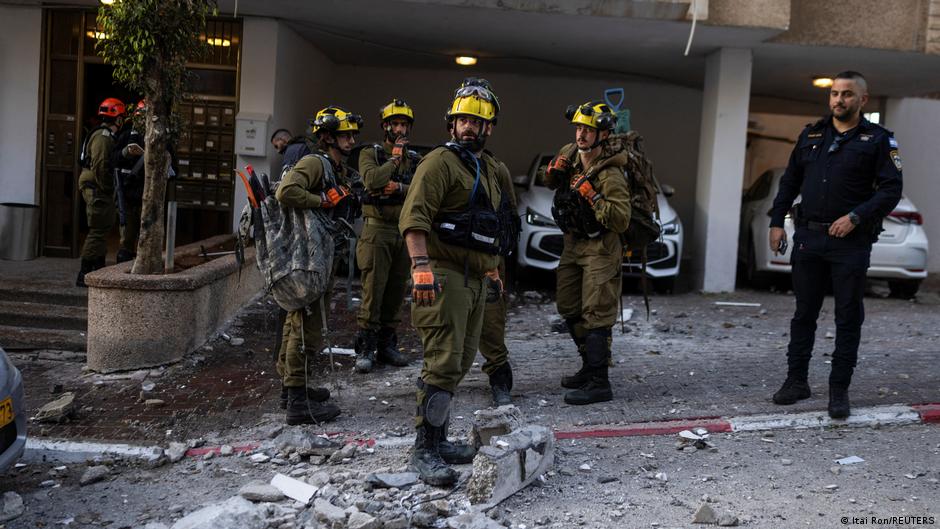
On the morning of February 28, at around 8 a.m. local time, the first warning messages were sent to mobile phones throughout Israel. All residents were instructed to immediately seek shelter and await further instruction.
Around the same time, Defense Minister Israel Katz declared a nationwide state of emergency. He said that a “preemptive strike” had been launched against Iran to “remove threats” to Israel.
Negotiations a ‘waste of time’
Since the events of that morning, Noam Tibon’s phone has hardly stopped ringing. The retired major general gained nationwide fame when he single-handedly rescued his family from their kibbutz during the terrorist attack on October 7, 2023. Tibon is also known as a critic of Israeli Prime Minister Benjamin Netanyahu‘s government.
Retired Major General Noam Tibon welcomes the military strike against Iran in principleImage: ABBfoto/picture alliance
But the military expert expressed an understanding for the attack that has now begun. “I think they have realized that all previous negotiations with Iran have been a waste of time,” Tibon told DW.
To his mind, the attacks are a direct consequence of the 12-day Israel-Iran war of June 2025, when Israel attacked Iran with US assistance. The military strike, which most experts considered a clear violation of international law, was primarily aimed at Iran’s nuclear program. Iranian counterstrikes caused considerable damage on Israeli soil and surprised many regional experts with their scale. Numerous Iranian ballistic missiles penetrated Israel’s defense shield, killing at least 28.
“When we saw these casualties, we understood that we had to do more to counter the threat,” Tibon said. “This led to the goal that Iranian missiles should never again pose a danger.”
Widespread political approval
So far, large parts of the opposition have also expressed their approval of the Israeli government’s decision to strike. Opposition leader Yair Lapid thanked Israel’s ally the United States for its “courage and determination to change history.”
Knesset member and former Defense Minister Benny Gantz wrote in a brief statement: “We all stand together — and we will win!”
Minister of National Security Itamar Ben-Gvir of Netanyahu’s far-right coalition partner Otzma Jehudit threatened all Israeli citizens who support Iran with beheading.
Uncertain times: People in Tel Aviv seek shelter from Iranian missiles in an underground parking garageImage: Oren Ziv/dpa/picture alliance
One of the few critics of the military action is left-wing Arab-Israeli parliamentarian Ayman Odeh. He doubts that the war will lead to greater security for Israel. “Take good care of yourselves — because this government will not do it for you,” the opposition politician said in a statement.
Many critical observers in Israel are particularly concerned about the increasing danger of another multi-front war. On Saturday morning, the Israeli army launched a comprehensive mobilization of reserve units. Their task is to protect the northern borders with Lebanon and Syria and prevent the Hezbollah militia, allied with Iran, from entering the war.
Regime change in Iran?
For most Israelis, there is no doubt that the war aims go far beyond the destruction of Iran’s missile arsenal. In his video address, Prime Minister Netanyahu directly called on Iranians to free themselves from the “yoke of tyranny” and “take their destiny into their own hands.”
Prime Minister Benjamin Netanyahu during his televised address on SaturdayImage: GPO/AFP
Political observer Noam Tibon believes that many within the Israeli government hope that US-based Reza Pahlavi, the son of the former Shah, will become the successor to Iran’s Supreme Leader Ayatollah Ali Khamenei. However, Tibon said that the success of a potential regime would be difficult to gauge. “At the moment, the picture is far too unclear,” he said.
Tibon also sees a real danger of military escalation that could turn into a “long war of attrition for the entire region.” This would be a particular problem for Israel because its position will depend on both the US and how the situation unfolds in Iran.
This article was originally written in German.