

After 12 years of working together, KaOS rocked the open-source world by announcing that it was getting rid of KDE Plasma, citing issues with being tied to Systemd. Since then, people have pointed out that KDE Plasma doesn’t need Systemd, and that only the login manager requires it, which can be worked around easily. The discourse was so big that t he KDE team itself stepped in to clear up which parts of Plasma depend on Systemd.
Despite this, the KaOS team has stuck with its new home. The OS now uses Niri with Noctalia, and the newest version comes with it all set up already. Now, I’m a huge KDE Plasma fan, so when I heard that an OS was dropping it for something else, I was curious as to see what the alternative was like. And it’s something I’ve not seen with Linux before.
The new KaOS is ridiculously minimalistic
No flashy UI here
As soon as you boot up KaOS via the live USB, you’re greeted with the new UI. As someone coming over from KDE Plasma, using Noctalia is an experience. There are no flashy graphics, no big icons, and no special effects; it’s very simple, basic, and aesthetically pleasing.
The minimalism really kicked in when I booted up Octopi, which, from what I could see, was KaOS’s new alternative to KDE Discover. I was greeted with a very slim and basic package manager, which I could search through and download from. If it didn’t feature the app I wanted, I could click the little alien head icon to switch to the AUR. It was really nice to have the AUR ready to go on setup, and honestly, the UI gives me vibes of using older Windows OSes, which I love.
Related
I switched to the COSMIC Linux desktop, and I can’t wait for the future
COSMIC is out of this world, even with its flaws
The shadow of KDE still lives within KaOS
You can still see the impact it made on the KaOS team
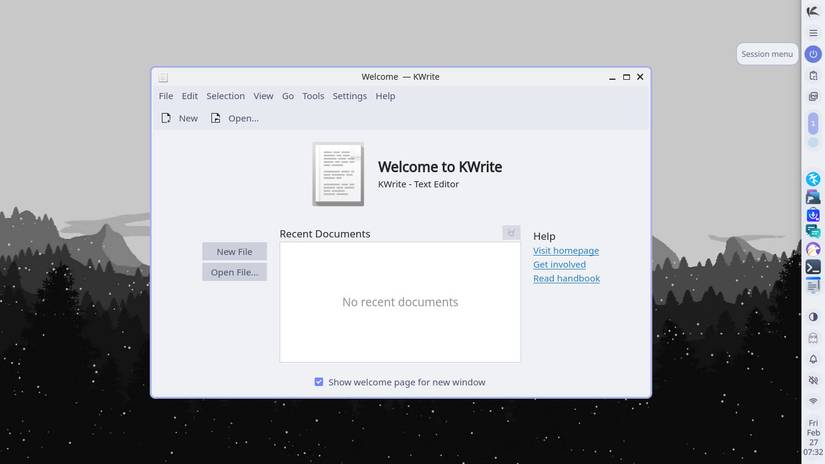
Interestingly, during the setup of KaOS, I noticed the setup window used KDE Plasma’s mascot, Konqi. At first, I thought it may have been a residual asset from the swap, but after installing KaOS, I also noticed tools like the KDE Partition Manager and KWrite were still hanging around.
It seems that, despite disagreeing with how KDE is handling things, KaOS still wants to maintain its stance as a Qt-based OS. While KDE Plasma is no longer part of the default installation (but can be added back in by the user if they want), it seems the KaOS team still wants to leverage the excellent apps that come with the package. And honestly, I don’t blame them; I’ve become a huge fan of KDE’s tools lately, and I would also struggle to cut them off entirely if I were in the KaOS developer team right now.
As such, this puts KaOS in this strange, but interesting limbo state. The UI and underlying systems of KaOS have changed drastically, but if you look around, you’ll find the detritus of the old KDE Plasma version still lying around for you to use. In fact, I was pretty happy to see that KDE Connect made it to the Niri version; it’s my fave mobile app by far.

Related
Linux Mint isn’t the answer for Windows refugees anymore
It’s still good, but not the best.
It left me wondering if the sacrifice was worth it
Did KaOS make the right call?
So, I’ll say upfront that I am neither a KDE developer nor a Linux distro maintainer. As such, I have no strong opinions for or against how KDE utilises Systemd. However, from what I have seen and heard, KDE’s Systemd dependency only goes so far as the login client. If a distro developer wanted to remove their dependency on it, they could use a different login service to get the job done.
Now, this might be the KDE Plasma fanboy side of me talking, but as I was using Niri with Noctalia and getting used to how everything worked and all the nuances, I was left wondering if KaOS’s decision to drop KDE Plasma as a default was the right call. Granted, people could always swap back to KDE Plasma if they want to; KaOS doesn’t forbid that.
However, in a scene where more OSes are adopting KDE Plasma as the default desktop environment, I was uneasy about KaOS going the opposite way. Would new users gel with Niri as I did with KDE Plasma? I can’t say for sure, but I have a gut feeling that newcomers to Linux would find KDE Plasma easier to use and more ‘Windows-like’ than Niri.
Related
Parrot OS 7.0 finally introduces my favorite desktop environment into the mix
Plus, a ton of new features arrived.
Here’s hoping KaOS settles in with whatever it chooses
It’s still early days for KaOS’s decision, so there’s a chance the team makes amends with KDE, and they return to Plasma as a default. If they never do, I do think Niri with Noctalia is a really classy choice, but I wonder if the decision will make it harder for new users to properly gel with the distro.