
Researchers have discovered and analyzed the world’s oldest geometric patterns on 60,000-year-old ostrich egg fragments, revealing the complex cognition that eventually enabled Homo sapiens to invent writing.
A recent study published in PLOS One found that our human ancestors—at their point of departure from Africa—created a “geometric grammar” on ancient water containers made from these shells.
On the surface, the forms resemble a series of boxes, hatched bands, grids, and diamonds. Upon deeper analysis, the study showed that these markings reflected “a genuine cognitive organization of forms, based on parallelism, orthogonality, and the repetition of lines and regular patterns.”
Silvia Ferrara, the study’s coordinator, described these patterns as “a surprisingly structured, geometric way of thinking.” This suggests that our earliest ancestors engaged in abstract thought by applying geometry to create a symbolic system—a math-rooted precursor to writing.
While these markings might appear inconsequential to the untrained eye, the study unveiled the impressive thought processes behind these “visuo-spatial forms.”
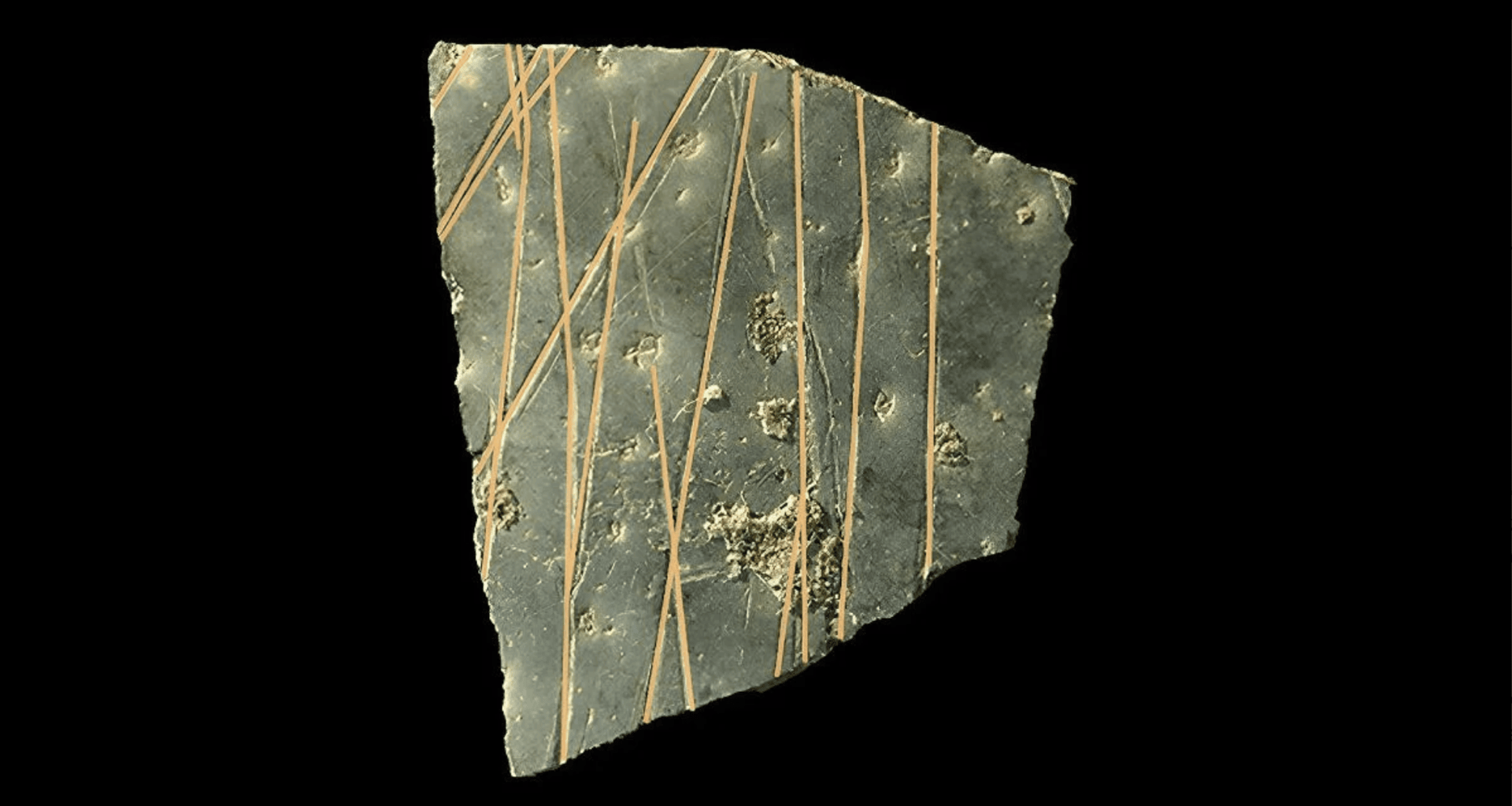
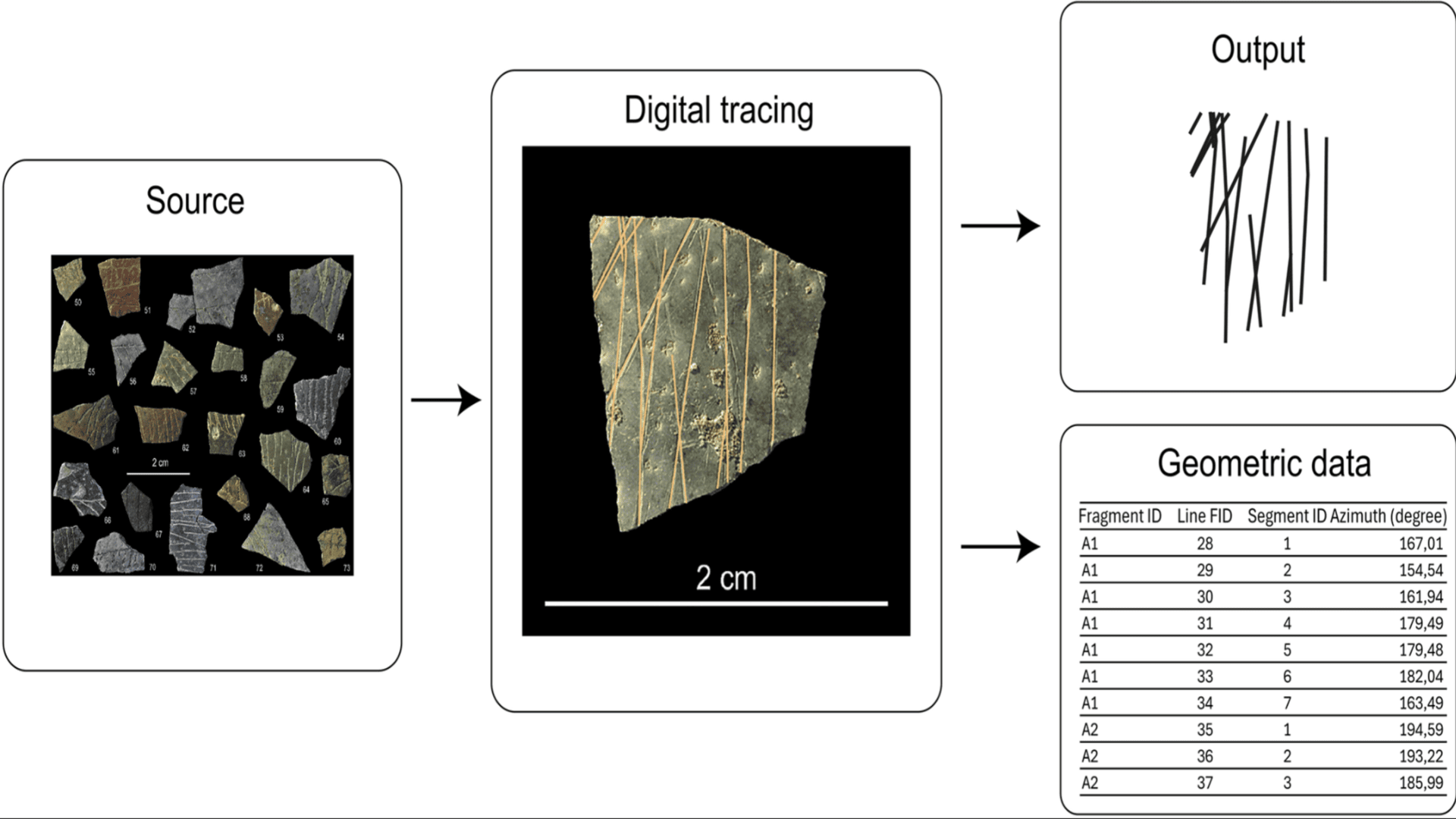 Images, details, and modeling the markings on the ostrich shells. Decembrini et al.
A visual grammar in embryo
In an intriguing new study funded by the University of Bologna, researchers gathered 112 marked fragments of water containers from two archaeological sites in South Africa. They showcased how even the simplest forms reveal extremely complex mental operations by reconstructing the lines, angles, and trajectories in detail.
Through geometric and statistical analysis, the team concluded that 80% of the configurations displayed coherent spatial regularities. The use of parallel lines, angles close to 90 degrees, hatched bands, grids, and diamonds showcases cognitive operations of rotation, translation, repetition, and “embedding,” or the ability to build hierarchical levels of signs within the same surface.
These engravings demonstrate a “mastery of geometric relationships,” according to Ferrara. Not only did they repeat signs, but rather they could conduct “real visuo-spatial planning, as if the authors already had an overall image of the figure in mind before engraving it.”
These humans were not randomly sketching; rather, they repeated the same mental operations across different shells. The study even highlights the intricate mental processes involved in the simple act of lifting an arm to draw—an action that requires conscious intention, subconscious planning, and motor execution.
In several cases, as per Archaeology News, the mind behind these symbols laid out a basic framework before “riffing” on the idea, visualizing the final product before producing it.
The cognitive processes behind adaptation
Far from being rudimentary, the study investigated the neural mechanics behind these visual representations, suggesting the presence of abstract thought—a crucial step in the evolution of human thinking.
Notably, by the time Homo sapiens left Africa, they already possessed a remarkable ability to organize visual space and transform simple forms into complex systems.
“Transforming simple forms into complex systems by following defined rules is a deeply human trait that has characterized our history over millennia, from the creation of decorations to the development of symbolic systems and, ultimately, writing,” study author Valentina Decembrini stated in a press release.
This specific ability to construct and manipulate symbols reflects the cognitive plasticity that enabled Homo sapiens to adapt and thrive, as per IFLScience.
The study was published in PLOS One under the title “Earliest Geometries: A Cognitive Investigation of Howiesons Poort Engraved Ostrich Eggshells”.