
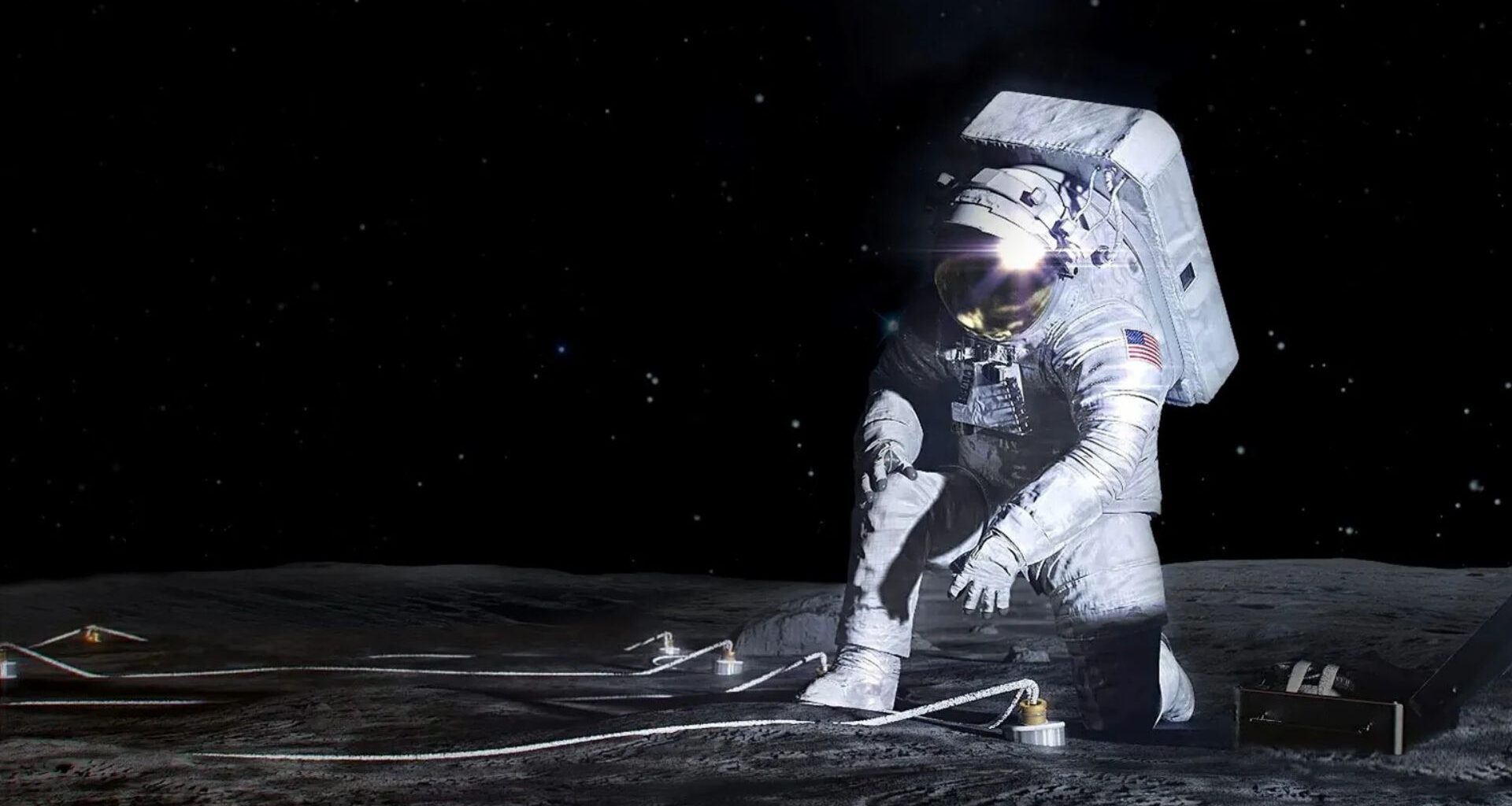
Space travel has always had a luggage problem. If you want to breathe, drink, or move on the Moon, you have to bring every molecule of it with you from Earth.
NASA’s latest testing indicates a shift in deep-space strategy. Instead of hauling every liter of life support from Earth, future explorers might be able to simply harvest the lunar landscape.
NASA’s Carbothermal Reduction Demonstration (CaRD) team recently hit a massive milestone.
Using nothing but concentrated sunlight and simulated lunar dirt, they successfully extracted oxygen. It’s a literal “breath of fresh air” for the Artemis program.
This reduces the need to transport heavy supplies from Earth, making long-term lunar stays more affordable and sustainable.
The test confirmed that solar energy alone can drive the chemical reaction needed to produce carbon monoxide, a critical precursor for generating oxygen and fuel.
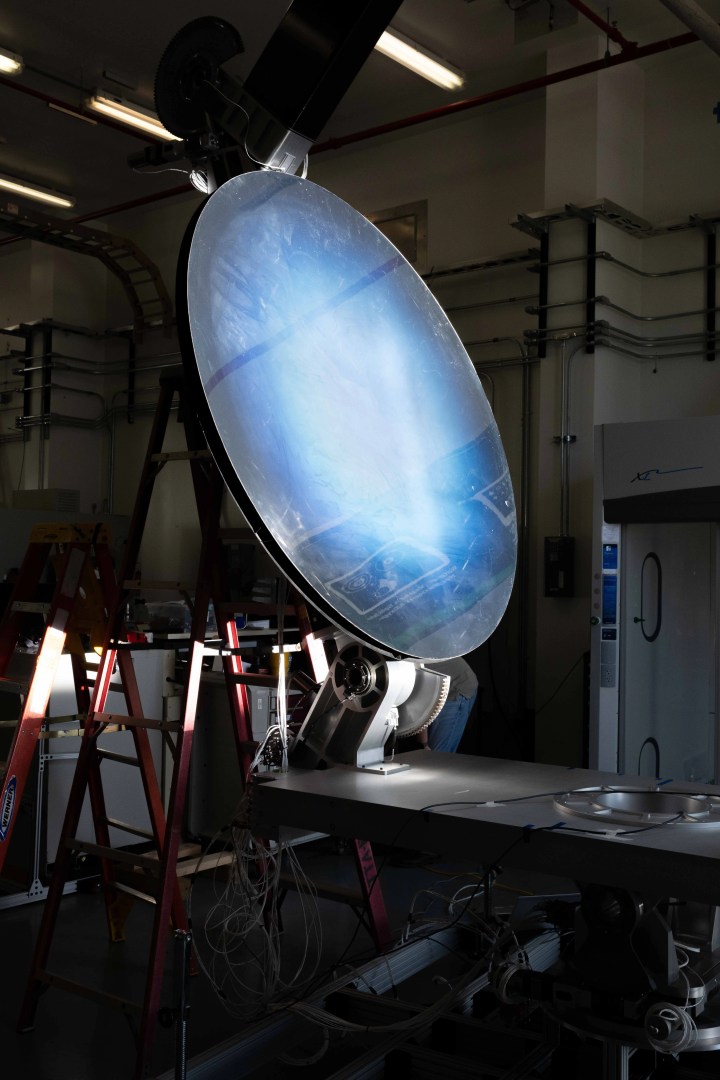 A solar concentrator is tested as part of the Carbothermal Reduction Demonstration (CaRD) project. Credit: NASA/Michael Rushing
Harvesting the grey dust
With resupply missions from Earth being rare and costly, NASA is prioritizing In-Situ Resource Utilization (ISRU).
This “live off the land” strategy allows astronauts to harvest local lunar and Martian materials to produce air, water, and fuel.
The concept is simple, yet the execution is pure rocket science. The lunar surface is covered in regolith — a fine, abrasive powder.
While it looks like dry ash, it is chemically rich in oxygen trapped within metal oxides. The Moon gets a regular delivery of oxygen from Earth’s magnetotail — the tail-end of our planet’s magnetic field.
Particularly, lunar regolith is nearly half oxygen by mass, though it remains chemically locked within silicate minerals.
NASA has now proven that carbothermal reduction can effectively break those bonds, transforming common moon dust into a life-sustaining resource.
The testing used a solar concentrator, precision mirrors, and advanced control software for processing lunar soil simulant.
To unlock it, the CaRD team used a solar concentrator to focus energy into a specialized reactor. The heat triggers a chemical reaction that strips the oxygen away, leaving behind carbon monoxide as a byproduct.
“The CaRD team performed integrated prototype testing that used concentrated solar energy to extract oxygen from simulated lunar soil, while confirming the production of carbon monoxide through a solar-driven chemical reaction,” NASA wrote.
No resupply needed
Transporting fuel and air into orbit costs thousands of dollars per pound. By producing propellant and oxygen on the lunar surface, NASA can slash the cost of long-term missions.
The technology is a two-for-one deal. The same systems used to process gases on the Moon can be tweaked for Mars. On the Red Planet, this hardware could convert a carbon-dioxide-rich atmosphere into breathable oxygen and methane, fueling the trip home.
The project was a collaboration between various organizations. Sierra Space built the reactor, while NASA Glenn and Composite Mirror Applications supplied the solar tech to capture energy.
Meanwhile, NASA Kennedy provided the electronics for analysis, all coordinated by NASA Johnson’s systems engineering to ensure these specialized parts worked as one machine.