
“Both, And” is a story about two girls. The first one, Yasmin, was born with her whole future mapped out. She was the daughter of a wealthy publishing magnate. She wasn’t born to be proficient at any occupation; she was born wealthy, so wealthy her father named a yacht after her, so wealthy it opened every door for her. She was a beauty: The type of it-girl that is admired in society pages and becomes a mood board for the women of the next generation. For the first 21 years of her life, she was this spoiled rich girl, private school bred, multi-lingual, knows how to wear a cocktail dress and fun at a party, the ultimate showpiece at her father’s events. She was in constant danger around her father and his predatory men, which trained her to live for their approval.
The second girl, Harper, was born into a humble family in upstate New York, to a mother who withheld her approval and love. We never quite get to see the emotional abuse this mother inflicted, but we see the scars she left on Harper and her twin brother. It teaches the young girl to be a lone wolf, never letting anyone get close enough to hurt her as she was once hurt. She writes a term paper on the “moral right” of capitalism (or Darwinism). The pressure of being a success, being pushed down her throat by her mom, turns her brother into a shell, too scared to be ambitious; it does the opposite to Harper, hardening her to the point where she pushes her brother away, everyone away, and drives hellbent towards her revenge fantasy, towards a level of success that will break her mother, always just beyond her grasp.
The two girls meet at Pierpoint, the British investment firm that each sees as the conventional portal to success and freedom that will spring them from their childhood trauma. One is clearly there because of her last name and her natural affinity for the client side, a carrot waved by the investment bank as the ultimate perk of doing business. The other is a maverick, using her intellect and identity as a Black woman as motivation in a white dominated field. It’s her ace in the hole, her hunger. She is restless, always looking for an advantage as her competition waits, spoiled and complacent, fattened by generations of ill-gotten rolled hundred dollar bills they have no reason to expect won’t be presented yet again on a silver platter for them to blow lines off. Her greatest champion, mentor and tormenter is her Asian boss, who she bonds with over being a minority in a white male field and the lonely life that comes with that awareness. The girls become fast friends, each seeing something they want in the other. Harper covets Yasmin’s white beauty and privilege, Yasmin covets Harper’s mind, force of will and independence. They both go through their share of harassment in a trading floor pen of pigs: Their clients and bosses and peers, everyone in this world wants to take something from them. This bonds them and splits them apart, in a constant state of attracting and repelling one another, hurting one another when it suits them but always having that love and admiration and desire lingering, stuffed deep down.
The girls are beefing, distrusting, resenting one another, hating one another, hurting each other with razor sharp words and open palms as sisters who know each other well enough to easily draw blood with these weapons. Yasmin knows Harper is both broken and selfish; Harper knows that Yasmin is a spoiled brat who hates herself as much as Harper hates herself. That they’re both always lonely. They bounce around professionally, from desk to desk, company to company, in search of freedom, in an industry where Yasmin doesn’t have the instincts or acumen to succeed and Harper doesn’t have the social skills, until she finally reconnects with her mentor, who will pave the road for her plow.
Sometime later, Yasmin’s father reaches out for the estranged daughter and a friend to come vacation with him on the yacht named after her. Yasmin fatefully invites Harper, because who knows if she even has another friend? Her father promptly reminds her why they’ve been estranged, how depraved and sick he is, how badly he’s damaged her. They begin to fight and her father locates all the ancient pressure points Harper also knows and loves. They both know how to hurt her like no one else, for her lack of talent, lack of niche in the world that doesn’t come chained to the privilege he bestowed upon her. When she pushes him away, he jumps off the yacht. She lets him drown. Harper, for once, is there, selflessly, to comfort her in her darkest and most vulnerable moment. Yasmin is free but like all her freedoms, it came cheap, unearned, and tied to ghosts.
Later, Yasmin has settled on a marriage that replaces the wealth and power of her publishing baron father with a publishing baron uncle and his nephew, afflicted and haunted in a way Yasmin should understand. It’s perhaps the role Yasmin was born to play. She becomes an influencer in the old fashioned sense of the word, turning the family manor into a place where politicians, titans of business, and socialites network and make deals over martinis. At one of these events both Harper and Yasmin meet a scammer who seduces them both. Harper sees (or perhaps) fucks through the illusion, Yasmin takes the bait. Their fortunes turn on this moment, their ability to read the lie in front of them. It will make Harper’s career and shatter Yasmin’s semblance of a life and marriage. She is left with no clear place in the world, without any clear direction or support. What will she fall back on?
Many months later, Yasmin is back doing what she knows, hosting a party, selling narratives, taking all the tools the scammer taught her and using them to build herself up, this time without the paternalistic control. It’s her party at last. Harper begins to see who her friend has become, consorting with Nazis and weak depraved men and underaged prostitutes- including the girl the scammer used to destroy Harper’s mentor. It’s the cohort Yasmin grew up around and was ruined by. Now they will drink her wine, and fuck her women and she will tape them, and she will bleed them, and she will own them.
She has become a member of the ruling class, and all her seat at the table cost was her soul. She has become a pimp. She is Ghislaine Maxwell. Harper doesn’t understand how Yasmin could debase herself like this, or at least pretends not to, but she does, because she’s seen the entire sad trajectory, as have we. “I’m necessary”, Yasmin tells her, black eyes reflecting candlelight, walking into hell sober with a confident smile on her face. Harper once told her that the world shows you what it is. Yasmin listened.
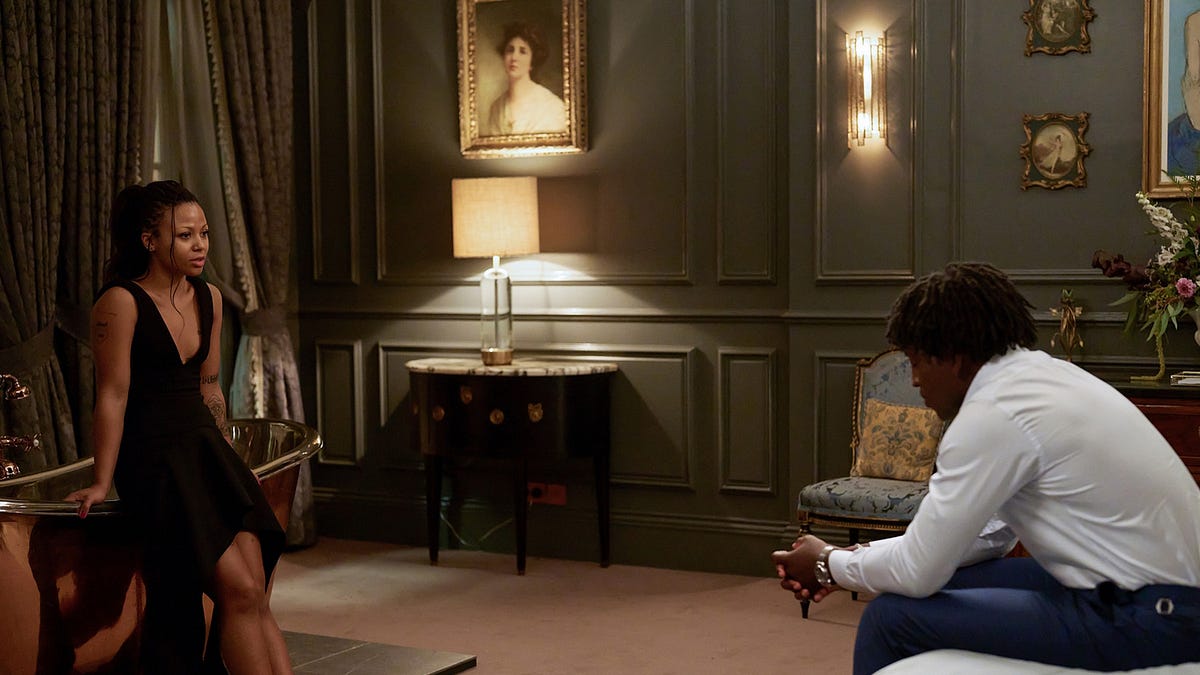
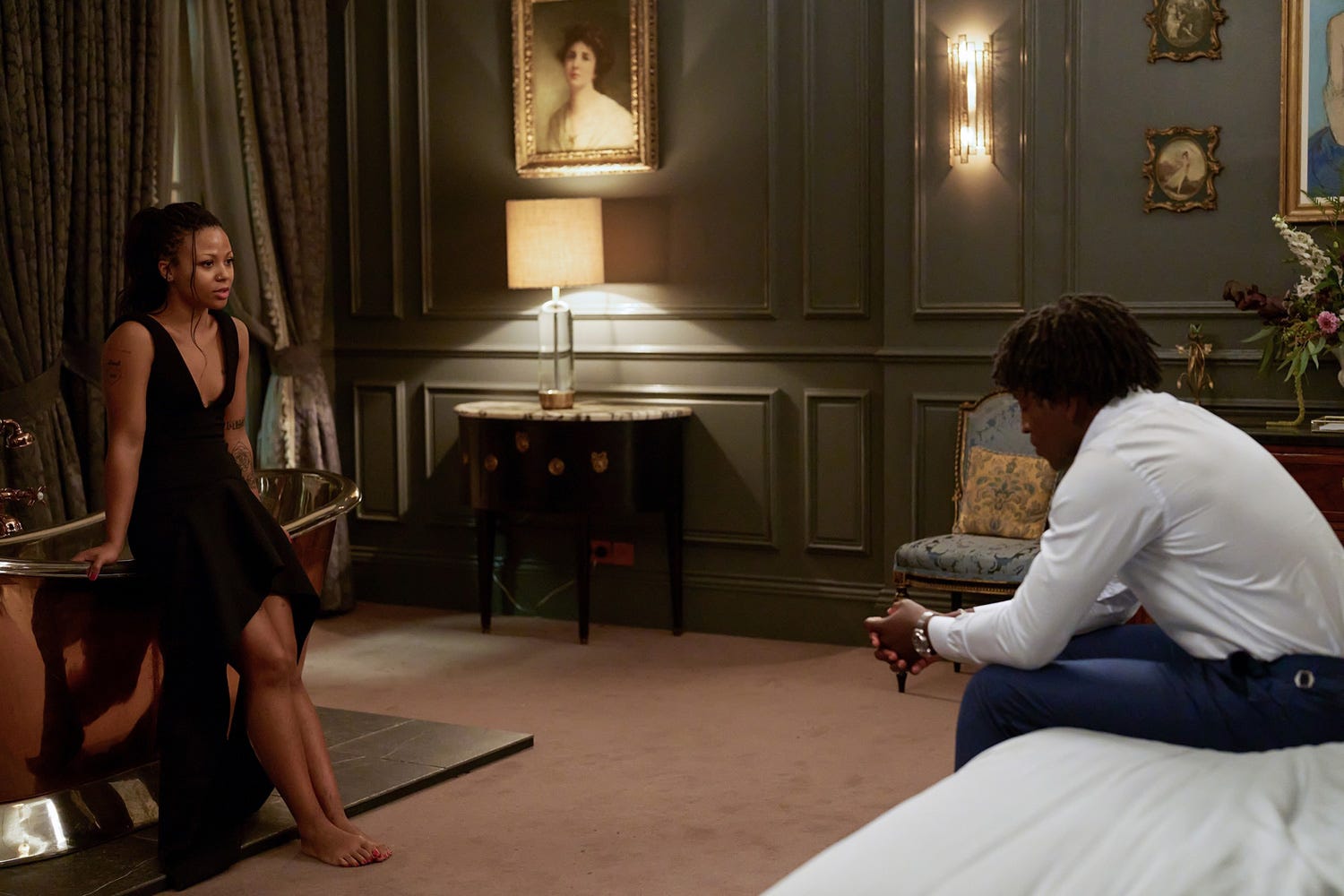
We close on Yasmin in her hotel suite. She is alone, replaying the voicemail message from her father, tormenting herself near catatonic on the floor, listening to the invitation to get on the yacht that will kill both her and her father on repeat. She is ruined, drowning in that voice that determined her life before it could begin in earnest. She is utterly, completely alone.
….And now! As always let’s have a little bit more Claret with Abe Beame! Abe, how you holding up?
Abe: Well Jayson, I wish I could say the Maxwell angle was the shit I expected, but sharp eyed viewers and people who have read the Epstein Files more closely than I have were onto the tragic end of this season long before I was. It was a truly crushing episode. So I’ll give readers a peak under the hood here, there is much debate as to what we actually just watched. Aside from the final line, which was a blatant jack of/homage to the Mad Men Season 5 finale, let’s compare notes, lightning round style, before we hash out how we feel about any of it:
So we disagree on Lord Muck’s final beat. I see it as a supremely tragic ending for Kitt Harrington, great again here, “reclaiming his soul” by tapping into his utterly gross English sense of caste superiority over Whitney. But we read that fishing expedition differently. On a golden pond with Lord Norton and Otto Mostyn, Henry is very much relapsed, unashamed of drinking and popping lithium in front of both his puppetmasters and destroyers (and just as a sidebar, Lord Norton’s entire motivation for the final act of this season is kind of lost on me. I don’t have any nephews nor a media empire at my disposal, but no matter how they conduct themselves, I like to think I wouldn’t shank him at the bidding of the wife he’d been with for a year or two because they weren’t getting along). Henry’s ironic theme song all season, from the HMS Pinafore is blaring, and he’s so fucked up he figuratively and literally can’t reel his own rod. This is a guy who was a few votes shy of the seat that a now ascendent Jennifer Bevan ended up with at the outset of this season. He was a man of grand ambition to whom much was promised in England for centuries. To me he’s left as a near lobotomized Fredo figure, an infantilized and emasculated man child cursed to wind down his years crushing pills with work boots on pianos in the museum he lives in, possibly before following in his father’s footsteps. Tell me what I’m missing.
Jay: It is possible that the low opinion that I have of Henry Muck is affecting my ability to see what you’re seeing in the final scene. There’s obviously the milligrams of Lithium that is in his right pocket, there’s the beer that he is drinking in order to take it, and there’s the Uncle above his shoulder, watching his consumption sadly. There’s also an exuberance, a cheerfulness in this scene and it is something that we have not seen from Muck all season. He is back home, with the men who have raised him, the men who — despite all of their evil — are the very people who have cared for him his whole life. Maybe he is just destined to be this. He’s finally comfortable in failure and defeat. Not everyone is a titan in their field; some rich boys are meant to fish with their male authority figures (and the world is better for it!). But another point we’ve debated is with about ten minutes left in the episode, Harper and Kwabena have a conversation that answers my question in the back and forth last week. When will Harper try to solve the problem of her?
Abe: I mean, we part on the question of is this actually Harper “solving anything”? It was the most ambiguous moment, even more than the Weiner ending. It started as a breakup, then sounds like an easing of hostilities in tone, but the final beat of the conversation is Harper essentially holding her ground.
Harper: I just want to protect myself
Kwabena: Not at the cost of everything else Harper, that’s too high a price.
Harper: No it’s not. It’s not for me.
She is looking up at Kwabena with eyes that say she wants to give in and stop fighting, and he ends up back on the plane (where the season ends with another journalist, who should’ve been Jim Dycker, who gave his life to deliver Harper’s game breaking short) but it’s their last words to each other this season. I don’t know, I think it’s a great call by the writers room to leave it up to us to decide (and give themselves the wiggle room to take that moment in either direction next season). But if I had to read that conversation, I think Kwabena is out of her bed, if not the fund (I hope Mickey and Konrad have more sense than to squander yet another great performer in Toheeb Jimoh).
Jay: Harper is lonely and doesn’t seem to fit in anywhere she goes. People she thought were constants in her life are now either cozying up with Nazi’s or have been forced out by scammers because of their own weaknesses. Her opening up to Kwabena is almost Harper conceding her loneliness. I’m not sure if they break up; I actually wonder if Harper was asking him to be her life partner. She can’t find anyone else; this, even though it is almost loveless, will have to do. It’s the cost of being a Black woman in a business of people who “want to skin her alive.” What are your final takes on this season and the (recently extended) future of Industry?
Abe: I genuinely was semi-surprised when HBO announced the season 5 renewal this morning. The show is a big fat fucking hit that has dominated the cultural conversation for two months, so not surprised from the network side of the equation, it was a matter of common sense. But as usual, Konrad and Mickey designed yet another season finale of Industry that works as a series finale. Down to the character, everyone got a perfect, if completely fucked up send off, and once again I’m fascinated to see where this goes because to me this is a moment where you either end the show or completely reimagine it to run for 20 seasons (I’ve made this joke before but Myha’la is…..THE SHORT SELLER!!! would’ve made for a classic TNT NBA Playoffs ad that ran incessantly). We have been given every impression it’s curtains for Rishi, Ken Leung’s long walk home certainly felt final, Muck has gone fishing, and now you’d imagine Yasmin is done (Marisa Abela celebrated the renewal, but I’ll be honest, I’m not stoked for where that character seems to be inevitably headed and wish that last beat was her goodbye). So what are we left with? Harper healing? The Harper reckoning? Gus and Rob return to take Silicon Valley by storm with their legal shroomz startup? For the team to write themselves out of yet another corner and deliver a satisfying final season arc seems crazy with the board all but clear, but they do this every year and every year what they come back with is riveting. But I’m throwing up my final lob, (and I thank every reader for following along on this extremely fun and challenging journey all season, before walking off down my own tree lined suburban Flatbush street whistling) where do you see this all heading?
Jay: One of the themes this season was about finding your place, a place. So many characters in season four consistently struggled with that. It isn’t only those born wealthy, it is those who earned their riches, achieved against all odds to become outliers. It’s poor con artists who refuse to accept their lot in life. It’s people pushing back against their privilege. I loved Sweetpea in Ghana, figuring out the scam, becoming Erin Brockovich in even greater danger. I loved Harper admitting that all she’s ever wanted was to prove to her mother she’s undeniable. Goosebumps started to develop on my skin from being seen on television. This season understood the price of constantly searching, doing things your own way, is that you find yourself alone quite a bit. Yasmin is alone, even though she has made herself necessary, it’s to the white power structure she was born into and is now stuck inside of, in a gilded prison of her own making. It is by far the most heartbreaking season since season two, bigger, better, and more devastating than Yasmin’s crisis in the third season. The ending of this season, with this girl who was so vibrant, full of charisma even in her worst moments, crush to a cynical husk, would make a fitness freak sick to their stomach. Her thought that “everyone is capable of being a beast and all I am doing is playing a role” felt honest, how most people who are sucking up to the power structure think. Industry explored that this season and they earned their biggest hit so far because Mickey and Konrad weren’t afraid to pierce into that darkness. It is hard not to think of every Epstein rumor we see online when Yasmin is on the ground, listening to voicemails of someone she will never see again, whose prophecy she fulfilled. I’ll never forget that scene. It’s as arresting as anything I’ve ever seen on television. Oh, man: Industry will leave us and we will be worse off from it.
Thank you everyone for reading: Abe, it has been such a pleasure doing these recaps with you because you have the same passion for this great, dynamic, diverse show as I do. To the readers, it would not be the same if people did not encourage us. The passion that I see for this show online inspires me to continue grinding, unable to wait for Sunday night so I can drop these reviews and compare notes, see what everyone thinks of the moments that Abe and I couldn’t stop texting each other about.
We wouldn’t want to be any of these characters, though we recognize some parts of them live within all of us, and some of them have now become people we do not wish to recognize. But what makes great television is we can’t live without them.