

Since childhood, books, photography, and travel have been part of my world. Fascinated by life, by the stars, by landscapes that tell stories without a single word, I quickly realized that I needed to express what I saw and felt.
Passionate about the world around me, I first pursued a degree in History at university, driven by my fascination with the stories of the past and the great civilizations that shaped our world. But over the years, another truth became clear: I didn’t want to spend my life in archives or research. I wanted to be out in the field, behind a camera or in front of a microphone, sharing what I learned.
So, I took a new path. I chose journalism, to learn how to tell stories differently—with rigor and clarity. I learned how to write, to interview, to edit, to capture both attention and emotion.
Giving meaning and sharing what matters
Since then, I’ve worked across different media: print, web, radio, television, and video. All of this has allowed me to bring to life topics that matter deeply to me: nature, animals, space, and the major environmental and human issues of our time.
Today, I continue my journey as a journalist at Futura. As part of the editorial team, I strive to share knowledge with curiosity, clarity, and passion. My guiding thread? To make visible what deserves to be seen, understood, and shared—and to keep my sense of wonder alive.
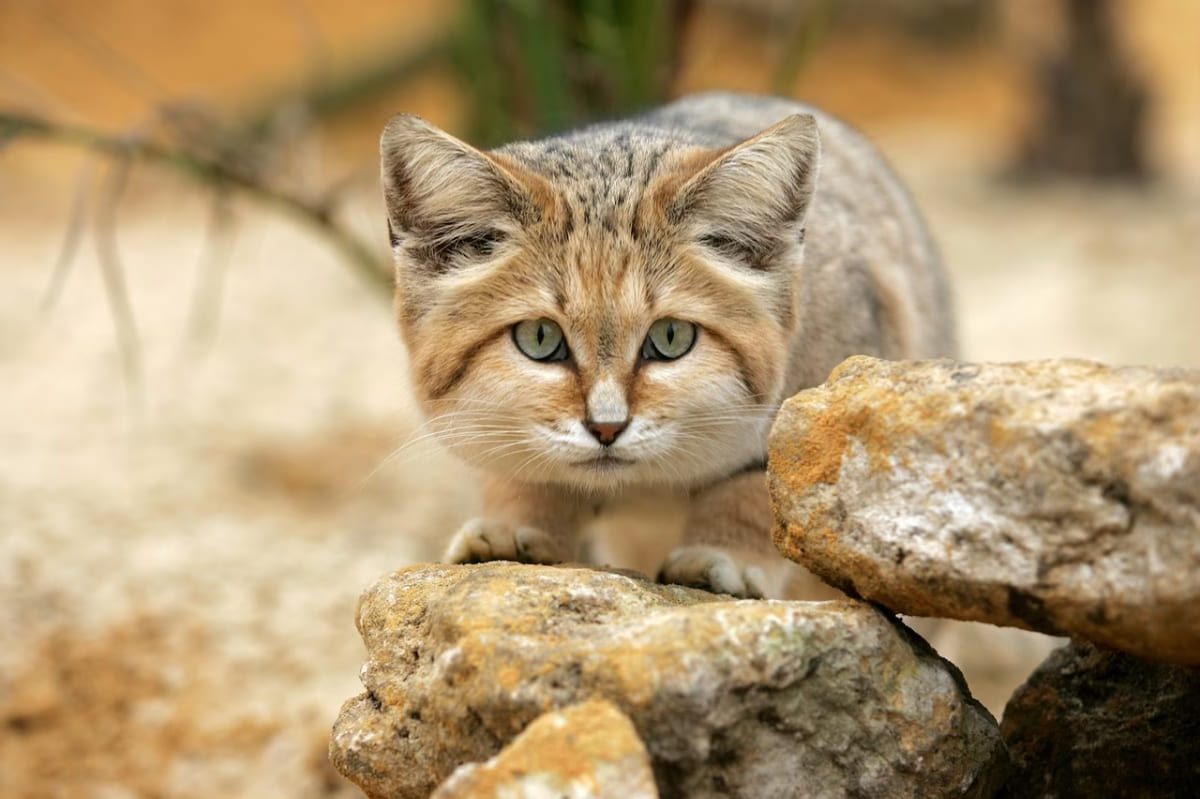
The sand cat (Felis margarita) is one of the smallest wild cats in the world. Its body measures just 18 to 22 inches in length and weighs a mere 2 to 7 pounds. Its relatively long tail adds another 11 to 14 inches to its compact silhouette.
But in the arid landscapes it calls home, that small size is an advantage. In fact, it is the only feline species that lives exclusively in sandy deserts. To avoid the crushing daytime heat, it is strictly nocturnal. Once night falls, it comes alive, guided by an exceptionally sharp sense of hearing that allows it to detect prey moving beneath the surface of the sand.
Its menu includes spiny mice, gerbils, jerboas, small birds, young hares, and sometimes reptiles. In the Sahara, it can even take on sand vipers. In an unusual behavior for a cat, it may bury its prey to return to it later.
Invisible but highly effective adaptations
The sand cat is also an accomplished digger. It burrows into the sand to escape extreme temperatures and skillfully unearths hidden prey with impressive precision.
One of its most remarkable features is its paws. They are covered with long, dense fur that acts like natural insulation, protecting it from scorching sand while muffling its movements. This clever adaptation also leaves very few tracks behind, making the animal extremely difficult to monitor in the wild.
Its ability to remain nearly undetectable explains why, despite its wide geographic range, it is still relatively little known to scientists. Tracking it across vast desert expanses is no easy task when it leaves barely a trace of its passing.
The mystery of the barking cat
A solitary creature by nature, the sand cat only seeks out others during breeding season. But finding a mate in the immense, open desert presents a challenge. To overcome this, it produces a surprising call – a short, powerful bark that has been compared to that of a small dog or even a seal.
This unexpected sound carries across long distances in a landscape where visual landmarks are scarce. Combined with its acute hearing, the bark allows individuals to locate one another in an environment that offers little cover and few reference points.
Today, the species’ distribution remains fragmented and difficult to measure precisely. It is primarily found in desert regions stretching from Morocco across the Arabian Peninsula, as well as in parts of Central Asia, including Pakistan, Kazakhstan, and Syria.
Elusive, expertly camouflaged, and astonishingly well adapted, the sand cat is a quiet reminder that the most effective predators are not always the largest or most imposing. Sometimes, survival depends not on strength, but on specialization – on evolving precisely the right tools to thrive where almost nothing else can.
In a world that often celebrates size and spectacle, this tiny desert hunter proves that subtlety can be just as powerful.