
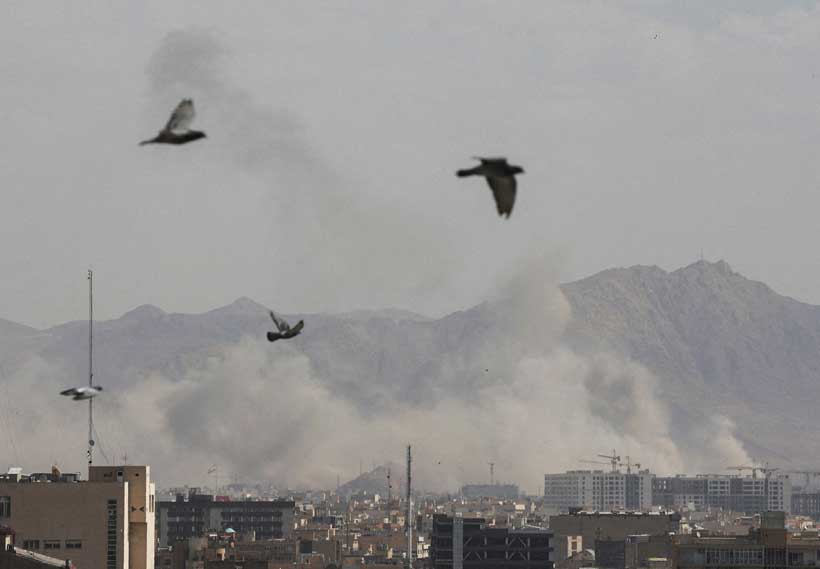
The Iran-Israel-US war that erupted on February 28, 2026, has fallen into the world division in an extremely shocking way. While it may seem easy at first glance to determine the sidelines of the war, the conflict process orchestrated by US President Donald Trump is a geopolitically very attractive point of interest.
Aircraft Carriers and “Controlled Chaos” Diplomacy
Following the February operations, CENTCOM, which conducts US operations in the region, announced the deployment of the USS Abraham Lincoln Carrier Strike Group to the Middle East with the goal of “contributing to regional security and stability.” Although this move was presented as a “precautionary measure” in response to ongoing protests in Iran, it proved that the February 28 war was part of a plan orchestrated from the Israeli side.
The main issue is the fact that Trump was directly involved in a war without the approval of the US Congress. Trump chose the path of engaging in the war by pitting two powerful forces against each other and then supporting Israel, thus overcoming the Congressional obstacle. It is possible to say that Trump had already extended the harsh offers that Iran would make in response to Israeli attacks. Indeed, the first airstrikes were directed at Iran, primarily targeting US forces in the region, in other words, to “multiply the offensive.”
March 1st Night: A Coup Against the Leadership and a Test of Defense
On the night of March 1st, the course of the war changed radically. The deaths of former Iranian President Mahmoud Ahmadinejad and Supreme Leader Ali Khamenei as a result of US-backed airstrikes directly turned the conflict towards Tel Aviv. In his assessment on CNNTürk, International Relations Expert Dr. Cihan Günyel emphasized that this was the biggest test of the Iron Dome since the Twelve-Day War. The fact that even the house of Alona Sa’ar, daughter of Israeli Foreign Minister Gideon Sa’ar, was damaged shows that the current Israeli defense doctrine is now eroding. The continuous missile waves throughout the night, affecting Haifa and Tel Aviv, and the US announcement of Khamenei’s birth to the world without confirmation from Iranian authorities, prove the prominence of psychological warfare. Furthermore, the fact that six US Air Force refueling planes charted a course to Ben Gurion Airport during the night clearly demonstrates the increasing intensity and logistical preparation of the war effort.
The “Iranian Valve” and the Russia Factor in the Energy Equation
Since the energy of the 1990s, the US has been at the very heart of the tensions generated by energy in the Middle East. The way Russia uses the “energy card” in the current Russia-Ukraine war is being replicated by the US in the Middle East today.
As emphasized by International Relations Expert Dr. Barış Adıbelli, the hypersonic missiles used by Iran are a product of military cooperation between Russia and Iran. It is possible to speak of the transfer of this technology as a quid pro quo for Iran’s support of Russia in the Ukraine war. However, the most fundamental goal in this big picture is Trump’s desire to take control of the “Iran valve.” This war is not just a security issue, but an effort to redesign global energy capacities.
Türkiye’s Role and the Issue of Antithesis
One of the most striking details of the war is that while Iran attacked all American bases in the region, it excluded Incirlik Air Base from this action. This shows that the deep connections between Ankara and Tehran are still in place. Turkish President Recep Tayyip Erdoğan stated that the attacks were carried out “at the instigation of Netanyahu,” and expressed “deep sorrow and concern” over what happened. While President Erdoğan harshly criticized Israel’s policies that were thrown into the fire, he also took a stand against Iran’s missile and drone attacks on Gulf countries, deeming them unacceptable. Türkiye’s stance on this point can actually be explained by its being a cultural and political antithesis to Iran. These two actors, quite different in terms of their regime structures and state ideologies, have been in a rivalry since the 16th century. However, Türkiye’s modern statecraft and capacity for influence are far superior to those of Iran. In this crisis, Türkiye is demonstrating its unique strength by acting both as a peace envoy and by preserving the stability of the region.