
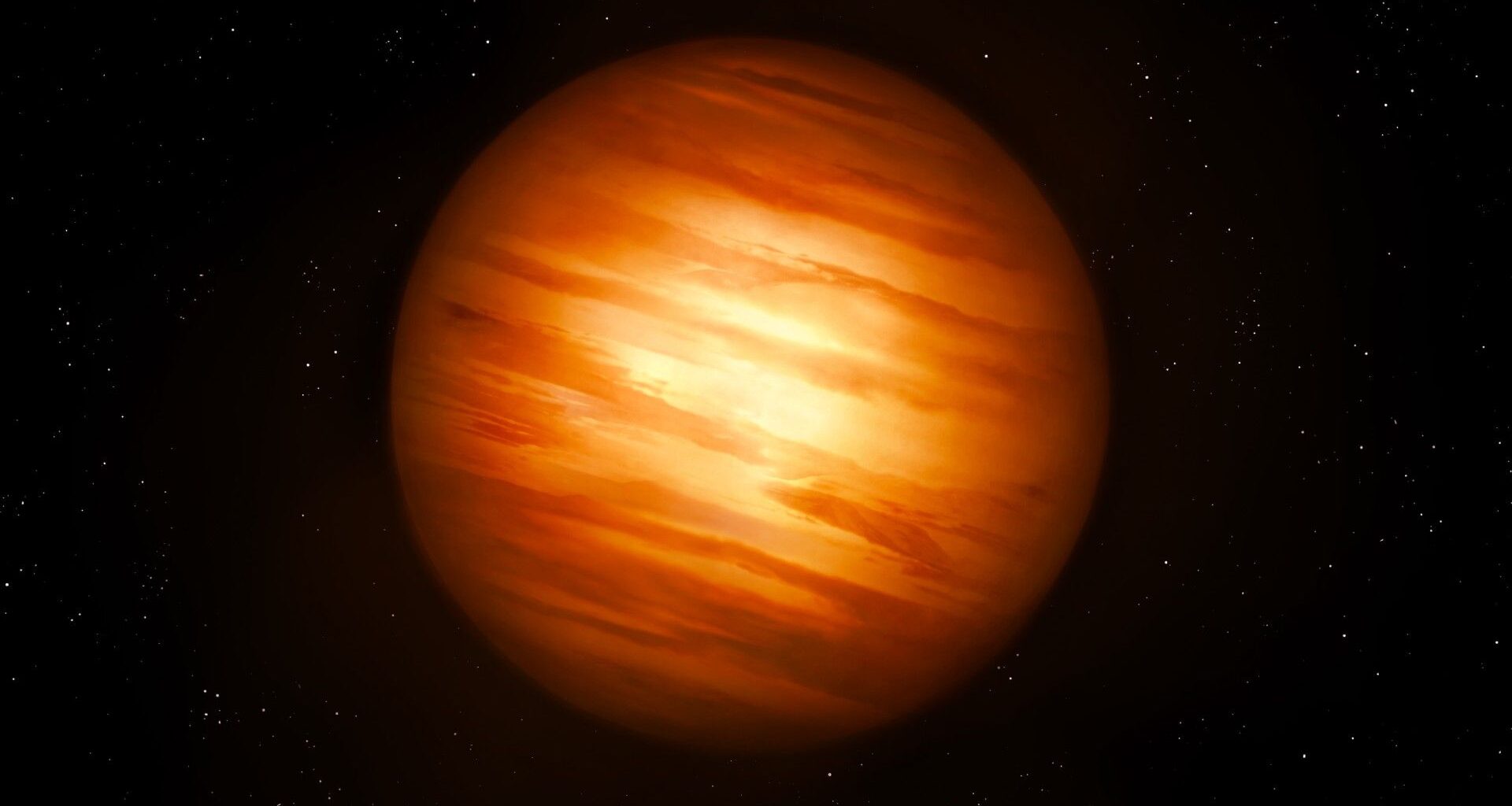
Many astronomical objects play by clear rules and fit into neat categories, but brown dwarfs (celestial objects too massive to be mere planets, but too small to be real stars) continue to refuse to cooperate.
Astronomers recently studied a sample of 70 objects, ranging from Jupiter-mass planets to brown dwarfs that are right on the brink of stardom. By looking for a relationship between the mass of these objects and certain features of their star systems (like whether the host star contained elements heavier than helium, or how round the objects’ orbits were), the researchers hoped to draw a clear line that divides massive objects that form like stars and smaller ones that form like planets. But they were destined for disappointment, because the actual universe is messy and complicated.
You may like
Planets and stars form differently — except for that group in the middle
Stars, by definition, boast at least 80 times the mass of Jupiter, and they form from the outside in. When a clump of gas in a molecular cloud collapses under its own gravity, the densely-packed atoms at its core start fusing together, releasing heat and light; a star is born.
Giant gas planets of sizes up to about Jupiter’s mass, on the other hand, form from the inside out. First, a few grains of dust clump together in the disk of material around a newborn star, and their combined gravity is enough to start attracting even more dust. Material keeps piling on, faster and faster, building up a rocky core surrounded by thick layers of gas.
In between, however, there’s a whole slew of objects that astronomers aren’t sure whether to classify as “failed stars” or “overgrown planets.”
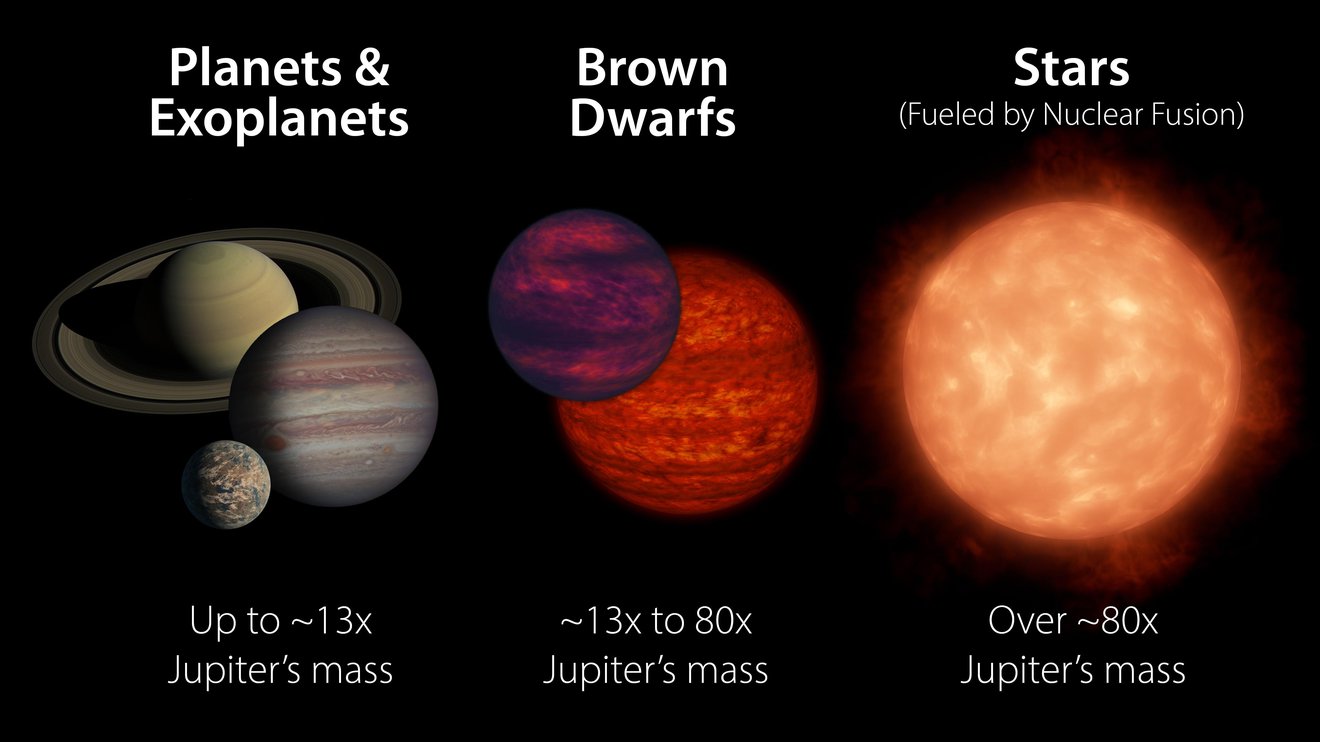
A size comparison between planets, brown dwarfs and the smallest stars. (Image credit: NASA/JPL-Caltech)
At between 13 and 80 times the mass of Jupiter, brown dwarfs aren’t quite massive enough to fuse hydrogen into helium like a real star, but they’re just big enough to fuse deuterium, an isotope of hydrogen that includes a neutron along with the standard proton and electrons. (Weirdly, deuterium requires less pressure to fuse into helium than straight hydrogen does.) And then there are “sub-brown dwarfs,” gas giants which are truly gargantuan by planet standards, but they’re not quite large enough to be proper brown dwarfs.
Ideally, there should be a clear line: objects above a certain mass should be failed stars that formed from collapsing gas clouds, and objects below that mass should be overgrown planets that coalesced from planetary disks.
So far, though, astronomers haven’t had much luck finding any such line.
In 2024, astrophysicist Steven Giacalone, one of the coauthors of the current study, found a brown dwarf that seemed to have formed by core accretion, making it basically the biggest planet ever. And some sub-brown dwarfs — gargantuan planets not quite big enough to count as brown dwarfs — seem to have formed by gravitational collapse, which means they failed so hard at being stars that they couldn’t even make it as brown dwarfs.
You may like
“Exactly how large of an object can be formed by core accretion or how small of an object can be formed by disk instability or cloud fragmentation remains to be determined,” wrote Gilbert and his colleagues in their recent paper.
“Perhaps … we have not yet examined the right combination of parameters”
Gilbert and his colleagues used statistical models to test how their objects’ mass related to the chemical makeup of the host stars and the shape of the objects’ orbits.
Looking at these objects’ orbital eccentricity (a measure of how close to a perfect circle an orbit is) tells pretty much the same story. Less massive objects tend to have rounder orbits, while the most massive, brown-dwarf-like of these objects vary more in their eccentricity. However, Gilbert and his colleagues noted that the trend was very gradual.
“We may reasonably assume that as the mass of an object increases, the likelihood that it formed via core accretion drops and the likelihood that it formed by gravitational instability [a gas cloud collapsing in on itself] rises,” the researchers wrote in their recent paper, but it’s more of a spectrum than a clean sorting of objects into two groups.
And then there’s metallicity. A planet can only accrete enough material, quickly enough, to grow into a gas giant if it forms in a star system that’s very metallic — meaning that it’s chock-full of elements heavier than helium (mostly carbon, oxygen, and iron). So if there were a clear dividing line between more massive objects formed by collapsing molecular clouds and less massive objects formed by accretion, researchers like Gilbert and his colleagues would expect to see smaller sub-brown dwarfs forming only in metal-rich star systems. But that’s not what Gilbert and his colleagues actually saw in their data.
Instead, it seems that there’s no relationship between the mass of a gas supergiant and its star system’s metallicity. That suggests that some of these objects formed by core accretion, while others formed more like stars — with the same end result and, often, the same mass. Which means right now, we can’t tell by looking whether something is a failed star or a wildly successful planet.
“Perhaps a clear dividing line between formation channels does exist, but we have not found it yet, either because we do not have enough objects or because we have not yet examined the right combination of parameters,” wrote Gilbert and his colleagues in their recent paper.