
Petrol retailers across the nation are being accused of “unconscionable” behaviour by preying on people’s anxieties as fuel prices surge in the midst of the Middle East war.
Economists are warning Australian petrol prices could rise by 40 cents a litre in coming weeks as the conflict in the Middle East escalates, disrupting the flow of crude oil through the Strait of Hormuz.
In Perth, thousands of motorists across the city lined up along streets to get fuel last night, the cheapest day in the city’s weekly fuel price cycle.
Many fuel stations across the city are selling fuel well above $2 per litre today, higher than than the daily average of 188.7 and the February average of 164.5c.
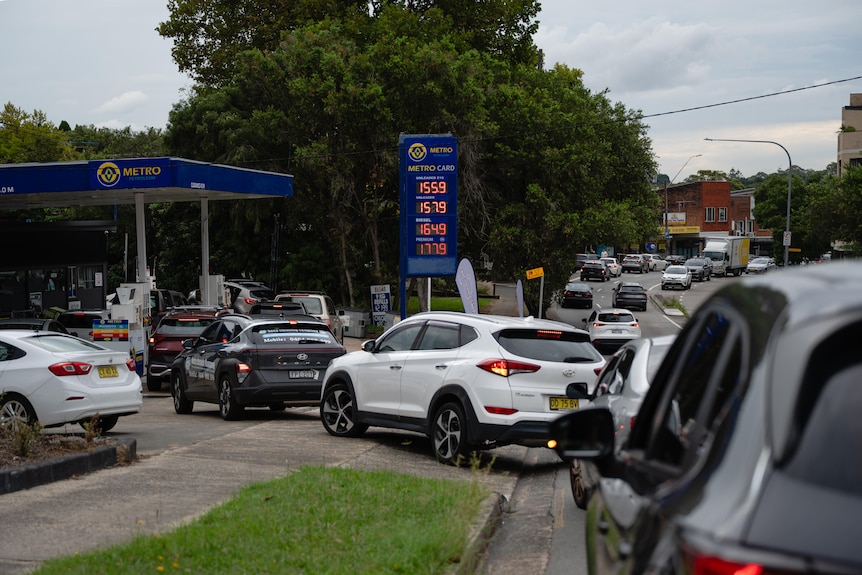
The price of petrol is expected to surge across the country, but stocks are expected to remain steady. (AAP: Sarah Wilson)
WA Premier Roger Cook said there was no need to panic buy, but had a strong message for fuel companies.
“Do not put up your prices simply because people are worried about their future,” he said.
“You have sustainable supplies of fuel for the moment.
“It is unforgivable and not on that you are taking advantage of people’s anxieties.”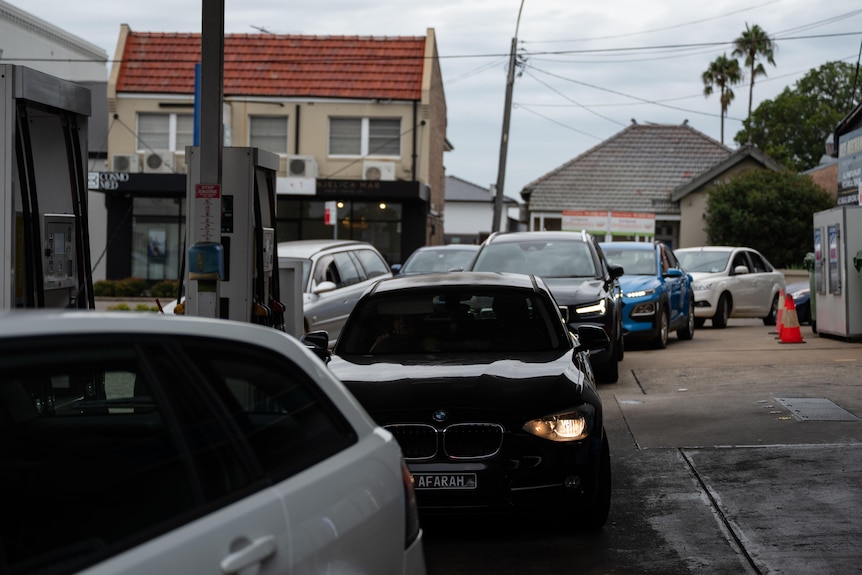
Cars pile into a service station in Sydney yesterday. (AAP: Sarah Wilson)
Meanwhile, Queensland’s peak motoring body announced it would refer major fuel retailers to the Australian Competition and Consumer Commission (ACCC) for “unconscionable conduct” after raising prices just days after conflict began in the Middle East.
RACQ economics specialist Ian Jeffreys described the price hikes as an “unjustified” cash grab.
“We believe there is no good reason why fuel companies should increase their prices at this time,” he said.
“We are concerned that fuel companies may be taking advantage of motorists, especially at a time when there is heightened anxiety and increased worry about the state of the world.”Loading…
In the past 24 hours, more than 210 petrol stations across South East Queensland increased their prices to 219.9 cents per litre — the highest in weeks, despite the price cycle being expected to hit a low.
“There’s plenty of fuel on its way to Australia, so there will be no supply problems,” Dr Jeffreys said.
Sydney, Brisbane, Melbourne ‘manipulated’
Insurer NRMA spokesman Peter Khoury also accused oil companies of putting up prices higher than they needed to in Australia’s biggest cities to unjustifiably capitalise on the “catastrophic” situation in the Middle East.
Read more about the US-Israel war with Iran:
He said average prices were already at the top of the price cycle and had “absolutely ballooned” in the past day, with half of petrol stations at or above $2.17 in Sydney, $2.19 in Melbourne and similar in Brisbane.
“Yet again Australia’s three largest capital cities are having their price cycle manipulated and it is families who are paying the price and there is no doubt that this is being done because of what is happening in Iran, even though the wholesale price has only gone up 5 cents a litre,” Mr Khoury said.
“This behaviour needs to stop tonight, those prices need to go back down again and we are calling on the ACCC to step up.”
Motor Trade Association of WA chief executive Neil Le Febvre said the increased cost of filling up the tank of freight trucks would also likely be passed on to consumers.
“Everything’s freighted around Australia. Those prices go up, so, of course, the price of the product that we’re selling has to go up as well,” he said.
Tensions at servos
Courier driver Tash Woods said she witnessed a verbal altercation at a fuel station in Bunbury, south of Perth, when a person started to fill 10 jerry cans with petrol, as cars queued behind.
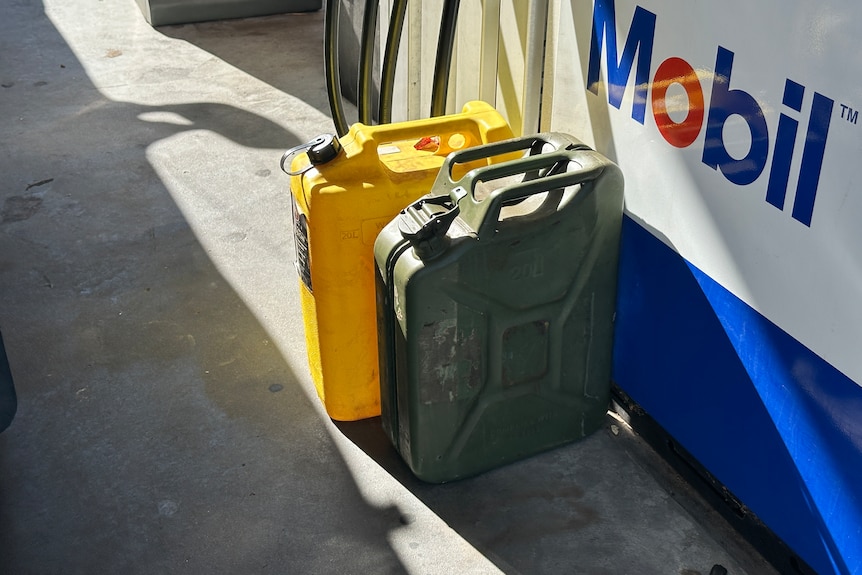
Jerry cans being filled up at a service station in Bunbury. (ABC News: Madigan Landry)
“There was a bit of a stand-off … I was shocked and I felt unsafe,” she said.
“Just calm down and be a bit more chilled and have a bit more respect for one another.”
In Perth on Wednesday, punters told the ABC they were lining up in their cars because they were not sure if they’d get a better price in the weeks ahead.

The ABC spoke to people lining up to fill their cars with fuel in Perth on Wednesday. (ABC News)
“I don’t know how long it will stay like this, tomorrow could be $2.50, I have no idea,” said one man.
“Other places are out of petrol, and others are running out of petrol very slowly.”
Another man said he had lined up twice to get fuel, after one station ran out.
But panic buying at fuel stations was risky and not necessary, warned the Australasian Convenience and Petroleum Marketers Association.
Its chief executive, Rowan Lee, said the majority of Australian oil came from Singapore, not the Middle East, so while prices in the market might rise, there would not be supply issues.
“[Also] your lag time is up to two weeks … it’s simply too early to see how this is going to play out,” he said.
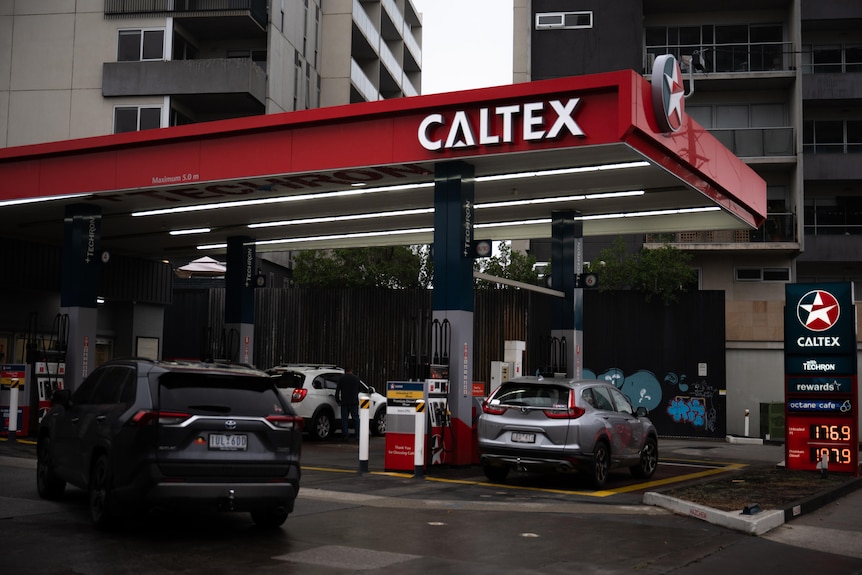
Fuel stations in Melbourne have also been inundated with customers today. (AAP: Jay Kogler)
Energy Minister Chris Bowen said Australia was well prepared to weather the instability to petrol supplies caused by the conflict in the Middle East.
The energy minister said he had spoken to the chief executives of Australia’s oil refinery companies and that Australia was currently in excess of minimum stock obligations for fuel.
Mr Bowen said those companies had informed him they were confident about oil supplies right through till May.
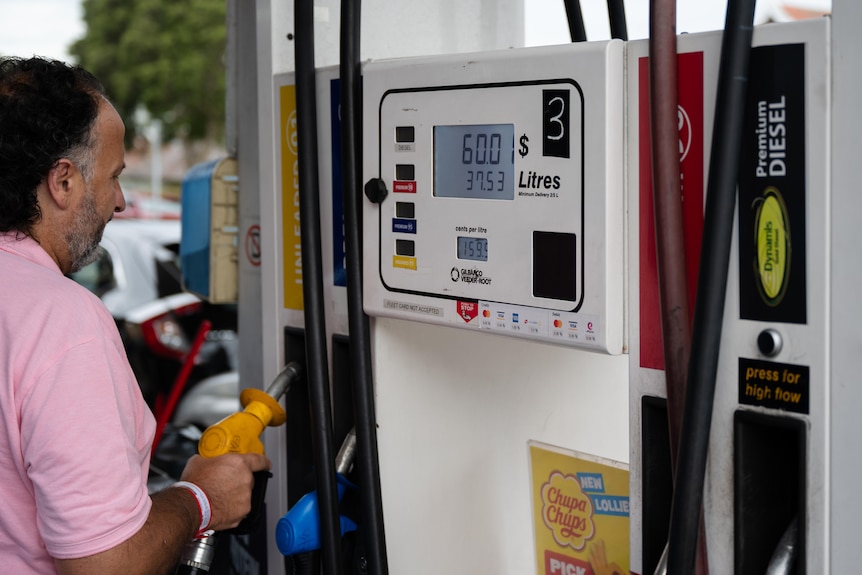
A man fuels up at a petrol station in Sydney on Tuesday. (AAP: Sarah Wilson)
He said there would be impacts as a result of the war in the Middle East and the ACCC would be monitoring prices closely.
“There are real challenges, but there is no need for panic,” Mr Bowen said.
“[That] will just make the situation worse.”
Farmer concerns ahead of sowing season
In regional Australia, farmers at the beginning of the winter sowing season are bracing for the fuel spike.
Grain Producers Australia president Barry Large said the situation was worrying.
“If I was a farmer, I’d most probably be filling my fuel tanks up,” Mr Large said.
“It doesn’t look good for us … there’s certainly uncertain times for the grain industry at the moment.”
Mr Large called for calm in the growers’ industry, but said the disruption had laid bare Australia’s reliance on global supply chains.
Meanwhile, Australia’s resource sector’s heavy reliance on diesel fuel will result in rising production costs, according to the industry body.
“The reality is there’s nothing we can do about it,” the Association of Mining and Exploration Companies’ Warren Pearce said.