
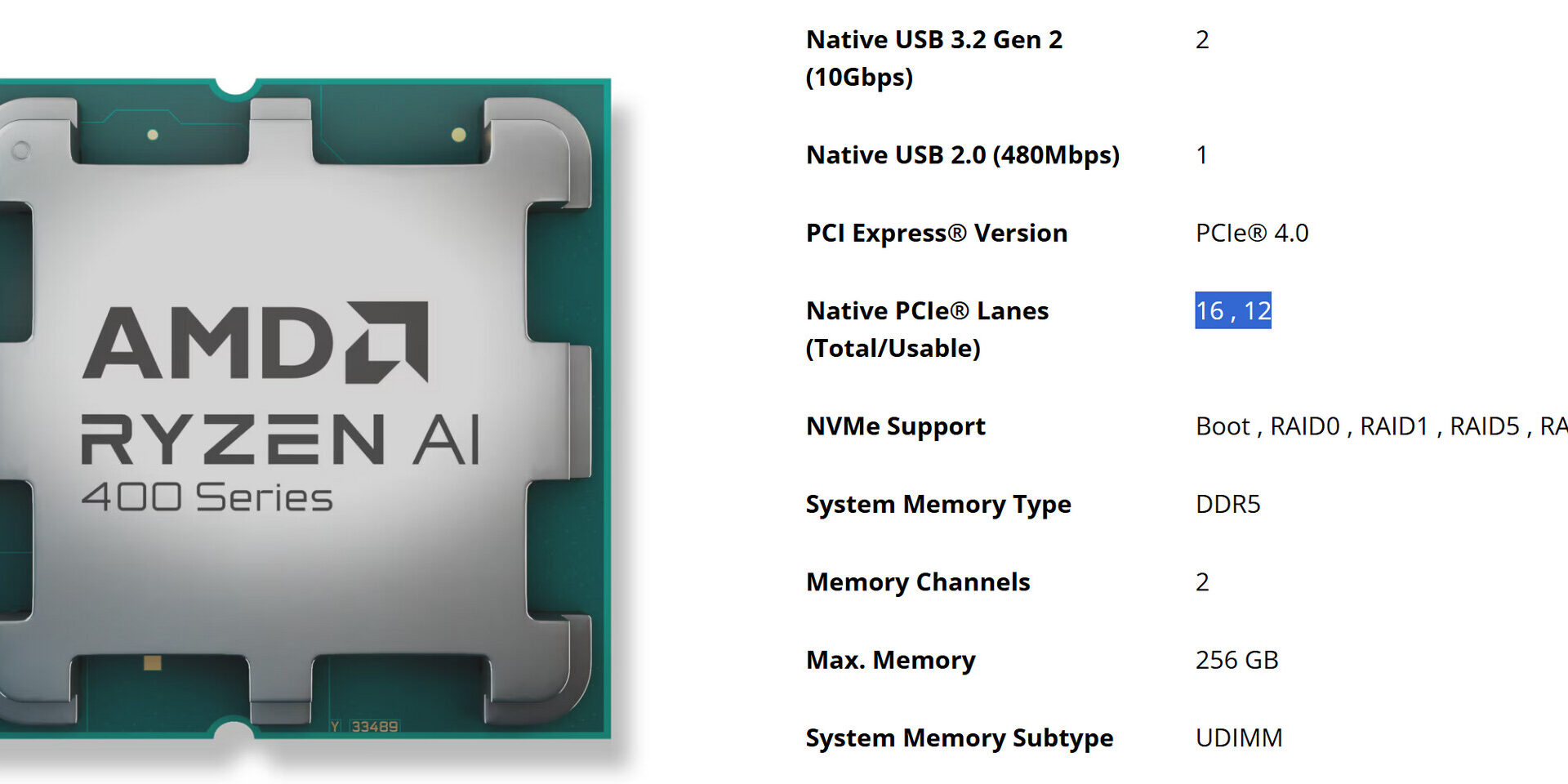
On Monday, AMD announced its latest Ryzen AI 400 Series and Ryzen AI PRO 400 Series desktop processors, based on the “Gorgon Point” silicon and powered by the “Zen 5” core configuration. This generation follows the Ryzen 8000G series, known as “Phoenix Point.” However, it has been revealed that the Ryzen AI 400 series reduces the number of usable PCIe lanes compared to the previous Ryzen 8000G generation. The new top SKU offers 16 native PCIe 4.0 lanes, but only 12 are available to the rest of the system. Four of these PCIe lanes are used for the chipset link that connects the AM5 socket to the motherboard chipset, leaving fewer lanes for the end-user. Lower-tier chips may provide as few as 10 usable lanes, which is insufficient to run a discrete GPU at its full 16x lanes in the PCIe 4.0 connector on the AM5 motherboard. When a user installs an M.2 PCIe NVMe SSD, only eight lanes remain available for a discrete graphics card, meaning the GPU will operate in x8 mode instead of x16.
Interestingly, AMD hasn’t fully utilized the “Gorgon Point” silicon in the desktop Ryzen AI 400G series. For example, the top model—Ryzen AI 7 450G—is configured with four “Zen 5” cores and four “Zen 5c” cores, making up an eight-core configuration. The fully unlocked “Gorgon Point” silicon in laptops has 12 cores in total, with four “Zen 5” and eight “Zen 5c” cores. This is a similar configuration to “Strix Point,” but adapted for mobile. It’s also worth noting AMD’s approach with the iGPU. The top 450G processor model only comes with 8 iGPU compute units, which is half the CUs physically available on the silicon. Most other processor models in the series come with just 4 CUs.
 This change seems to reflect AMD’s design choice that prioritizes integrated graphics performance and smaller, simpler motherboards. For small form factor builds where space, power consumption, and cost are primary concerns, the Ryzen AI 400 family should offer a good balance of CPU and on-die GPU resources. For users planning to pair a high-end graphics card with multiple high-speed SSDs, older desktop lines that provide more PCIe bandwidth will remain a wiser choice. However, if users are willing to sacrifice a few percentage points by running on a x8 PCIe bus instead of the full x16, the compromise is sensible. For example, in testing with a mid-range graphics card like the GeForce RTX 5060 Ti, using x8 PCIe 4.0 lanes instead of the PCIe 5.0 lanes results in only a 2% drop in FPS at 1080p, and an even smaller 1% drop at 1440p, according to our own testing.