
Israel conducted a round of strikes on Iranian military sites in Tehran on Wednesday evening, the military confirmed.
Earlier on Wednesday, the military completed a new round of “wide-scale” strikes on multiple Islamic regime command centers and Iranian military sites in Tehran. This included the regime’s ballistic missile array, missile launchers, and defense systems, the IDF stated.
Some of these launchers were struck while Iranian operatives were preparing to use them and launch missiles towards Israeli territory, the military reported.
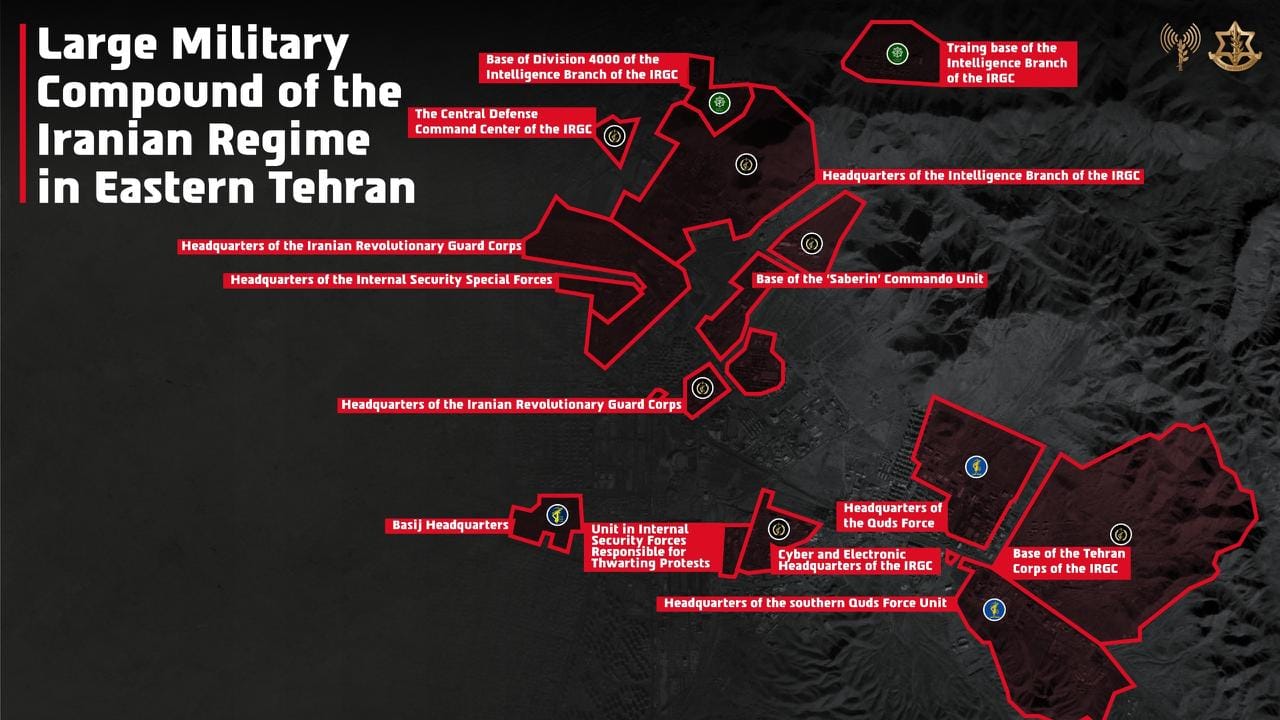
The strikes, carried out by the Israel Air Force, targeted a compound containing the headquarters of multiple Iranian regime security agencies, the military noted.
Military and paramilitary headquarters struck by the IAF include the Islamic Revolutionary Guard Corps (IRGC) headquarters, the Basij paramilitary headquarters, and the IRGC-Quds Force headquarters. Israel additionally struck the Iranian Intelligence Directorate headquarters, the Internal Security forces headquarters, and the Iranian Cyberwarfare headquarters, the IDF stated.
According to the military, Iranian operatives responsible for the repression of the people of Iran, as well as promoting and planning attacks against Israel, were targeted in the strike.
IDF drops 5,000 bombs on Iran since start of war
Earlier on Wednesday, the IDF announced that it had dropped 5,000 bombs on Iran since the start of the current war.
As of Tuesday, the IDF had dropped 4,000 bombs in four days, equal to the number of bombs it dropped during the entire 12-day June 2025 conflict with Iran.
By increasing the total volume of bombs dropped by a full 1,000 even on the fifth day of the war, the IDF showed that it has continued to find sufficient quality targets to strike and is not yet close to running low on munitions.
Earlier, the IDF announced that it had destroyed Ghadr-class ballistic missiles and their launch platforms at Isfahan in Iran.
The Ghadr 110 is the most advanced type of Ghadr missile (there are several categories of Ghadr), and is a two-stage missile that includes a solid-fuel engine to shorten launch preparations, which makes it potentially harder to strike prior to launch.

Its range is estimated between 1,500 and 2,000 kilometers, one of Iran’s longest-range ballistic missiles, and can easily strike anywhere in Israel.
In June 2025, the Islamic Revolutionary Guard Corps confirmed that it had used the Ghadr against Israel during that conflict.
Experts believe that the Ghadr design has the potential to be further developed to eventually be used for further ranges of up to 5,000 kilometers and possibly as an anti-space satellite.
Isfahan has both nuclear sites and ballistic missile sites and has been a repeat target both in June 2025 and the current conflict.
Following the IDF revelation on Tuesday night that not only have several dozen missile launchers been destroyed, but over 300 have been neutralized (likely meaning damaged or caved in by bombings), the latest attacks could start pushing the IDF toward neutralizing closer to 400 launchers.
In June 2024, Iran only had around 400 launchers, of which over 200 were destroyed.
However, IDF sources said that Iran has rebuilt new launchers at an impressive rate since June 2025.
IDF strikes Iran’s Basij paramilitary forces, IRGC command centers across Tehran
The IDF conducted several strikes on Islamic regime command centers throughout Tehran on Wednesday morning, according to an official statement from the military.
Strikes targeting Internal Security and Basij command centers in Tehran, March 4, 2026. (CREDIT: IDF SPOKESPERSON’S UNIT)
Dozens of munitions were dropped on several different internal security centers belonging to the Iranian regime, including those belonging to the Basij, a paramilitary militia under the umbrella of the IRGC.
Israel also struck the regime’s supply and logistics center, as well as missile launchers and other systems.
IDF destroys secret nuclear site, over 300 ballistic missile launchers across Iran
The IDF destroyed a secret Iranian nuclear weapons development site on Tuesday, IDF Spokesperson Brig.-Gen. Effie Defrin revealed in a press conference. Separately, the IDF stated that, since the start of the war, the air force had destroyed some 300 Iranian missile launchers.
Naming the site as Min Zadai, on the northeast outskirts of Tehran, Defrin said that the site was linked to weapons development. He said that IDF intelligence followed nuclear scientists who tried to travel there clandestinely.
Israeli Air Force fighter jets destroy Iranian missile launchers in Iran, March 3, 2026 (IDF SPOKESPERSON’S UNIT)
By following these scientists, he said, the IDF was able to learn about the dangerous nature of these activities that could help Tehran resume aspects of weapons development for a nuclear bomb.
Additionally, on Wednesday, an explosive drone targeted the Democratic Party of Iranian Kurdistan (PDKI) headquarters in Iraq and hit a weapons depot; no casualties have been reported.
Ghadr missile storage and production facility was struck in Isfahan
During a broad wave of strikes overnight on Tuesday, the Israeli military struck a facility used by the Iranian regime for the storage, production, and launch of ballistic missiles – including Ghadr missiles – in Isfahan in western Iran.
The facility was struck to reduce the number of launches from it. In addition, the Israeli Air Force struck defense systems and extended Israel’s aerial control in the skies of Iran.
Operation Roaring Lion
Former supreme leader Ali Khamenei and many top Iranian military and intelligence officials were killed early on Saturday after Israel began Operation Roaring Lion.
According to the IDF, the complex contained the President’s headquarters, the headquarters of Iran’s Supreme National Security Council, a meeting compound used by the Islamic Republic’s senior forum, and a headquarters for training Iranian military officers.
Reuters and Jerusalem Post Staff contributed to this report.