
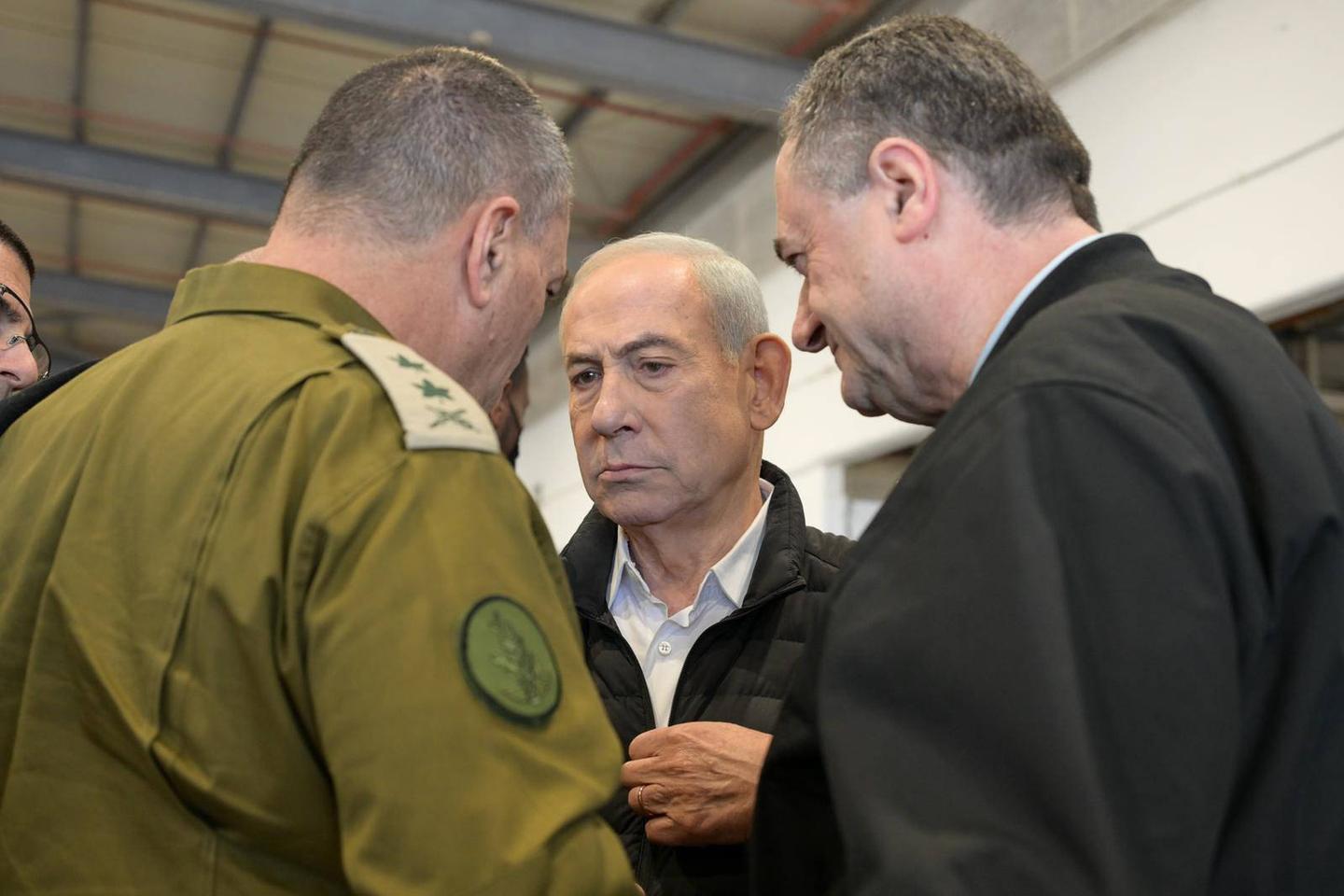
 Chief of the General Staff Eyal Zamir, Prime Minister Benjamin Netanyahu and Defense Minister Israel Katz at the Palmachim Air Base in Israel, March 3, 2026. MAAYAN TOAF/ISRAELI GOVERNMENT PRESS OFFICE/ZUMA VIA SIPA
The pace and number of missiles fired from Iran toward Israel slowed considerably from the afternoon of Monday, March 2. Authorities are now considering partially reopening Ben-Gurion Airport in Tel Aviv. “We have managed to reduce their capability to fire missiles at us and at the region. We have succeeded in destroying hundreds of ballistic missiles, and we are seeing their rate of fire slow down,” an official military source said on Tuesday. The Israeli military has not entirely ruled out the possibility that the Iranian regime is trying to manage its stockpile of weapons to preserve offensive capabilities.
Israel and the United States said they had taken control of the skies over Iran. As a result, nearly 300 missile launchers have reportedly been destroyed since the start of the bombing campaign, drastically reducing the capabilities of the Shiite regime. The stock of ballistic missiles capable of reaching Jerusalem or Tel Aviv has also been partially destroyed. At this point, Israel has remained relatively unscathed from a military perspective, despite Iran launching around 200 missiles. Only a handful were not intercepted by the air defense system. Ten people have died so far, in addition to two seriously injured, six with serious wounds and 396 slightly injured, 288 of whom were hurt while rushing to shelters. During the so-called 12-day war in June 2025, 32 people were killed. According to the Red Crescent charity, as reported by Agence France-Presse, the bombings have killed 787 people in Iran, though this figure cannot be independently verified.
You have 72.64% of this article left to read. The rest is for subscribers only.