
As night follows day, so too the denunciations of Israel for violating international law follow every use of armed force by the Jewish state.
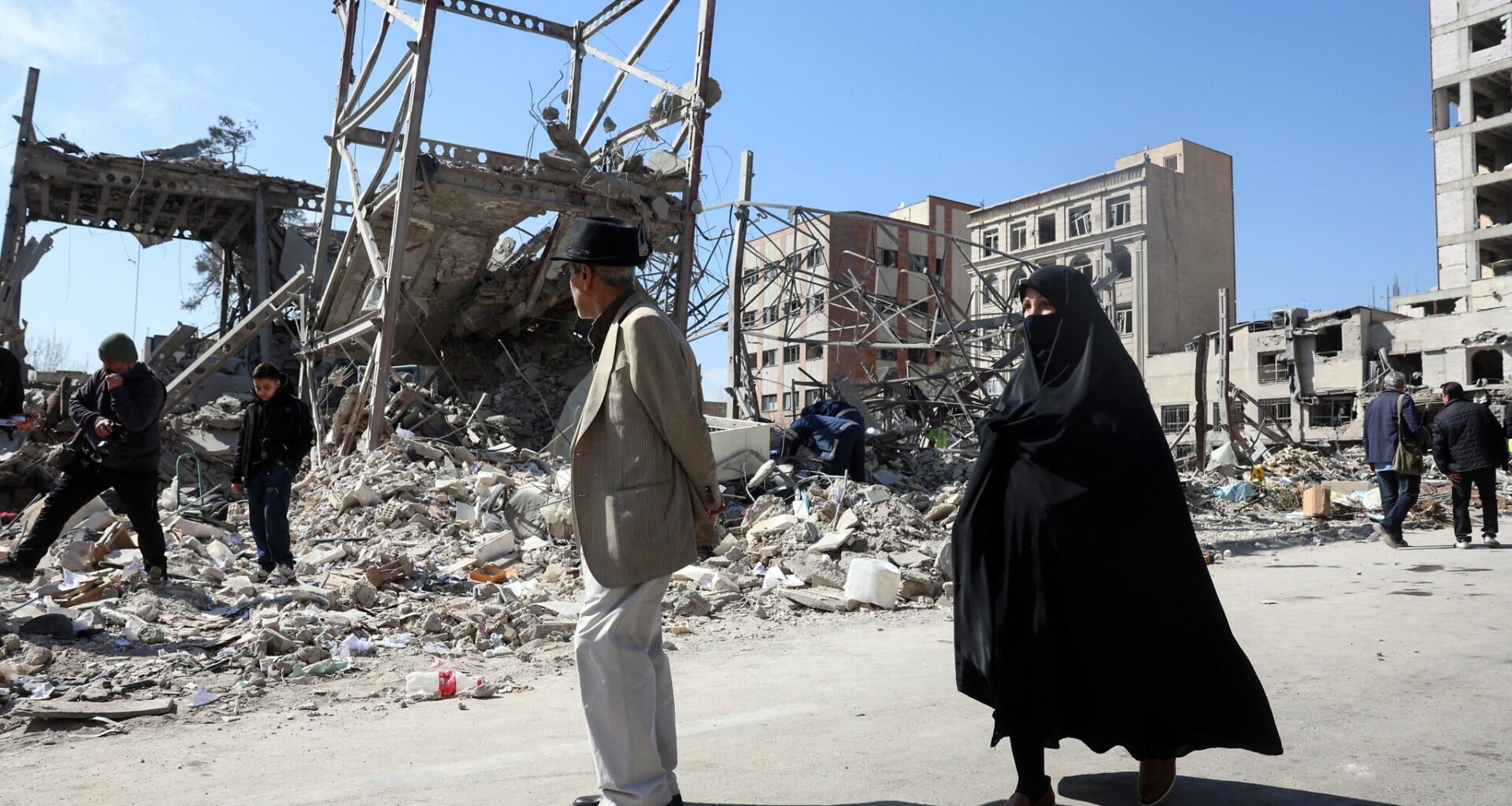
The joint Israel-US strikes against Iran which began on Saturday were no exception, unleashing a flood of claims that the actions were illegal and unjustified.
Citing the UN Charter’s prohibition on the use of force against other states, UN Secretary-General António Guterres “condemned the massive military strikes by the United States and Israel against Iran” at the UN Security Council on Saturday.
At the same meeting, Iran’s representative called the strikes “unfounded legally, morally and politically,” a criticism echoed by some other countries hostile to Israel.
Prominent legal scholars, including the executive editor of leading law forum and blog Just Security, have also accused Israel and the US of violating international law.
Get The Times of Israel’s Daily Edition
by email and never miss our top stories
By signing up, you agree to the terms
Both Jerusalem and Washington have justified the strikes as necessary given the threat posed by the Iranian regime, including its buildup of ballistic missiles and pursuit of nuclear enrichment, as well as its support for proxy militias around the region.
Scholars have questioned whether any of the conditions for the use of preemptive force — as a last resort to thwart an imminent assault — as understood within a strict and rigid reading of international law, were met by Israel and the US.
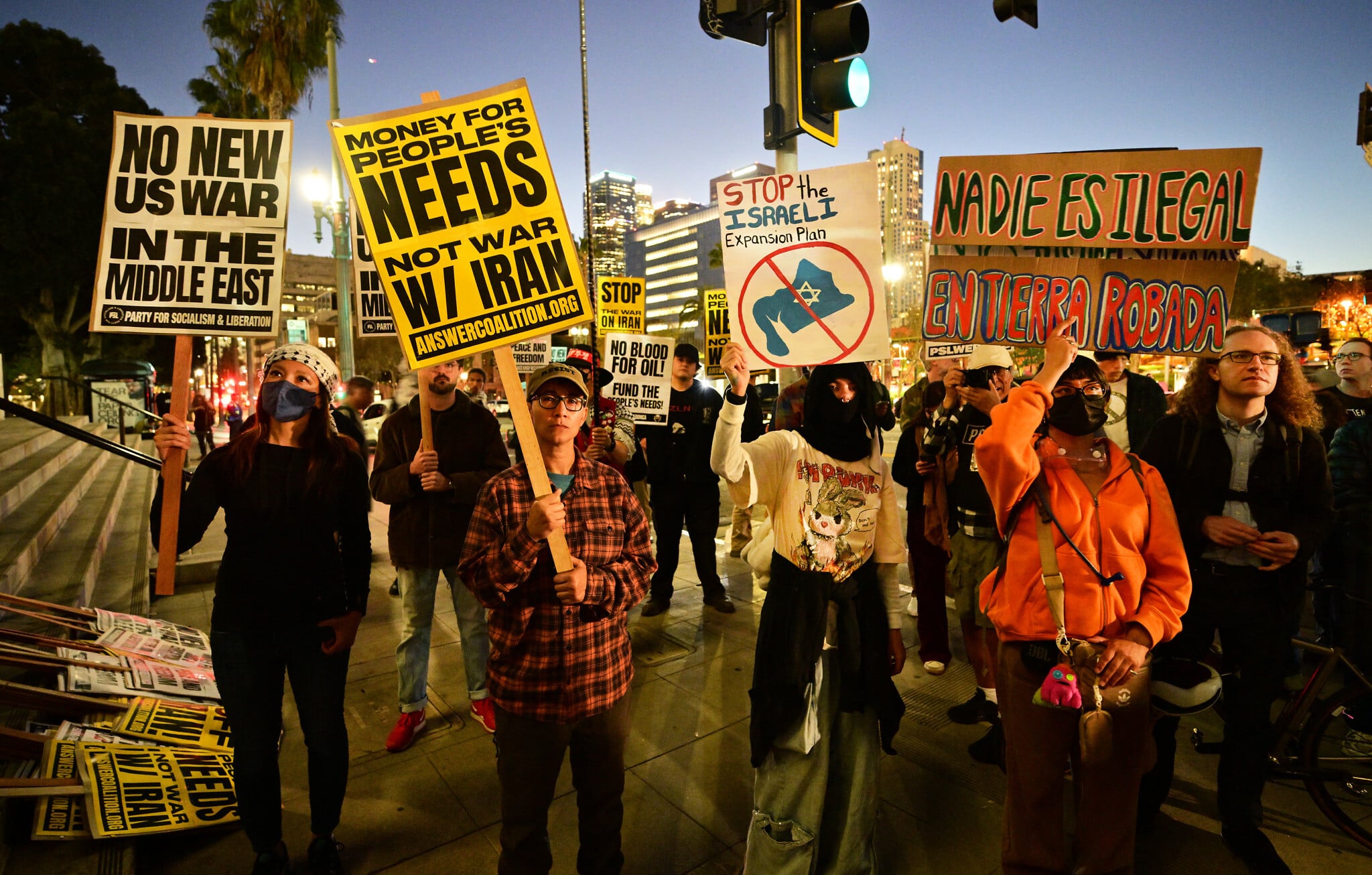
Demonstrators hold placards as they rally against military action in Iran outside of City Hall in Los Angeles, California, on March 2, 2026. (Frederic J. BROWN / AFP)
But some prominent figures have forcefully asserted that international law can fail when its requirements forbid actions necessitated by morality.
The UK’s shadow attorney general, David Wolfson, argued earlier this week that if international law was “unable to restrain Iranian terrorism and mass murder,” it would have failed and become an immoral system.
“Law doesn’t always reflect morality,” said Yuval Shany, a prominent Israeli legal scholar. “Rogue states support terrorism, they constitute a long-term threat to their neighbors, they oppress their own people, so there’s a moral case to say that their conduct can be interrupted and obstructed.”
Lawful warfare
One of the underlying principles of the post-World War II international order governing the use of force is Article 2 of the UN Charter, which states that member nations must “refrain” from the use of force “against the territorial integrity or political independence of any state.”
Self-defense is explicitly allowed under Article 51 of the charter after one state is attacked by another. Even preemptive, or more technically “anticipatory,” attacks are permissible under international law, although such measures are subject to several conditions.
These include that the anticipatory attack be absolutely necessary to stop the hostile state from launching its attack first, that the hostile state’s attack be imminent, and that it has the capability and intent to conduct an attack.
Humanitarian intervention to prevent atrocities can also be lawful, but usually only with the authorization of the UN Security Council.
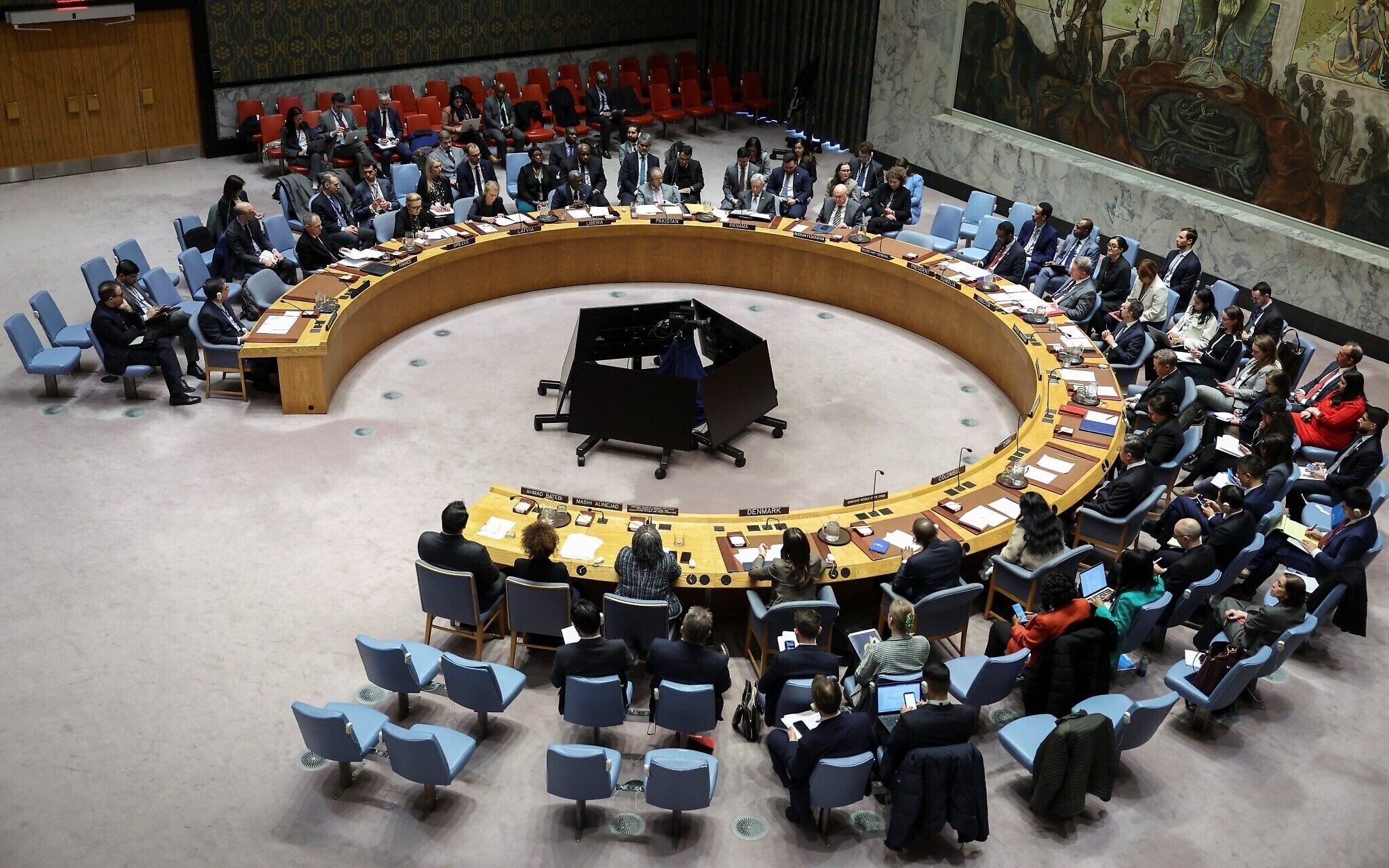
General view of a UN Security Council meeting on the situation in Iran at the United Nations headquarters in New York on January 15, 2026. (ANGELA WEISS / AFP)
US President Donald Trump initially threatened to attack Iran to protect protesters being slaughtered by the regime during popular protests that erupted in January.
Over the following weeks, his administration also cited the Islamic Republic’s nuclear program, its growing ballistic missile stocks and its support for terrorist proxies such as Hezbollah as justification for going to war.
On Tuesday, Secretary of State Marcio Rubio said the US launched attacks on Iran after receiving intelligence that American assets in the region would be targeted in response to an Israeli attack, though he also said the joint attack on Iran would have taken place regardless.
In Israel, which views Iran’s nuclear program as an existential threat, Prime Minister Benjamin Netanyahu said early Tuesday that an attack against Iran was urgently necessary because Iran was building new underground sites to shield its missile and nuclear programs from attacks.
“If no action was taken now, no action could be taken in the future,” he said.
There is no doubt that Iran has been the source of severe violence and terrorism around the Middle East for decades, if not since the inception of the Islamic Republic.
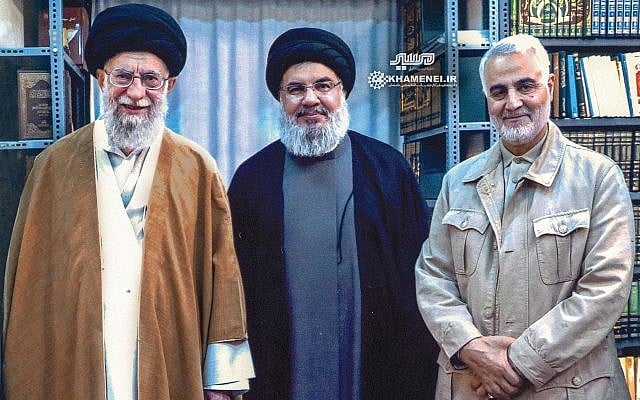
An image published on Ali Khamenei’s official website on September 25, 2019 showing Khamenei, the Iranian supreme leader, left, alongside Hezbollah chief Hassan Nasrallah, center, and Islamic Revolutionary Guards Corps Quds Force commander Qassem Soleimani. (Khamenei.ir)
Iran has armed and funded murderous jihadist organizations around the region, which have repeatedly attacked Israel; developed an advanced nuclear enrichment program with no civilian application whatsoever; built a massive arsenal of ballistic missiles; actually used those missiles to attack Israel even before last year’s war; and engaged in repeated genocidal rhetoric against Israel.
But despite the level of malign activity, legal scholars have argued that, especially in the wake of the 12-day war in June 2025, in which Israel and the US bombed Iran’s nuclear sites and destroyed some of its military capabilities, there was no necessity for further attacks, or indication that Iran intended to launch an offensive in the near term.
“Even the doctrine of imminent [threat of] use of force is very controversial,” UK legal expert Susan Breau told The Guardian. “Academics are divided on what it actually means. But in this case, there doesn’t seem to be any evidence of an imminent threat by Iran.”
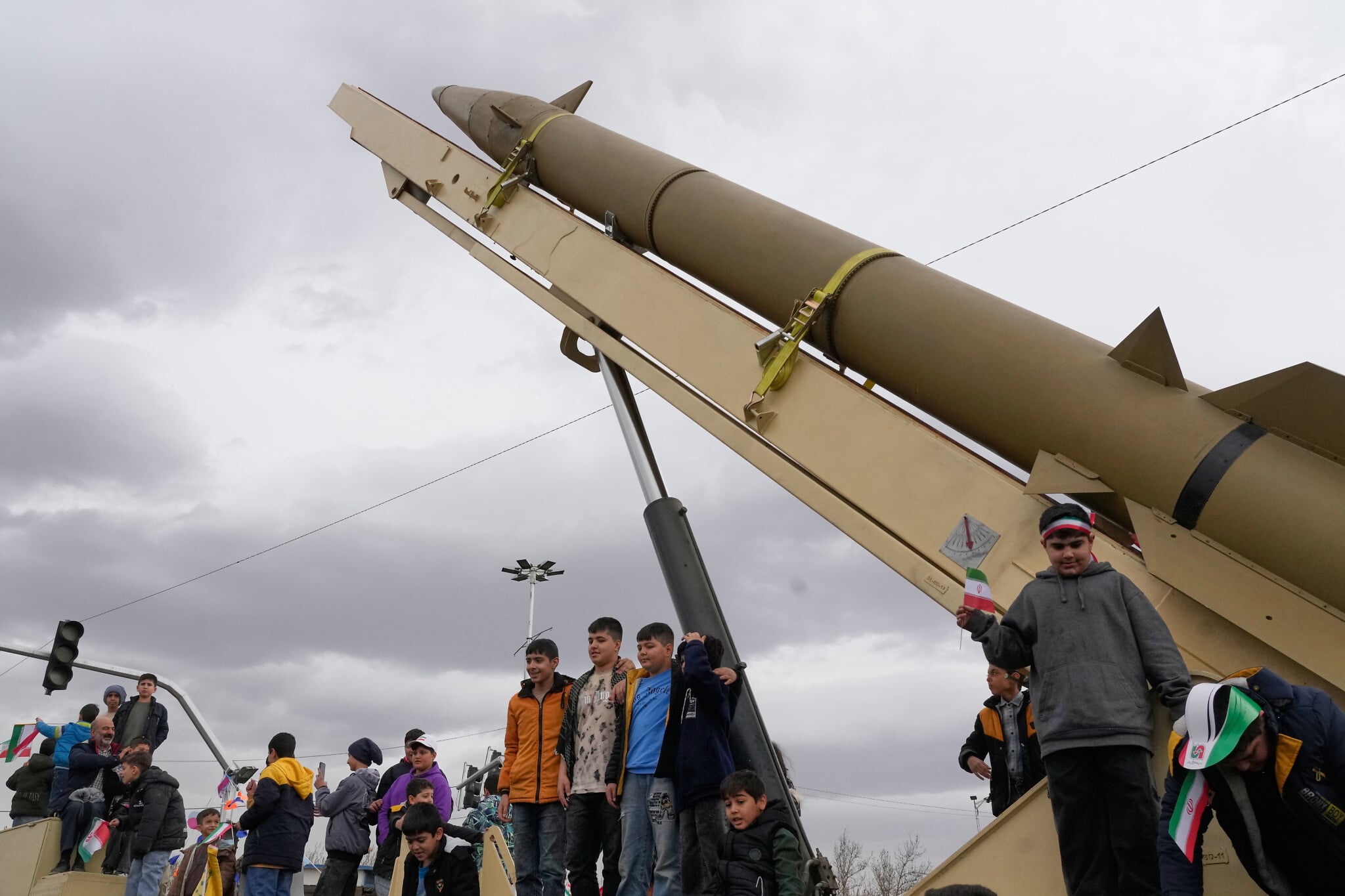
Boys stand on the launcher of an Iranian domestically-built missile during an annual rally marking the 1979 Islamic Revolution at the Azadi (Freedom) Square in Tehran, Iran, on February 11, 2026. (AP Photo/Vahid Salemi)
Australian legal scholars Shannon Brincat and Juan Zahir Naranjo Caceres noted for The Conversation that Israel’s justification of needing to launch the war to prevent a future conflict was also not a legal defense.
“Preventive war has no legal basis under international law,” they wrote.
And writing for Just Security a week before Israel launched the strikes, experts confidently declared that “There are quite simply no grounds for justifying an attack against Iran based on anticipatory self-defense of the United States.”
Legal isn’t always moral
Speaking to The Times of Israel, Shany allowed that a plain reading of the law does make it harder to justify the current attacks on Iran.
Ceasefires were in place with Iranian proxies Hamas and Hezbollah, said Shany, which blunts arguments that Israel was in an ongoing armed conflict with Iran at the time of Saturday’s strikes.

Prof. Yuval Shany, Vice President of Research at the Israel Democracy Institute and chairman of the
Israel’s claim that Iran was required to halt its nuclear and missile programs following the end of the June 2025 war did not give it the right to “unilaterally enforce” such assertions, even if they were accurate, he added.
But Shany and other legal authorities criticize an overly rigid, dogmatic approach to the law as essentially allowing Iran to persist in its grey-zone tactics of advancing its nuclear program, working to create a massive arsenal of ballistic missiles, and continuing to undermine peace and stability in the Middle East with its network of violent terrorist proxies.
As Mr. Bumble from Oliver Twist put it, “If the law supposes that – the law is an ass – a idiot.”
According to Shany, arguments on the basis of morality rather than international law were made for intervention in Kosovo, Libya and Syria in recent decades.
He noted that despite criticism from the UN and some nations such as Turkey, Russia and North Korea against the US-Israel strikes, the response had thus far been “relatively muted.”

Anti-missile batteries fire interception missiles toward incoming ballistic missiles launched from Iran, as seen over central Israel, March 3, 2026. (Yossi Aloni/Flash90)
Some Western nations such as Canada and Australia are even vocally supporting the strikes, because of a perception that “using force against a country like Iran is a politically and morally just position,” Shany added.
Though these kinds of issues should be dealt with in the UN Security Council rather than the battlefield, that body is so dysfunctional it cannot properly address these issues, he said.
“It’s not a healthy place for legal systems to be,” Shany said of the gap between international law and moral action. “Legal systems should be aligned with morality.”
Shany described some of the legal debate regarding the attacks on Iran as a “dogmatic, fundamentalist approach to international law.”
Some of those adopting this line would not even acknowledge that this left them without any way of dealing with regimes such as those in Iran and Venezuela “which systematically oppress their people, prevent democratic change, and represent existential threats to their neighbors,” he added.
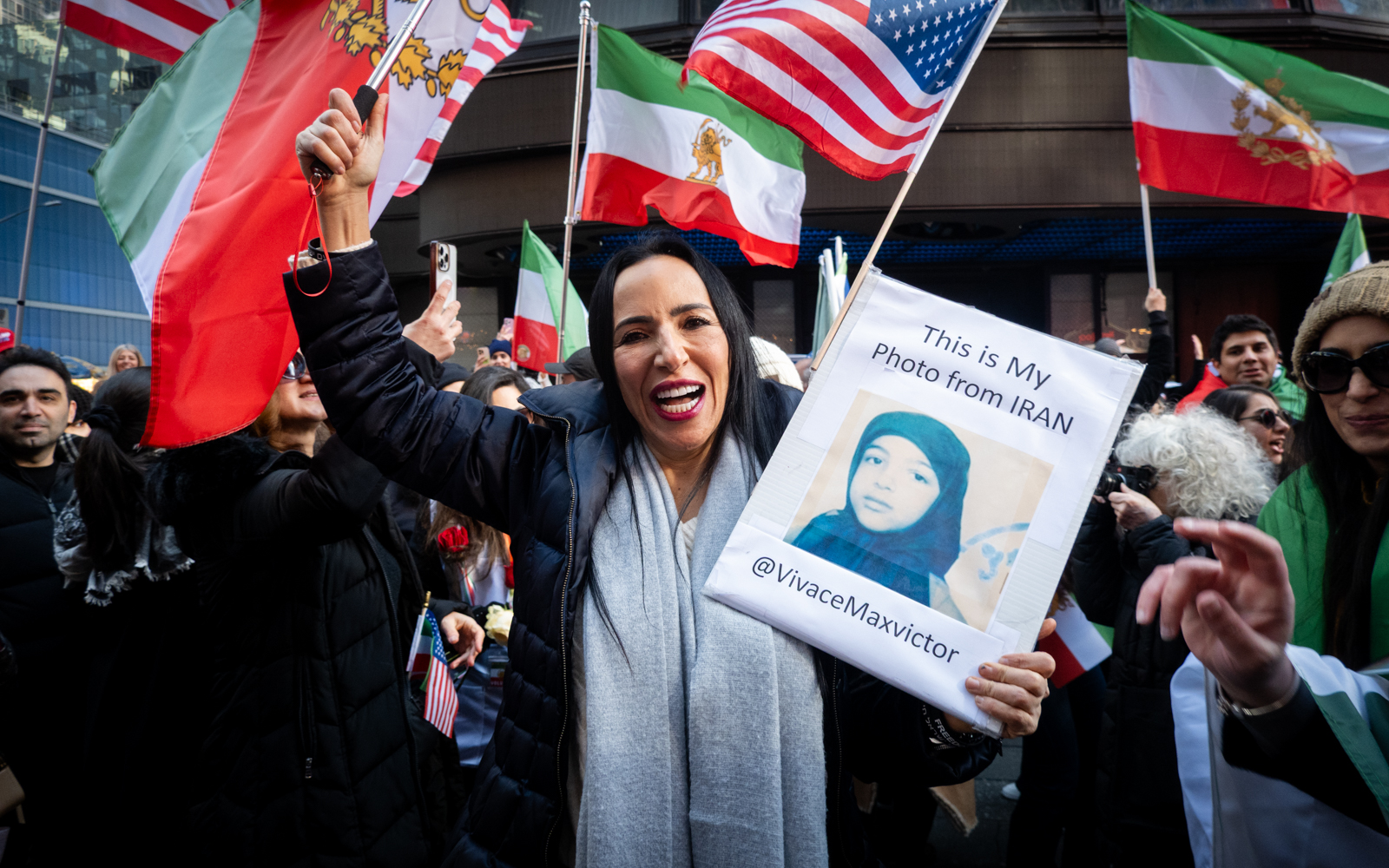
A rally in support of US and Israeli strikes against Iran, in Times Square, New York City, March 1, 2026. (Luke Tress/Times of Israel)
In a lengthy post on X on Sunday, Wolfson, a member of the UK’s House of Lords who serves as the Conservative Party’s shadow attorney general for England and Wales, insisted that a legal system that thwarted efforts to counter a repressive regime such as Iran’s could not be moral.
“International law ought to provide a mechanism to restrain and, if necessary, end despotic and tyrannical regimes such as that in Iran,” he wrote.
Wolfson issued his post in response to the determination by the UK Attorney General Lord Hermer that the UK could not participate in the initial strikes on Iran, rejecting claims that the strikes were illegal, and pointing out Iran’s various types of malign activity.
I disagree with Lord Hermer KC, the Attorney General. I don’t accept that international law requires our Prime Minister to deliver a pusillanimous statement setting out the UK’s position whose first point is “We did not participate”.
I’ve set out the gist of my approach below.…
— David Wolfson (@DXW_KC) March 1, 2026
He derided what he described as the “expositors” of international law, too many of whom, he said, “serenely promote an analysis which ultimately protects tyrants.”
“If the doctrines of international law prove unable to restrain Iranian terrorism and mass murder, and tie the hands of democracies while forcing them to stand and watch Iranian atrocities, international law will have failed,” he wrote. “It will have become a fundamentally immoral system of law, and one which is worse than worthless in the modern world.”