
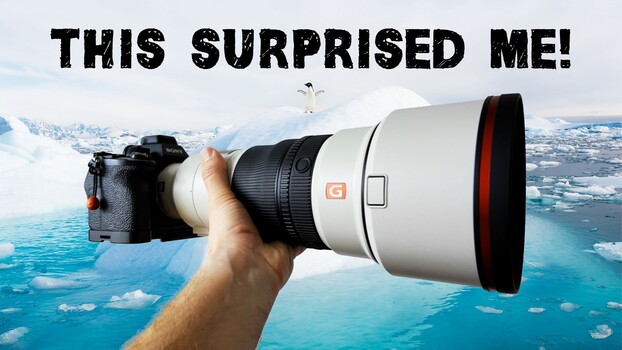
Antarctica will test how fast you think and how well you know your camera. When wildlife and weather shift by the minute, hesitation costs images you cannot recreate.
Coming to you from Mads Peter Iversen, this reflective video breaks down ten lessons from a 20-day Antarctica trip where Iversen shot 12,322 photos. The first point is simple: optimize for speed. Use zoom lenses so you can reframe without changing position. Carry two camera bodies so one covers wide angle to mid-range and the other handles mid-range to telephoto. Set up custom buttons and custom modes so you can jump from landscape settings to wildlife settings without diving into menus. A penguin can leap from the water, pose for three seconds, and vanish. If your camera is not ready, the moment is gone.
He also made a deliberate choice not to vlog during the trip. Shooting video and stills at the same time splits your attention. When you remove one task, your awareness sharpens. Instead of thinking about clips and B-roll, you track behavior, light, and background. That mental space shows in the work. You see it in small, reactive images, like a single penguin framed against sea and ice rather than a tight portrait that could have been taken anywhere. Focusing on one medium at a time changes the depth of your concentration.
Conditions in Antarctica forced flexibility. Landings were canceled due to swell. Routes were blocked by ice. The ship left early to avoid a storm in the Drake Passage. You plan for epic landscapes and end up adapting hour by hour. Iversen shifted toward environmental wildlife images, using the landscape as context rather than the main subject. Chinstrap penguins crossing a bright strip of sea. A lone bird on an iceberg with turquoise water around it. A 22° halo in the sky with three penguins placed carefully beneath it. You see the environment and the behavior working together instead of competing.
Quality over quantity became a practical strategy. When stepping onto a beach crowded with Gentoo penguins, he paused to observe patterns before firing away. Some birds porpoised through shallow water, visible just below the surface. By adding a polarizing filter and working the scene, he captured penguins swimming underwater with icebergs above the surface, all in one frame. Then he adjusted position, stepping onto a submerged rock to change the angle and distance. Small movements changed the framing more than any setting tweak.
Gear made a difference in low light. On this trip, he borrowed the Sony 300mm f/2.8 GM OSS. Compared to a slower superzoom, an f/2.8 aperture gives two extra stops at the long end. That can mean ISO 3,200 instead of ISO 12,800 when photographing orcas at 5:00 AM in snowfall. The tradeoff is razor-thin depth of field and the need for a faster shutter speed than you think. Some frames missed focus. Others showed slight motion blur. When focus and shutter speed aligned, the detail in fur and fins was brutally sharp.
Another lesson came from watching how others approached the same scenes. A street-oriented perspective led to compositions that included the ship, hard shadows, and mid-range focal lengths like 40-70mm. That normal perspective often feels more immersive than ultra-wide drama or heavy telephoto compression. It places the viewer inside the space rather than outside looking in.
He also experimented with panoramic crops such as 2:1 and 3:1. Antarctica’s long mountain ridges and bands of ice often sit in horizontal layers. Trimming excess sky or foreground strengthens scale and focus without adding clutter. Check out the video above for the full rundown from Iversen.