
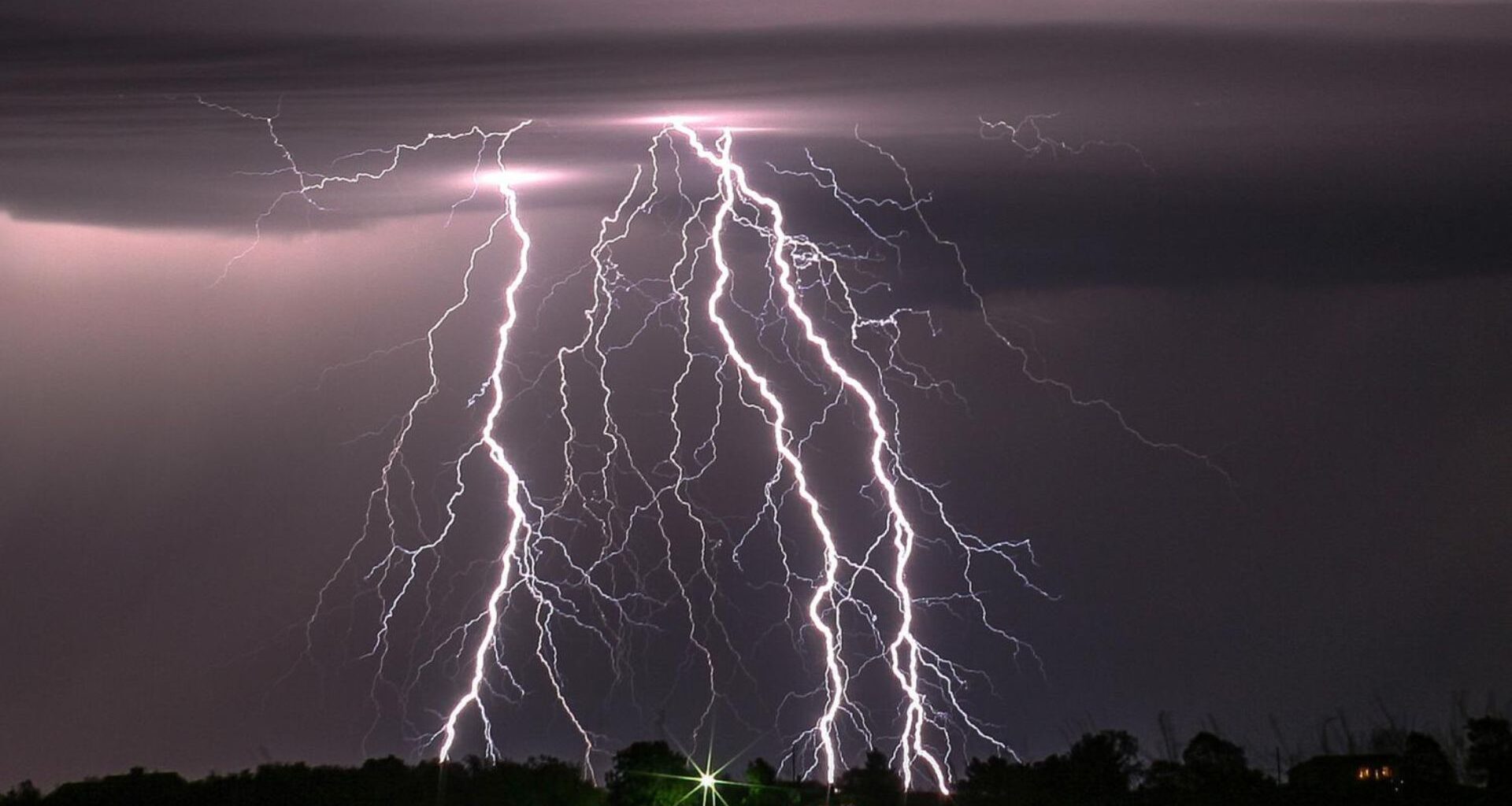
The scientific community long assumed that to understand how lightning works, one needed a massive storm cloud.
But a new modeling study shows mini-lightning can be created and studied inside a small block of plastic.
Penn State researchers have proposed that the fury of a lightning bolt can be tamed, shrunk, and triggered on a lab bench inside a piece of acrylic no bigger than a deck of cards.
Numerical simulations showcased that lightning-like discharges can occur in solid materials just a few centimeters wide, rather than across kilometers of sky. All it requires is density.
“We applied the same exact models that we use for lightning research, but shrunk down the scale to slightly larger than a deck of cards,” said Victor Pasko, professor of electrical engineering at Penn State.
“We calculated that when supplied with a high-powered electron source, lightning can be triggered in everyday insulating materials like glass, acrylic, and quartz,” the lead author added.
The density factor
Lightning is sparked by “relativistic runaway electron avalanches,” where electrons in a storm’s electric field accelerate so rapidly they collide with air molecules and snowball into massive energy bursts.
This chain reaction — a photoelectric feedback loop — produces intense radiation bursts of X-rays and gamma rays that can reach deep space.
Detailed simulations showcased that photoelectric feedback discharges can be recreated inside small solid blocks in a lab setting.
To do this, dense materials such as acrylic, quartz, or bismuth germanate can be used.
These solid materials are roughly 1,000 times denser than air. This density allows them to reach extreme electrical potentials within a space smaller than a thumb, mimicking thunderstorm conditions.
Interestingly, the materials could achieve 100-million-volt potentials over mere centimeters rather than kilometers.
“We were amazed because we were able to model the same phenomena in a material one thousand times denser than air, and strike a thousand times faster than in thunder clouds – one-billionth of a second,” Pasko said.
These simulations also suggest that a high-powered beam can trigger the same lightning-like photoelectric feedback loop in everyday solids that was once thought to only exist in the sky.
A deeper understanding of these feedback loops could help resolve long-standing mysteries about how lightning initiates and propagates in Earth’s atmosphere.
Reducing scientific cost
Recreating lightning in a controlled lab setting offers both scientific and practical advantages.
Researchers once had to rely on unpredictable storm-chasing tools like rockets to gather data, but the focus is now shifting toward the precision of the lab bench. In the lab setting, various atmospheric variables can be precisely manipulated to closely understand the phenomenon.
Beyond cost savings, it could pave the way for more compact and safer X-ray technology for medical and security applications.
“If you’re able to experiment with lightning-like conditions on a desktop under controlled conditions, it would be wonderful — much more cost-effective and could answer so many questions,” Pasko said.
It makes the entire field of meteorology more accessible, moving the study of the atmosphere from the vast, unpredictable outdoors to the precision of a laboratory.
This mathematical confirmation proves that the physics of a kilometer-wide storm doesn’t require the sky.
For now, the work remains theoretical, but if experimental confirmation follows, the “shrouded mystery” of lightning may finally be solved.
The study was published in the journal Physical Review Letters on March 5.