
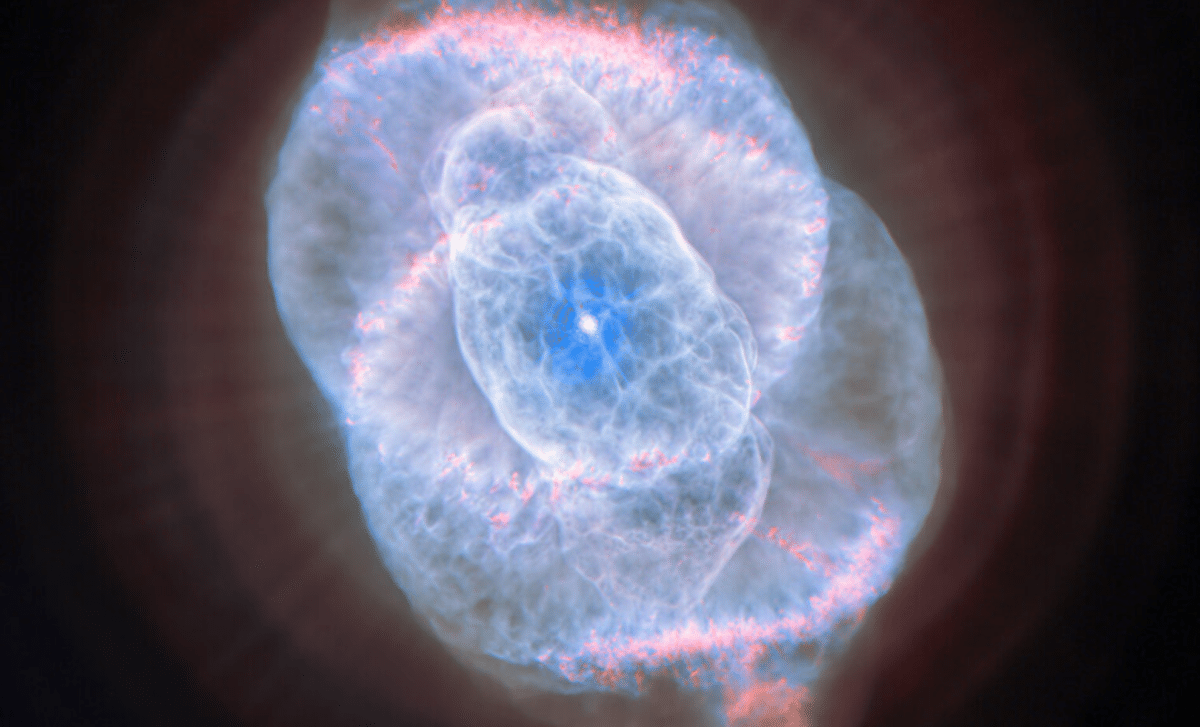
The cosmic wonders of the universe often remain shrouded in mystery, but thanks to groundbreaking technologies and powerful space missions, we’re unveiling the secrets of distant celestial bodies. One such revelation comes from the remarkable collaboration between NASA/ESA’s Hubble Space Telescope and ESA’s Euclid mission, which together offer us a stunning new perspective on the Cat’s Eye Nebula (NGC 6543). As detailed in a recent article from the European Space Agency (ESA), the combination of these two space observatories’ capabilities has brought the intricate details of this planetary nebula into focus, capturing the awe-inspiring remnants of a dying star and providing us with a rare cosmic “fossil record” of its final stages.
Hubble And Euclid: A Perfect Partnership To Explore The Cosmic Eye
The Cat’s Eye Nebula is one of the most visually complex remnants of a star’s death, located approximately 4,300 light-years away from Earth in the constellation Draco. Astronomers have been captivated by its multi-layered structure for decades. Through the advanced imaging power of the Hubble and Euclid missions, we can now appreciate the full scale of this stellar transformation in unprecedented detail. This partnership of space telescopes offers an extraordinary opportunity to examine both the local beauty of the nebula and the broader universe in which it exists.
 Hubble’s new view of the Cat’s Eye Nebula
Credit:
ESA/Hubble & NASA, Z. Tsvetanov
NASA/ESA’s Hubble Space Telescope specializes in high-resolution visible-light images, making it an ideal tool to focus on the core of the nebula. It captures the concentric shells of gas, jets of high-speed matter, and dense knots shaped by shock interactions, which together form a surreal, intricate landscape. Meanwhile, ESA’s Euclid mission, designed primarily to study the farthest reaches of the universe, provides a broader, wide-field view in both visible and near-infrared light, unveiling the nebula’s outer halo and the colorful gas fragments speeding away from the central star.
The Cat’s Eye Nebula, discovered in 1864, was the first nebula in which astronomers identified the presence of gas, an important clue in understanding stellar evolution. Now, thanks to these advanced missions, we can witness its stunning beauty in greater detail than ever before.
The Legacy Of The Cat’s Eye Nebula And Its Role In Stellar Evolution
Planetary nebulae, like the Cat’s Eye, are often mistakenly thought to be related to planets because of their round appearance through early telescopes. However, these nebulae are the result of stars expelling gas in their final evolutionary stages, marking the transition from the late red giant phase to a white dwarf. The Cat’s Eye Nebula provides a vivid snapshot of this cosmic process.
 Euclid’s wide view of the Cat’s Eye Nebula
Credit: ESA/Hubble & NASA, ESA Euclid/Euclid Consortium/NASA/Q1-2025, J.-C. Cuillandre & E. Bertin (CEA Paris-Saclay), Z. Tsvetanov
Within its complex structure lies evidence of episodic mass loss from the dying star at its center. As the star sheds its outer layers, they form a variety of gas shells and rings, creating a stunning, dynamic structure that astronomers study to understand the final moments of a star’s life. The unique structure of the nebula, with its intricate patterns of gas and dust, serves as a kind of cosmic fossil record, capturing key moments in the life cycle of a star.
The Role Of Euclid In Capturing The Nebula’s Wide View
Euclid’s primary mission is to map the distant universe, particularly focusing on the dark energy that governs its expansion. However, it also contributed significantly to our understanding of the Cat’s Eye Nebula. Euclid captures an expansive view of the nebula, revealing the outer halo and gas fragments that were ejected from the star at an earlier stage of its evolution. These images, taken in visible and near-infrared light, show the nebula’s complex structure within a larger cosmic context.
What makes Euclid’s observations particularly significant is its ability to survey the nebula against a backdrop filled with distant galaxies. This provides a sense of the nebula’s position in the broader universe, offering astronomers a chance to compare local astrophysical phenomena with the vast, far-off reaches of space.
Hubble’s High-Resolution View Of The Nebula’s Core
While Euclid offers a wide view, it’s Hubble’s high-resolution imaging that dives into the very core of the Cat’s Eye Nebula. Hubble’s images capture remarkable detail in the nebula’s central region, allowing scientists to observe the intricate structures within the gas clouds. These include concentric shells, shock-induced knots, and fast-moving jets of gas, which represent the complex processes occurring as the star sheds its outer layers.
The level of detail captured by Hubble is extraordinary, with images showcasing a dynamic, almost surreal landscape of gas and dust. The nebula’s center appears almost like a cosmic “fossil” that records the star’s death throes, making these images invaluable for understanding stellar evolution.
The Cosmic Dance: Combining Hubble And Euclid For A Complete Picture
The synergy between Hubble and Euclid represents a significant advancement in the study of nebulae. While both telescopes have distinct purposes, Hubble focusing on high-resolution images and Euclid on wide-field surveys, the combination of their data provides a comprehensive understanding of celestial objects. By merging Hubble’s intricate, close-up view of the nebula with Euclid’s broader cosmic survey, we get a fuller picture of the Cat’s Eye Nebula’s structure and its relationship to the larger universe.
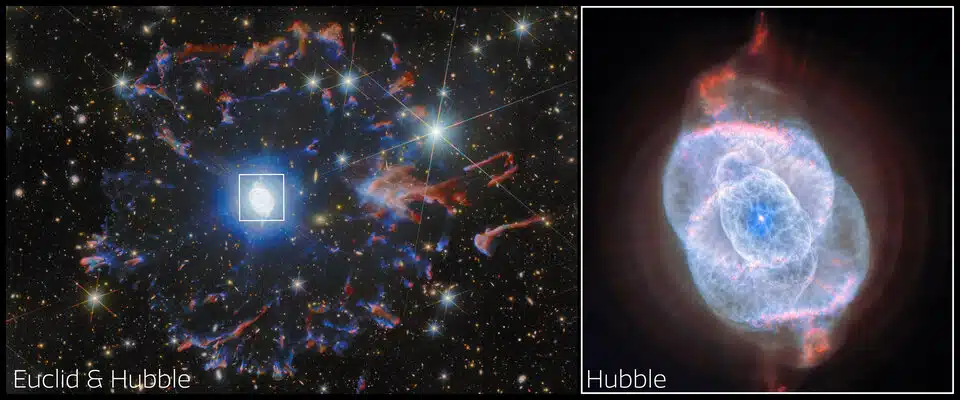 Hubble & Euclid zoom into Cat’s Eye Nebula
Credit: ESA/Hubble & NASA, ESA Euclid/Euclid Consortium/NASA/Q1-2025, J.-C. Cuillandre & E. Bertin (CEA Paris-Saclay), Z. Tsvetanov
This complementary approach highlights the power of modern astronomy, where different instruments and missions work together to provide a deeper understanding of space. The combination of these two telescopes helps reveal not just the nebula’s intricate features, but also its place in the vast, expanding cosmos.
The Cosmic ‘Fossil Record’ Of A Dying Star
What makes the Cat’s Eye Nebula so fascinating to astronomers is its role as a cosmic fossil. The detailed patterns of gas shells, jets, and shock fronts are not just random formations; they are evidence of the processes a star undergoes in its death. These “fossils” offer critical insights into the final stages of stellar evolution, as the dying star expels its outer layers and transitions into a white dwarf.
The study of these structures can reveal much about the forces at play within a star as it sheds material and transforms into its final state. The fact that we can study such a nebula in such detail provides us with a rare glimpse into the natural processes that govern the lives of stars, processes that shape not only the nebula itself but also the surrounding space.