
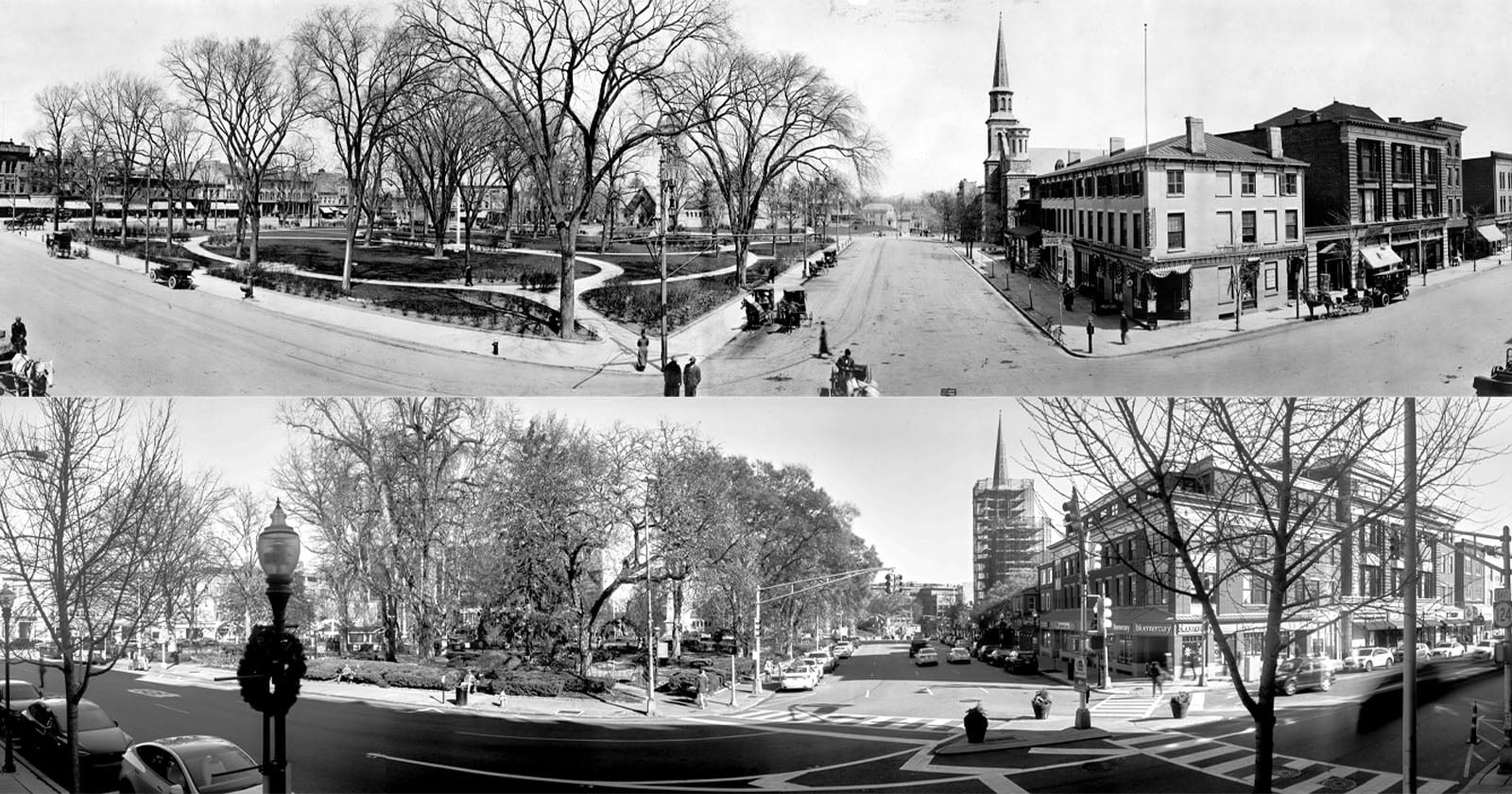
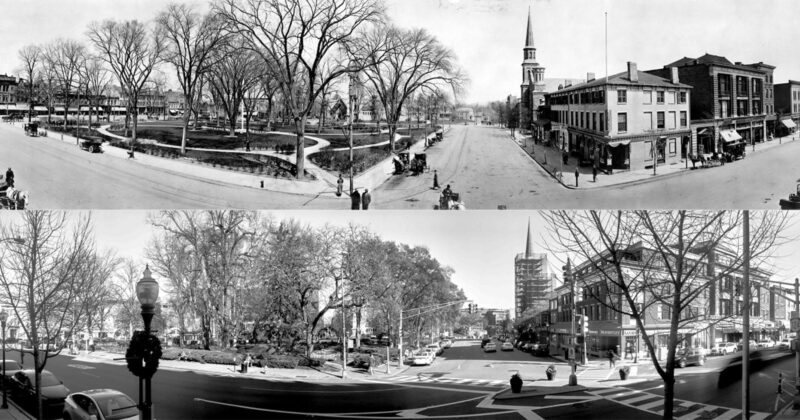
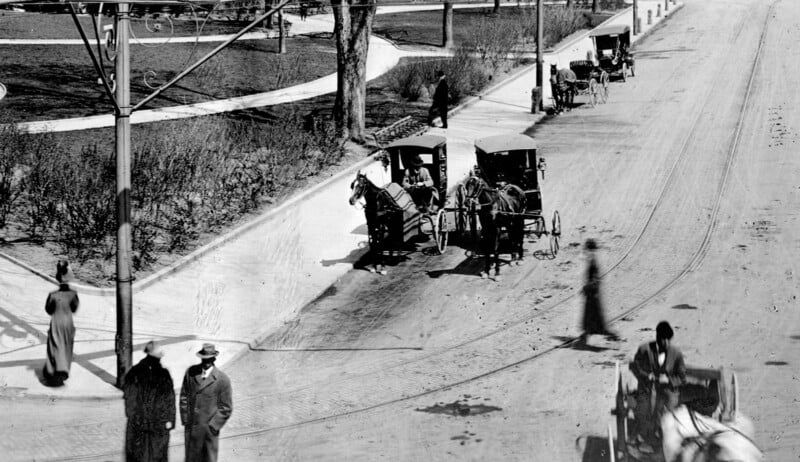
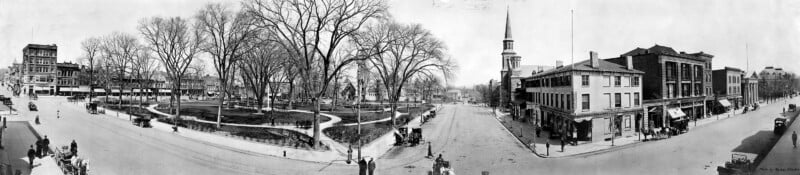
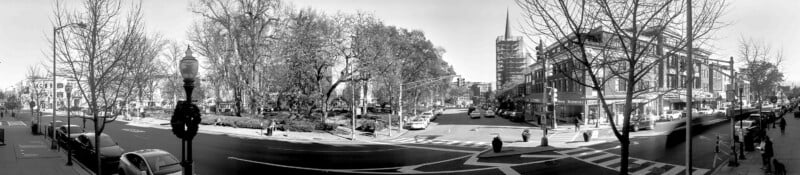
 Morristown, NJ, in 1910, top, and as it looks today on the same camera, bottom.
Two New Jersey photographers have paid homage to their hometown by going to great lengths to recreate a historic photo using the same rotating panoramic camera the original photographers used all the way back in 1910.
Christian Fiedler and Marshall Roshto tell PetaPixel they like to take on creative projects together and after seeing the original photo of Morristown Green plastered around town, the pair decided to research it and eventually recreate it.
Cirkut Cameras
The original photo is credited to the Parker Brothers, who ran a sophisticated studio in Morristown from 1898 through to the 1940s. It shows a 180-degree view of the town’s newly-completed central square in stunning detail.
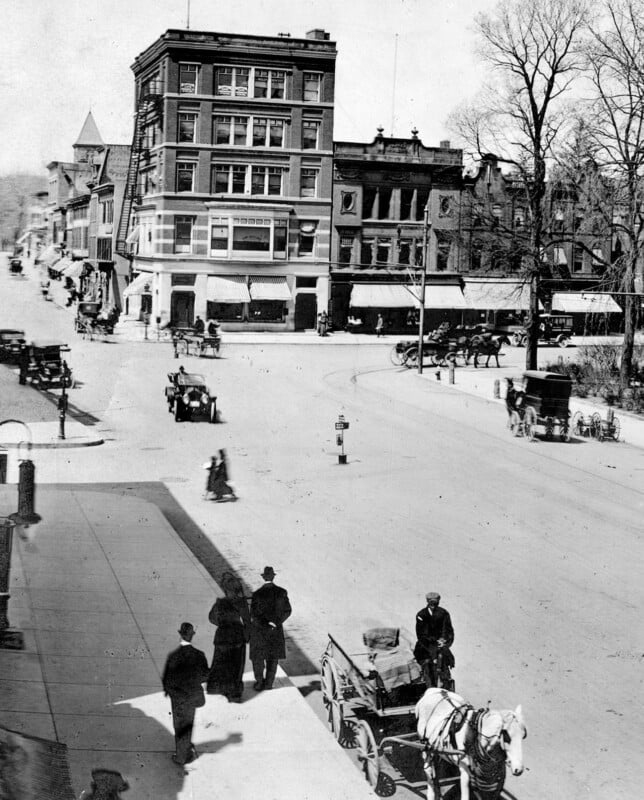 Zoom in and the 1910 panoramic offers a fascinating glimpse of life during the Progressive Era.
 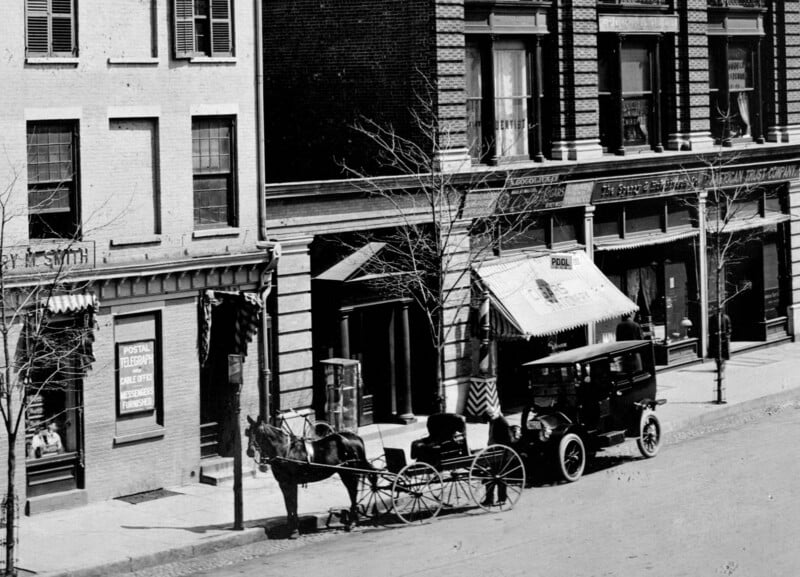 Here, a telegraph and cable office stands next to a cigar shop, dentist, and a pool hall on South Street as a horse and cart waits next to a Ford Model T, the motorcar was about to supplant the original horsepower.
 The Parker Brothers
Fiedler and Roshto tracked down the original contact print at their local library’s North Jersey History Center and verified that the original negative was several feet wide and eight inches tall.
“The only camera capable of creating an image like this at that time was a Cirkut No.8,” Fiedler says.
“Marshall and I then put our heads together to figure out how we could recreate the 1910 panorama. We considered stitching several large-format images together, but this was less than ideal since there would be a bit of distortion when stitching standard photos together along a curved scene.
“We also considered swing-lens cameras like the Horizon or vintage Panoram cameras, but the original perspective required something that could capture more than 180 degrees. Eventually we landed on procuring a Cirkut camera just like the original.”
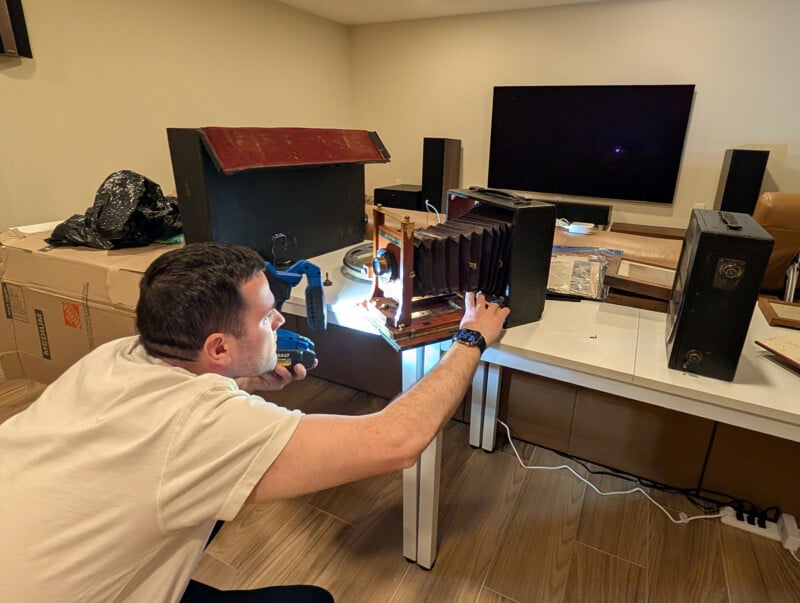 Marshall and Roshto had to engineer a working Cirkut camera.
Cirkut cameras are not only very niche but also very difficult to get hold of. The duo bought several non-functional models from eBay. Luckily, Roshto is an engineer by trade and he was able to get them working. Cirkut cameras are completely mechanical and work like old clocks with wind-up motors, gears, and a speed governor.
“Marshall was able to disassemble, clean, and tune until we had a really smooth panning Cirkut camera,” says Fiedler.
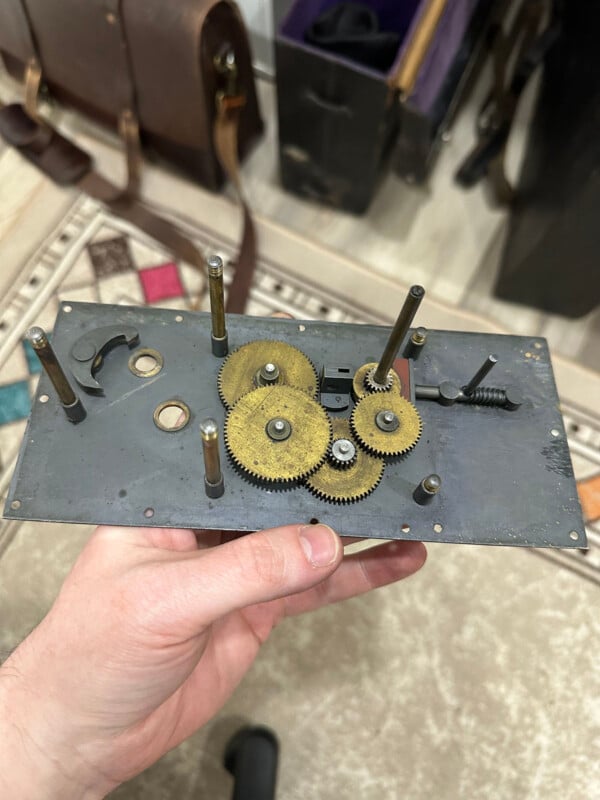 Deconstructed gear plate.
 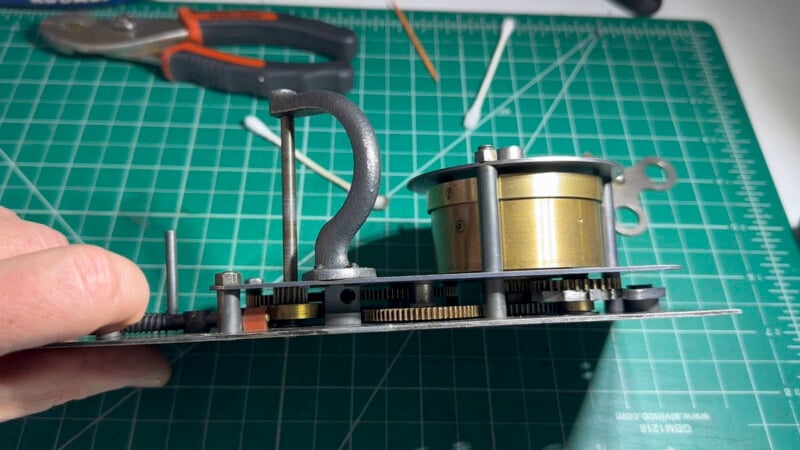 Repaired and cleaned internals.
A working rotating camera is one thing, but what about procuring the seven-foot-long film?
“The film is long out of production,” explains Fiedler. “Kodak used to make spools regularly, and Ilford will occasionally do an ultra large-format custom run, but we had access to neither.”
Fiedler spoke to online Cirkut expert Skyy, who makes custom rolls and sold Fiedler and Roshto a few of them.
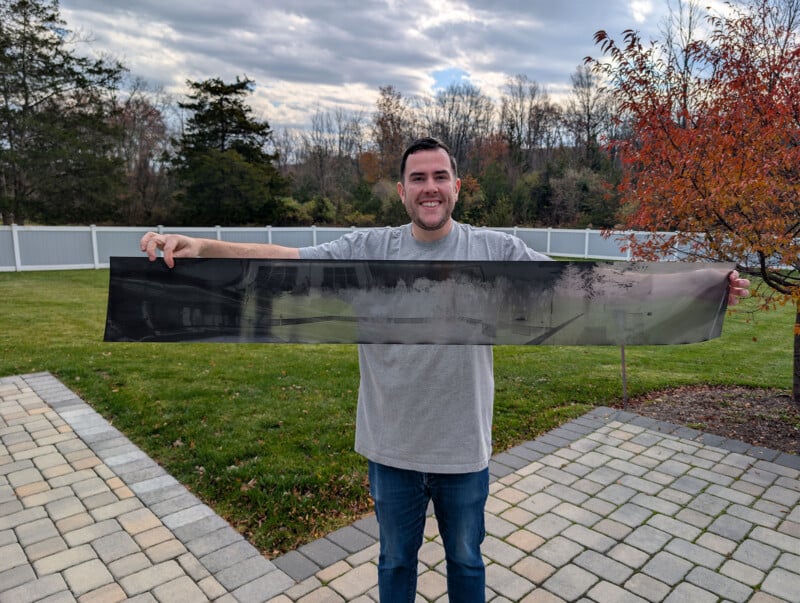 Marshall Roshto holds up one of the massive test negatives.
“For development, we cloned Drew Tanner’s setup, which was large but worked well,” says Fiedler.
“This was our first time doing darkroom work, but if you’re going to get into home development, this seemed like a heck of a debut.”
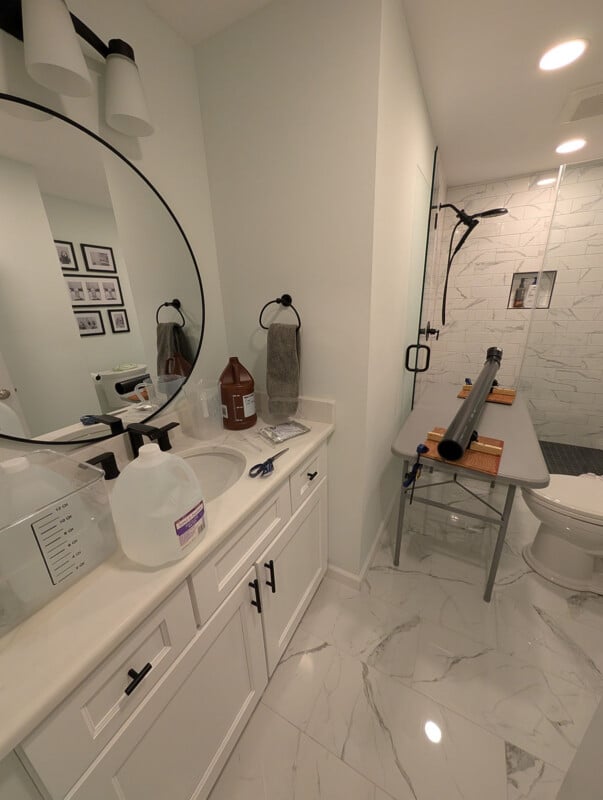 Turning a bathroom into a darkroom.
Plenty has changed in Morristown in the intervening century, including the balcony the Parker Brothers used to shoot the original photo on. Fiedler and Roshto applied for a permit to erect a scaffold on the sidewalk to match the 1910 perspective.
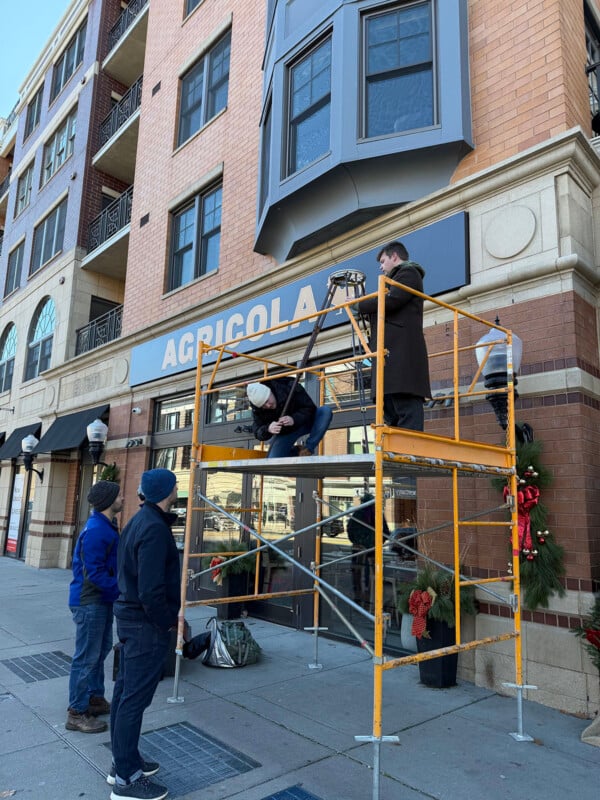 Setting up the scaffold.
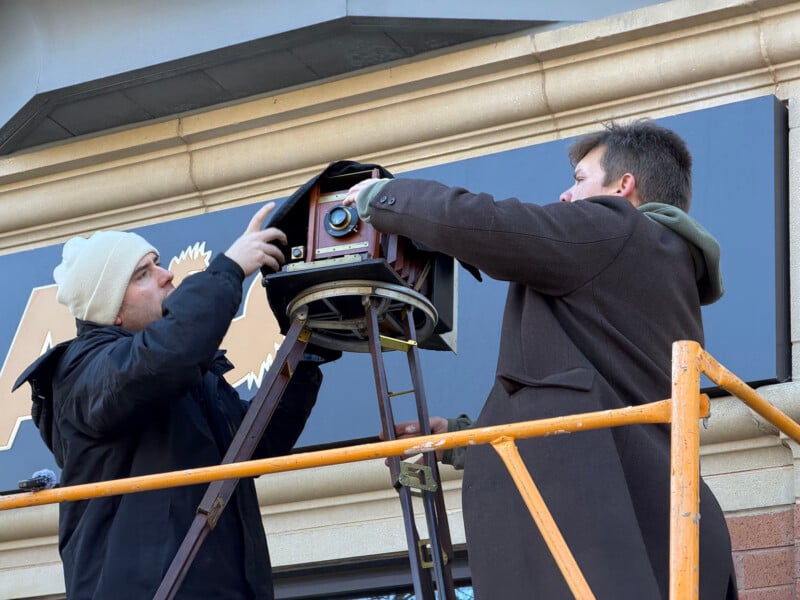
 Christian Fiedler and Marshall Roshto
The Parker Brothers
Their work has been received positively and the local library, where the pair first saw the original photo, now proudly displays their image side-by-side for comparison. It’s culminated in a show called Morristown: In Focus that visitors will be able to see through the spring.
Check out Primitive Pines for prints and to see high-res versions.
Update 3/6: Updated with link and typo correction.
Image credits: Photographs by Christian Fiedler and Marshall Roshto.