
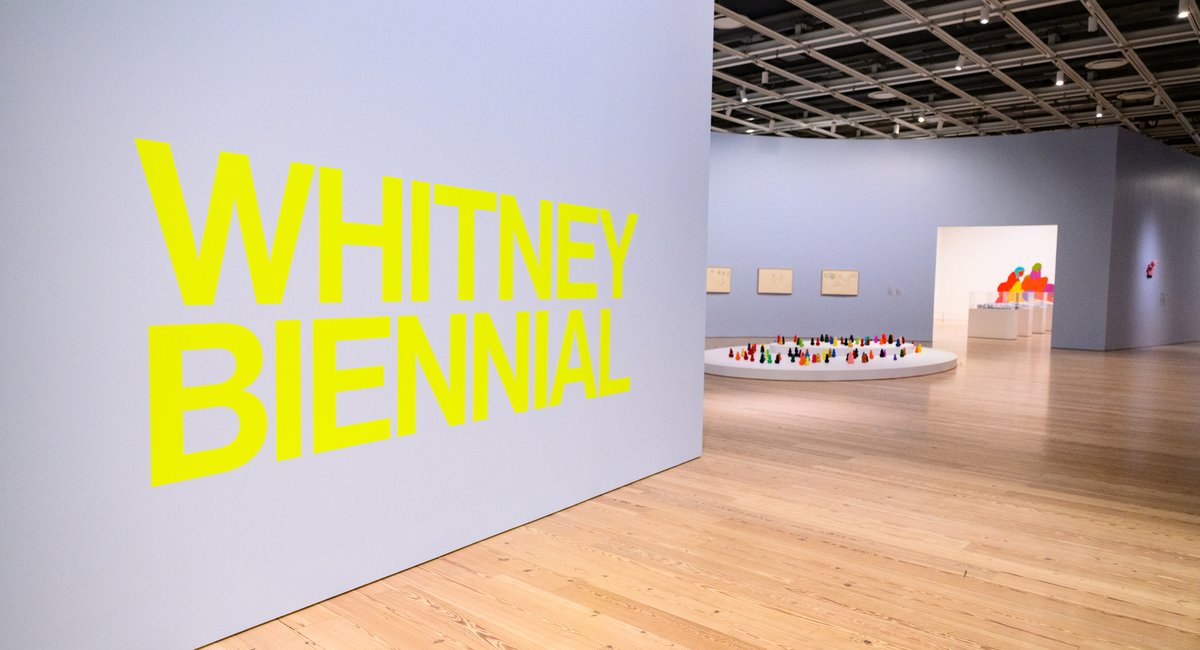
On a gray afternoon in Tribeca, painter Samia Halaby poured cups of tea from a fresh pot while Taína Cruz scrolled through her phone, looking for a photo she’d taken the day before. The photo was of one of her artworks on a billboard, installed across from the Whitney Museum to advertise its 2026 Biennial, the museum’s long-running group survey of contemporary American art, which opens Sunday.
The two artists were born six decades apart. Cruz was raised in Harlem and the Bronx and is the youngest artist in the show. Halaby, the oldest artist in the show, is a Palestinian born in Jerusalem and raised in Lebanon, who came to the United States in the 1960s.
They met for the first time in Halaby’s studio late last month, surrounded by luminous abstract canvases and hanging fabric works. Cruz arrived with the buoyancy of someone still metabolizing her graduate program at Yale. Halaby was direct and sharp, with decades of experience navigating (and often resisting) the art world’s structures.
They talked about ancestry and propaganda, billboards and perspective, Yale and rejection, the internet, intuition, money and what it means to keep making art across a lifetime. An edited transcript of the conversation follows below.
Samia Halaby: Taína, hi, it’s a pleasure to meet you. Do you have some pictures of your work on your phone?
Taína Cruz: I do [handing her phone to Samia]. They actually just put up this billboard at the Whitney yesterday.
Halaby: Is that a self-portrait?
Cruz: No. I mean, it could be. It is probably an extension from somewhere in my imagination. It’s a small painting, the original size is 16” by 20”. So it’s pretty cool to see it blown up like this.
Being from the city, I’m used to the billboards of Times Square. I’ve been around image-making so heavily, my sensibility is being surrounded by images, and then, yeah, growing up with the internet. I love the internet so much.
Samia, any strong feelings about the internet?
Halaby: I don’t have strong feelings about it. It came about within my lifetime, I was part of the very first collective art on the net group, which was called “Art on the Net.” So the internet, to me, I look at it more scientifically. It’s communication. I don’t love social media, I distrust it.
As a painter, I want to remain the artist. I don’t want anybody to stand between me and understanding both the history and the art of picture making. So if I use a paint program, they’re telling me how to paint to some extent. They’re saying, this is the area in which you can act. And I said no, I’m going to program my own things.
Samia, tell us about something you have in the show.
Halaby: [The Whitney] decided they would like to show my Omega programmed works from the 1980s. With the idea that no one was going to be between me and the computer, I started programming. The minute I ran the first graphics program, I knew there was something in this medium that was unusual.
I would tell myself, “Samia, people are gonna think you’re insane. You’re telling them you’re painting. They can see your painting only if they click one button to run the program.” So we ran the program, it ran for 30 seconds and then you saw a moving painting that made sounds.
So this is what The Whitney selected?
Halaby: Yes, 10 pieces from that period of time. I could have expressed preference, but they know what they want to make a coherent show, so I left them alone. I would have liked them to choose a painting to go with it, to show both. But in the world of contemporary exhibitions, they have a hard time just taking paintings when you have something a little more exciting.
Samia, is there something in your practice that’s gotten easier over time, or more difficult, or just changed in a way that you would remark upon to Taína?
Halaby: My practice changed considerably from the beginning to the end. When I left school I sort of crashed. “What am I going to do?” I decided that I had to clean my brain of all my teachers, because I’m hearing them whisper in my ear was good and what’s bad.
Then about 20 years later, I crashed again. I arrived at abstraction through the back door, by wanting to see how the eye saw and questioning perspective. So I started a group of paintings that progress slowly until I’m doing what I’m doing now. These are my last paintings.
Ten years from now, Taína, what do you imagine you’ll be doing?
Cruz: Still making art. I’ve been making art since I was 6 years old, I can’t imagine doing anything else in the world. Hopefully I’ll get a bigger studio space, just keep making.
What’s changed for me is I used to feel like I had to be in the studio 24/7 in order to make work that is truly meaningful. But in 2026, I’m going through a really internal transformation and I think that is what studio life is for me, taking time to make work but also to rest.
Samia, any thoughts on that?
Halaby: The creative process is a big question I’ve thought about and thought about. I just do things, and in the end, when the painting is near finishing, it becomes a fight. Either what I’m doing pleases the intuitive Samia, and she’s quiet and approving, or she doesn’t like what I’m doing, and so the painting refuses.
I give the painting a personality for fun. This painting is acting up, it’s refusing to be finished, I am angry with the painting and I go to bed. In the morning, I’m saying, “What was wrong with me? This is pretty good.”
I asked a friend once — because it’s a question you have when you’ve lived a long time and you’ve dealt with it day in, day out for 60 years — “Why do you think there are days that things go very well and days that things go very badly in the studio?” He said, “Maybe there are days when you’re feeling in harmony with your society and there are days when you’re not.”
You asked how long it takes to make a painting: Sometimes it’s one evening and sometimes it’s two years. Is just like: How nasty is this painting going to be?
What’s something that’s surprised you the most in your careers?
Halaby: The advantage I had in my career is that I was rejected all the way around and I had to either stop painting or say, “They don’t know what the art is about.”
Art is not about us. Can you imagine the Pope going to Michelangelo and saying, “Come here my boy, can you express yourself all over my ceiling?” Art was about the society, for the society, with the society. And it’s at its best when society is in revolution. The Renaissance was a revolution of capitalism against feudalism and it was beautiful at that point, but now it’s pretty rotten and backwards.
You learn they don’t make art, you make it. And if you didn’t make it, they wouldn’t have stuff to sell. So we are at the bottom of the totem pole, but we’re really in the lead ideawise.
Taína, what questions do you have for Samia?
Cruz: What do you do for fun besides the artmaking?
Halaby: At various times in my life, I’ve had hobbies. I had a hobby in studying Arabic grammar, I like playing number games. I get my news from Instagram, I threw away my TV. Instagram is lying, too, but at least I can pick and choose individual opinions. I like to go buy food and cook something occasionally. And I like being just lazy and vegetating.
Taína, what’s your answer?
Cruz: I do like to buy a special treat at a bakery, like to wander around my neighborhood. Luckily I have a dog. I like to play shooting games.
Samia, any other questions you had for Taína?
Halaby: It seems like she’s what I might have been in this age, if I were a young artist. She’s finding her way and I think she has good instincts, I think she’ll find a way moving forward. It’s a difficult world for an artist.