
 Save
Save
You have reached your maximum number of saved items.
Remove items from your saved list to add more.
Save this article for later
Add articles to your saved list and come back to them anytime.
Got it
AAA
Death touches everyone, sooner or later. Even cartoon characters. “You know the hardest thing/ is to say goodbye/ to someone you love,” is lead singer 2D’s recurring refrain on the new Gorillaz album, The Mountain. He may be an animated figment of Damon Albarn’s imagination, but the depth of feeling is no joke.
The Gorillaz are a ‘virtual band’ formed by former Blur frontman Albarn, and artist Jamie Hewlett in 1998. It features four fictional band members 2-D, Murdoc Niccals, Noodle and Russel Hobbs with their video clips released as animations, and the band’s imagery also featuring the characters.
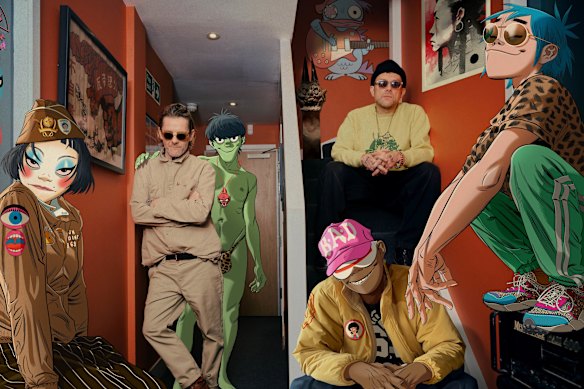 Jamie Hewlett and Damon Albarn and their Gorillaz characters. Gorillaz and Ruben Bastienne-Lewis
Their new album, The Mountain is about death and transcendence, swirling with voices of the dearly departed. The actor Dennis Hopper, Trugoy from De La Soul, Afrobeat architect Tony Allen, soul legend Bobby Womack, The Fall’s Mark E Smith and Detroit rapper Proof all chime in from the great beyond.
It’s a panoramic hour that plays like a journey along the edge of the proverbial veil. Anoushka Shankar’s celestial sitar, Ajay Prasanna’s divine flute and choral voices make like some sepulchral welcoming committee. If this is cartoon pop, it’s come a long way from The Archies’ Sugar Sugar.
But haven’t we all? Apart from the fallen comrades named above, Albarn and Gorillaz’ visual artist Jamie Hewlett both lost their fathers within 10 days in 2024. The Mountain is a creative act of public grieving and personal reckoning. Even virtual pop stars have to grow up and face that music.
Gorillaz would be acquainted, no doubt, with canonical explorations of bereavement like Neil Young’s Tonight’s The Night and Lou Reed’s Magic and Loss: works made in the throes of grief to try to make sense of the kind of questions that popular music, certainly in their time, was designed to ignore.
In the early 2000s, Johnny Cash and George Harrison were among the first ’60s legends to make final albums in the conscious shadow of their imminent departures. As the rock ′n’ roll years took their toll, it made sense that the more thoughtful survivors would begin composing their own last testaments.
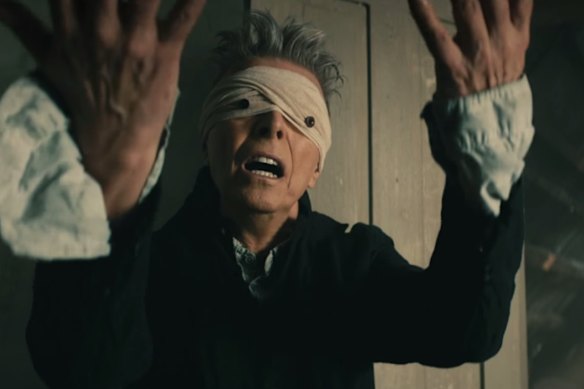 David Bowie in the video for the release of his final album Blackstar – made just before his death aged 69.
The death album concept escalated dramatically when David Bowie released his swansong, Blackstar, 10 years ago. The opening line of Lazarus – “Look up here, I’m in heaven” – was instantly immortal when he died days after its release on his 69th birthday.
That same year, again within days of his passing, Leonard Cohen’s You Want It Darker didn’t flinch either. More overtly spiritual in life and closer to a fair innings at 82, he regarded the abyss with less of Bowie’s trademark dread but enough deathbed doubt to keep it real.
Songwriters reflecting on mortality was not new. What changed was the scale. In the hands of such monumental figures, the final curtain became an epic canvas that amplified the human condition in ways that fans would unpick forever.
Not that younger generations of songwriters needed permission to grieve out loud. Kurt Cobain made raw psychic pain the lingua franca for Generation X. By the 2010s, the “personal truth” imperative of the new confessional wave had no time for their grandparents’ notions of discretion and decorum.
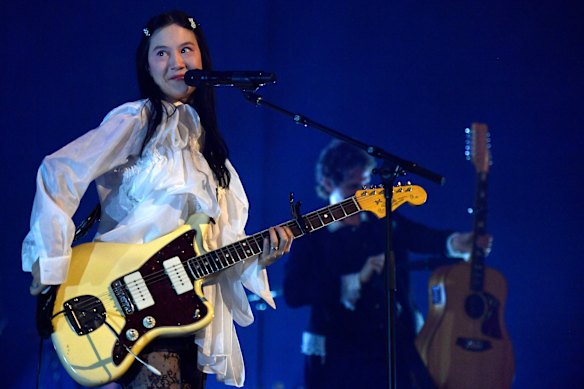 Japanese Breakfast frontwoman Michelle Zauner performing in Melbourne last year. ©Martin Philbey
When Sufjan Stevens released Carrie & Lowell in 2015, it felt weirdly transgressive: a son cataloguing a complicated relationship with his late mother. As Mount Eerie, Washington indie-folk artist Phil Elverum went way further with A Crow Looked at Me, recorded in the room where his wife had died weeks earlier, refusing metaphor and resolution to become a critics’ favourite in 2017.
From Rufus Wainwright’s sombre All Days Are Nights to Japanese Breakfast’s perversely upbeat Psychopomp to the hardcore fury of Touche Amore’s Stage Four, the song cycle processing a lost parent has become a potent genre unto itself, a shared gothic undertow to pop in all its forms.
Nick Cave’s part in this conversation is hard to ignore. After the death of his son Arthur in 2015, his albums Skeleton Tree and Ghosteen opened a space for public sorrow in the music community that’s grown into a vast, rolling support network via his Red Hand Files forum.
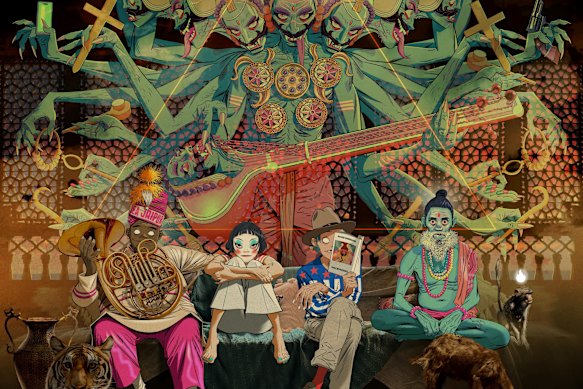 Damon Albarn and Jamie Hewlett recorded the new Gorillaz album while travelling In India.
In fans’ letters, he sensed “a need to speak about their own suffering so that another human being could acknowledge it,” Cave told Sean O’Hagan in their book Faith, Hope and Carnage. “I felt it pointed to a form of healing through the combined acts of telling and listening.”
Again, the new thing is the scale of the audience. Western thinkers such as Elisabeth Kübler-Ross have long argued that modern societies avoid talking about death at their peril. Many Eastern traditions, of course, have been there for centuries: death isn’t taboo, it’s just part of the trip.
Which brings us back to The Mountain. Much of it was recorded in India, where Albarn scattered his father’s ashes in the Ganges River according to Hindu custom. Sessions traversed the world from Morocco to Argentina and beyond, as Gorillaz’ elastic sprawl of collaborators conversed from both sides of the veil: the living and the dead in healing communion.
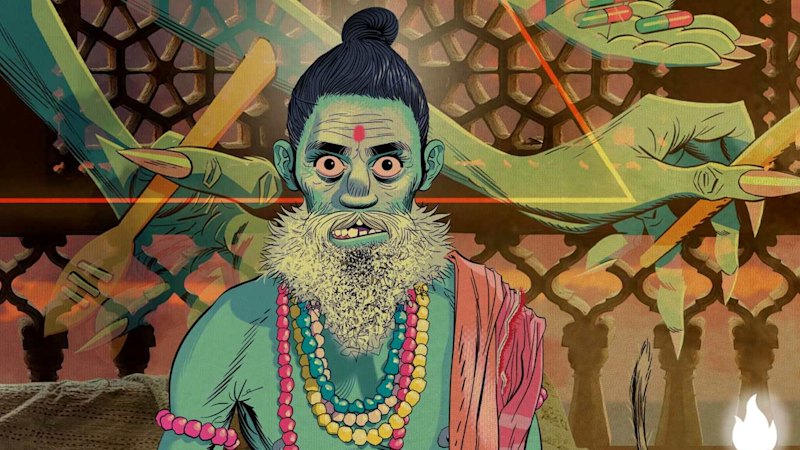
Hewlett’s stunning accompanying cartoon, The Mountain, The Moon Cave & The Sad God, elaborates on the idea of life/death as a continuing journey. He and Albarn’s alter egos, Murdoc and 2D, and bandmates Noodle and Russel venture silently through the jungle towards … well, “the end is the beginning”, the enigmatic pitch goes.
“The band has turned its back on international pop stardom,” the official Gorillaz narrative continues, “with our heroes now immersed in the rhythms of mystical music-making, as they navigate the mountainous terrain of this thing called life.”
It’s a profound twist for a virtual band that began as a cheeky reaction to the churn of the 21st-century pop machine. Given the immense size and demographic spread of their audience, an album with something to say about death that’s heartfelt and uplifting as well as catchy as hell is a radical addition to the big cartoon of modern pop.
Nine albums and countless members deep in a limitless collage of musical styles and visual spectacle, who can say where the mortal elements of Gorillaz begin and end? On The Mountain, the dead are not memorialised, they’re just dialled up and mixed into something ready to pack into trucks, aeroplanes and hard drives for an epic “live” tour that kicks off in the UK next week.
That’s about as close to immortality as pop gets.
The Mountain is out now.
Save
You have reached your maximum number of saved items.
Remove items from your saved list to add more.
From our partners