
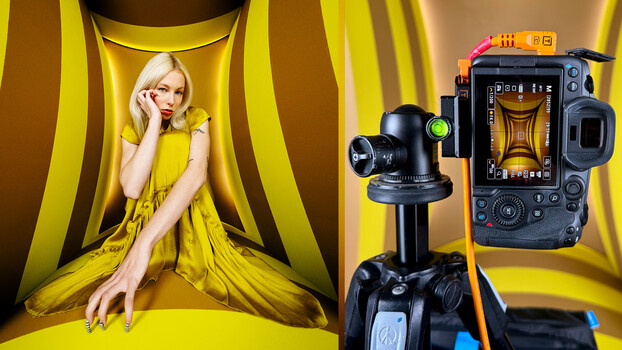
Most photographers do not get creatively stuck because they stop shooting. They get stuck because their process becomes too efficient.
That is where we were. Then I heard this quote by the art critic Jerry Saltz, and it unlocked something. This was the quote.
“Art is slow, physical, resistant, material; it involves an ongoing commitment to doing the same thing differently over and over again.”
— Jerry Saltz
Our sets were working. The images were working. The system was dialed in. But somewhere along the way, the ideas started to feel boxed in—literally. We kept building the same types of sets over and over again. Boxes. Clean lines. Rectangles. They photographed well. They were reliable. But they also started to feel familiar in a way that limited us. We knew that staying inside those familiar structures was slowly narrowing the way we were thinking about our photography.
David is the builder. I am the photographer. And together, we could feel that our process had become a little too comfortable.
We were not tired of making. We were tired of building boxes.
When Familiar Structures Start to Feel Limiting
Most of our sets live inside some version of a box: flats, walls, floors, ceilings. For a long time, that structure served us really well. But eventually, we realized we were tired of building boxes—not because they stopped working, but because everything started to feel the same.
And that feeling is familiar to a lot of photographers. You can be busy, productive, even successful, and still feel boxed in creatively. The process becomes reliable, and before you realize it, you start to feel bored and uninspired by something that used to push you creatively.
We knew we needed to break the box—literally.
At first, we tried to design something completely different. Nothing landed. Then the idea flipped. What if we did not abandon the box, but warped it? What if the walls curved inward, like the space itself was squeezing the subject?
Once that idea was sketched out, everything clicked.
Letting Materials Lead the Design
The biggest challenge was structural. The walls and floor needed to bend, but they also needed to support a human body. That led us to bendy plywood, essentially luan with the grain running in one direction so it can curve.
The floor was the hardest part. It required extensive bracing to hold the model’s weight without collapsing. When everything finally came together, the effect was exactly what we hoped for. The walls felt like they were squeezing inward. The floor subtly lifted.
This was not a look we could create in post. The tension, compression, and distortion had to exist physically in front of the lens for the posing to feel believable.
Shooting for Exaggeration, Not Digital Distortion
Image by Jada and David Parrish | https://www.jadaanddavid.com
From the start, lens choice mattered. Every build decision was made with the final camera angle in mind. The plan from the beginning was to shoot this set with the Canon RF 10–20mm f/4 L IS STM because it exaggerates perspective, makes spaces feel much larger, and corrects fisheye distortion.
We shot the set two ways. First, from farther back so it read almost like a framed photograph. Then, from inside the set, pushing the camera past the walls. Once the camera crossed that threshold, everything stretched and elongated in a way that amplified the tension.
Color, Conflict, and Control
The color palette came from a thrifted dress. That yellow-green that sits right on the edge of agreement: Is it green? Is it yellow? That tension felt right for a set about control and discomfort.
We paired it with gold paint, which quickly became an obsession. The stripes were another intentional choice. We wanted as many leading lines as possible to accentuate the curves of the set.
Stripes are tedious: measuring, taping, repainting. But this project demanded patience, and resisting that process would have undercut the concept entirely.
Directing Emotion Inside an Unstable Space
Once the model stepped into the set, everything changed. Even holding a basic pose felt difficult. That physical discomfort became part of the story.
The narrative was about control—about being placed into a space you did not choose and having to adjust your body and emotions to survive inside it.
Image by Jada and David Parrish | https://www.jadaanddavid.com
We started with simple poses so the model could acclimate, then gradually pushed into more intense, distorted positions. As a photographer, I have found that giving models specific emotional scenarios produces stronger, more repeatable results than vague direction, especially in physically demanding sets like this.
Frustration. Boredom. Panic. Resistance. The walls are closing in, and you are fighting back.
That specificity is what made the images feel alive.
Why This Set Mattered More Than the Final Images
The final images were surreal and trippy, exactly what we hoped for. But the real value of this shoot was what it unlocked creatively.
We did not invent a brand-new process. We did the same thing differently. We changed the material. We changed the shape. We let the resistance of the build guide the idea instead of fighting it.
For us, this set was not about novelty. It was about adjusting one variable in a familiar photographic process and letting that shift ripple through composition, lens choice, direction, and emotion.
If you are feeling creatively stuck as a photographer, the answer might not be more inspiration. It might be a new piece of gear, a method of shooting, or a material constraint that forces you to see differently through the camera.
Before your next shoot, it can help to pause and ask a few simple questions: What part of your process feels most automatic right now? What constraint have you been avoiding because it feels inconvenient or inefficient? If you changed one physical element—a material, a space, a lens, or even how the subject interacts with the environment—what might that unlock? Creative growth does not always come from adding more. Sometimes it comes from putting gentle pressure on what already works.
That is where this set came from. And honestly, that is where some of the best work starts.
Check out the YouTube video to see the full set build and a behind-the-scenes look at the shoot.