
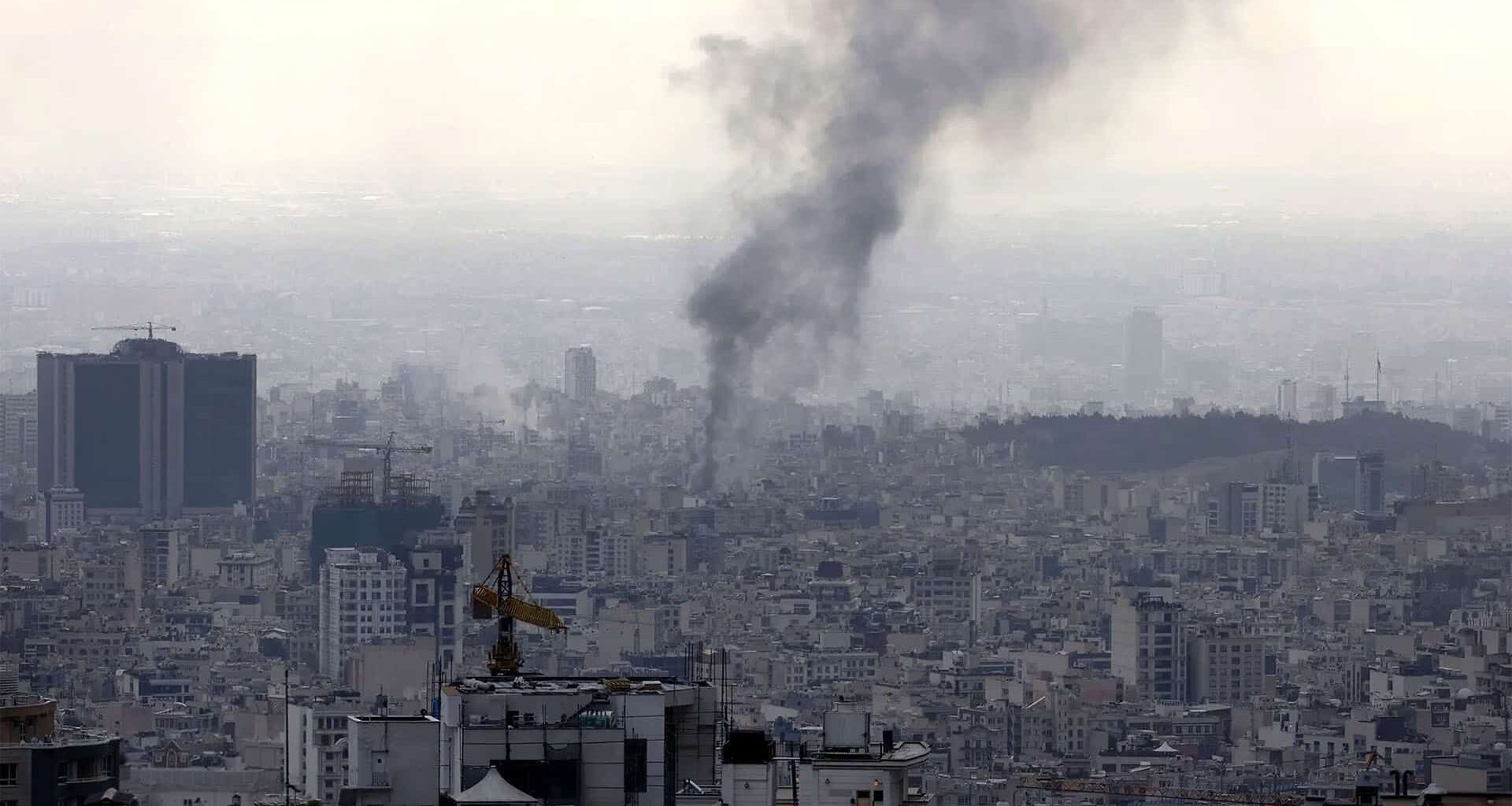
Shiny, futuristic skylines across the Arab Gulf, once touted as symbols of affluence, stability and ambition, now circulate on social media shrouded in smoke, with the debris of intercepted missiles scattered beneath their glass façades.
From Riyadh to Abu Dhabi, from Baghdad to Beirut, previously contained disputes now collide, creating a sprawling theatre of war that threatens to envelop the entire region. For the first time, the Gulf states are fully drawn in and this conflagration, ignited by US and Israeli strikes on Iran and Tehran’s sweeping retaliatory campaigns, could become the Middle East’s own Great War in which multiple conflicts converge and the regional order is irreversibly reconfigured.
It is a fragmented, multi-player struggle where influence, ideology and survival intermingle, making escalation harder to curtail.
To understand how unprecedented this is, it helps to look back. The region’s conflicts in the 20th century, though brutal, were far more conventional. The Arab-Israeli wars between 1948 and 1973 saw Egypt, Jordan and Syria facing off against Israel in largely state-on-state combat, with clear frontlines and armies. The Iran-Iraq War (1980-88) unfolded as a gruelling, attritional struggle, marked by trench warfare, mass casualties and prolonged stalemate, emerging as the longest conventional war in the 20th century. Iran’s then newly formed Islamic Republic fought that war alone, with no international allies, while the USSR, the US and France, along with all the Gulf states aided Saddam Hussein’s Iraq. Later, the Gulf Wars of 1991 and 2003 pitted Iraq against the US-led coalitions, relying on firepower and technologically advanced militaries. These conflicts were primarily battles between nation-states with defined combatants.
US President Donald Trump promises this conflict will end in the ‘four weeks’ he has predicted. But the current conflict should already be recognised as the US’s third Gulf War. Four weeks is a long time for a Middle-Eastern war. The 1991 Gulf War lasted six weeks, and the 2003 Iraq War concluded in less than a month. Nevertheless, the last war did not really end when George W. Bush declared ‘Mission Accomplished’ on a carrier off the coast of San Diego, as insurgency broke out and the Islamic State, a terrorist group that still exists today, emerged. The unintended consequences of this Third Gulf War are already dire and could easily escalate into a wider regional Great War involving non-state actors.
This is because the evolution of regional rivalries complicated the picture. During the Arab Cold War of the 1950s through the 1970s, states like Egypt under Gamal Abdel Nasser squared off against Saudi Arabia, Jordan, Syria and Iraq, often through direct interventions, most famously in Yemen, while battles remained largely between governments. Today, however, the ‘cold war’ has changed. Iran and Saudi Arabia vie for dominance through proxies, with Egypt playing a more peripheral role. Militias, armed factions and other non-state actors now fight on behalf of external powers, turning the battlefield into a complex web of asymmetric warfare. The conflict is no longer defined solely by borders and armies. It is a fragmented, multi-player struggle where influence, ideology and survival intermingle, making escalation harder to curtail.
The most recent eruption underscores how these proxy networks operate in practice. On 7 October 2023 Hamas launched a large-scale attack on Israel, prompting swift military responses from both Israel and the US. Tehran was widely blamed for orchestrating the assault, despite no conclusive evidence of direct orders. This is a hallmark of 21st century proxy warfare, where influence is exerted through intermediaries rather than formal armies. The dynamic recalls the Lebanese Civil War, when multiple states backed factions within a single conflict. Still, today’s crises span far wider geographies and inflict unprecedented destruction. From Libya to Yemen, Syria to Iraq and Gaza to Israel, the human and economic toll has been immense.
The spectre of a ‘Great War’
Taken together, these overlapping crises evoke the spectre of a ‘Great War’ in the Middle East, reminiscent of Europe’s world wars, where separate conflicts intertwine across the region, creating a vast and chaotic theatre of combat. The stakes have never been higher. The Gulf states are fully engaged and urban centres have become combat zones, placing civilians directly in harm’s way. The array of actors is equally diverse, from militias to monarchs, sheikhs, military commanders and presidents, many of whom remain cautiously taciturn, waiting to see where the chips may fallas the regional balance shifts.
In addition to conventional and proxy battles, the conflict increasingly reflects elements of 5th generation warfare, where frontlines are blurred and the war extends into cyber, media and social networks. Social media, influencer content and AI tools accelerate the spread of disinformation and propaganda, skewing perceptions, inflaming sectarian tensions and obscuring the truth about attacks and casualties. Deepfakes, AI-generated imagery and misleading narratives allow rival actors to project influence beyond traditional battlefields, complicating responses by civilians, regional leaders and external powers alike. The digital and informational battlefield has become just as consequential as the physical one.
Against this backdrop, traditional institutions such as the Arab League and the Gulf Cooperation Council face an enormous strain, with their relevance and capacity to mediate the conflict put to the test. They may not withstand the pressure, and their ability to endure is increasingly uncertain as the region’s political architecture is reshaped.
The Middle East today may be witnessing its first ‘Great War,’ where overlapping conflicts, proxies and rivalries intersect across borders and cities. Like Europe’s world wars, this maelstrom could either entrench divisions for generations or lay the foundation for a new order of coexistence. Its conclusion may produce a regional equivalent of the Treaty of Versailles, a comprehensive agreement redefining borders, political authority and mechanisms for managing disputes, or a charter for an organisation capable of sustaining peace. In the end, the region will either descend into intractable chaos or finally achieve what has so far remained elusive, a durable peace.
Tragically, the former seems more likely. Whereas the Paris Peace Conference benefited from a US President, Woodrow Wilson, genuinely aiming to create the League of Nations and secure lasting stability, the current constellation offers no such vision. With his transactional instincts and unpredictability, the current US President may be the ‘trump card’ in this scenario. Some analysts speculate that regional chaos and disorder might, paradoxically, align with certain strategic aims. A fragmented landscape can empower select actors while undermining systemic constraints. In this context, the Middle East may be drifting towards a scenario where disorder is not merely a byproduct but, for some, a calculated feature of the regional order.