
By Lauri Myllyvirta and Belinda Schäpe
China has released the draft outline of its 15th Five-Year Plan, setting out the country’s development trajectory for 2026 to 2030, including key climate and energy targets. The plan is highly supportive of clean energy across the board, but still refrains from setting strong, measurable targets to reduce emissions or fossil fuel consumption. The clean energy boom has a real chance of keeping China’s CO2 emissions on a downward path. Yet, the policymakers were not prepared to make such a commitment.
The coming five years will determine whether China can achieve its headline climate targets. China stands at a critical juncture where emissions have started to level off, thanks to clean energy meeting all of the electricity demand increase, but there is still a large pipeline of coal power projects looming and limited progress in industrial decarbonisation.
This new five-year plan sees policymakers walking back the earlier commitment to gradually reduce coal consumption and power sector emissions, and set a less strict carbon intensity target than for the previous five years, allowing emissions to increase over the five-year period.
The overall approach to the plan continues to be to scale up clean energy and cleantech industries, relying on falling costs and increasing supply of clean energy to drive down emissions rather than focusing on strong, measurable emission targets.
Uncertainty over emissions trajectory
The target for CO2 intensity is the most important climate target in the plan, as it determines to what extent emissions can continue to grow before they must peak at the latest by 2030 in line with China’s international climate pledge made by President Xi. In 2021, President Xi pledged personally to reduce carbon intensity 65% below 2005 levels by 2030. However, this target is now at risk based on the newly revealed five-year plan.
The plan sets a target to reduce CO2 emissions per unit of GDP by 17% from 2026 to 2030. This is well below what would be needed and even lower than the 18% set for the previous five-year period, which was missed by a large margin.
China’s reported annual carbon intensity improvements in 2021-25 only add up to a reduction of 12.4%, putting the country severely off track from the country’s Paris commitments, which would have required an 18% reduction over the same period. A stronger target for the 2026-30 period would have made up for the shortfall. Instead, the new five-year plan states that carbon intensity fell 17.7% over the past five years, and sets an even lower target for the next five years of 17%. China’s decision-makers decided to meet the target by revising past data rather than ramping up efforts.
The newly suggested definition of CO2 intensity now includes not only energy emissions but also industrial emissions, making it much easier to claim higher emission reductions with the slowdown in cement production due to the real estate sector’s decline. But even this change cannot account for the entirety of the data revision.
The revision of the carbon intensity numbers is dramatic: the 12.4% carbon intensity drop reported in annual statistical communiques, combined with reported GDP growth, implies that CO2 emissions went up by 13% from 2020 to 2025. Whereas if carbon intensity fell 17.7%, then that implies that emissions only went up 6%.
The 17% carbon intensity target allows China’s CO2 emissions to increase by 3-6% over the next five years, assuming 4.5-5.0% GDP growth. Similarly, the 3.8% target for this year allows emissions to increase 0.5-1.0% with 4.5-5.0% GDP growth. In contrast, without the data revision, a 2% reduction over the five years would have been needed.
While the draft plan for 2026 states that this will be the first year of China’s transition from controlling the total amount and intensity of energy consumption to controlling the total amount and intensity of carbon emissions, it only offers a CO2 intensity target and no target for the total amount of emissions.
The lack of clarity on how the new system will be implemented and what targets it sets creates uncertainty that still leaves room for emissions to continue growing.
Ambiguous signals on coal
The plan calls for ‘promoting the peaking of coal and oil consumption’. This is clearly walking back the commitment to gradually reduce coal consumption made by President Xi back in 2021, targeting a plateau instead and specifically leaving space for coal consumption in the power and chemical sectors to grow past the targeted peak of overall coal consumption. The plan did not confirm earlier suggestions by Chinese state media that coal consumption would peak by 2027 and oil by 2026.
A statement on ‘strengthening the clean and efficient utilisation of fossil energy’ is included, which is essentially code for the development of the highly carbon-intensive coal-to-chemicals industry that has been a major driver of China’s emissions growth. The policy direction also suggests a push to strengthen and upgrade major chemical industry bases, signalling continued support for expansion of the sector. Instead of limiting the growth of the industry, the plan is to try to reduce its carbon footprint by integrating the use of green hydrogen and biomass.
What remains acutely missing from the 15th five-year plan are binding caps on coal consumption in the power sector, with a declining trajectory toward 2030, translating China’s carbon-intensity target into an operational constraint on coal power generation. Similarly, there is no explicit power-sector emissions peaking target, ensuring that power-sector emissions do not increase during 2025–2030 and providing a binding constraint against further coal power expansion.
To achieve the key targets, it would be crucial to limit net growth in coal power capacity at the beginning of the five-year period by halting approvals for new and reactivated coal power projects and tightening permitting standards for projects still in the pipeline. The previous five-year plan called for ‘reasonably controlling the scale and pace of coal power development’, whereas this formulation is absent from the current one. Similarly, there remains a lack of clarity on the retirement of coal power units that are ageing, inefficient or persistently underutilised.
China’s planning agency highlights that the growth in electricity generated from renewable resources in 2025 surpassed the annual increments in China’s total electricity consumption for the first time. However, there is no mention of the ongoing transition of coal power from baseload generation source toward a more flexible, supporting role in the highlighted ‘new type power system’.
The plan does refer to replacing 30 million tonnes of coal consumption per year with cleaner alternatives. However, the scale of this effort remains modest relative to China’s overall coal use, which reached 3.17 billion tonnes in 2025.
Clean energy as key driver for emission reductions and the economy
Throughout the plan, there is considerable emphasis on the role of clean energy, both in the context of the energy transition and emissions, but also for economic growth.
A new action plan will be implemented to double non-fossil energy in ten years. If this means doubling total use of non-fossil energy from 2025 to 2035, it could be significantly more ambitious than China’s existing targets of 25% non-fossil energy by 2030 and 30% by 2035, and it sets a very actionable planning target, representing a step forward. If total energy demand grows around 2.5% per year, then the share of non-fossil energy would need to reach 29% by 2030 to deliver the required reduction in carbon intensity. But the target remains purposefully ambiguous.
Building a ‘new type power system’ remains a key goal. The new system should be capable of incorporating large amounts of variable wind and solar, and built around storage, smart grids, interprovincial electricity trading, and large-scale transmission. This includes ‘vigorously developing’ battery energy storage and building 100GW of pumped hydro storage.
Beyond the power system itself, the plan also points to hydrogen and nuclear fusion as potential new drivers of economic growth. In the case of hydrogen, the focus is on developing supporting infrastructure and integrating hydrogen into industrial, transportation fuel and energy systems. Nuclear fusion is highlighted as a frontier technology, signalling ambitions to position China in what is becoming an increasingly competitive race to commercialise next-generation energy technologies.
The plan targets the continued expansion of gigantic clean energy bases, which have been a key driver of solar and wind development during the past five years. The bases include both the northwestern desert bases, which have been most significant in the past five years, and a new emphasis on bases in the southwestern, hydropower-rich provinces, combining solar, wind and hydropower.
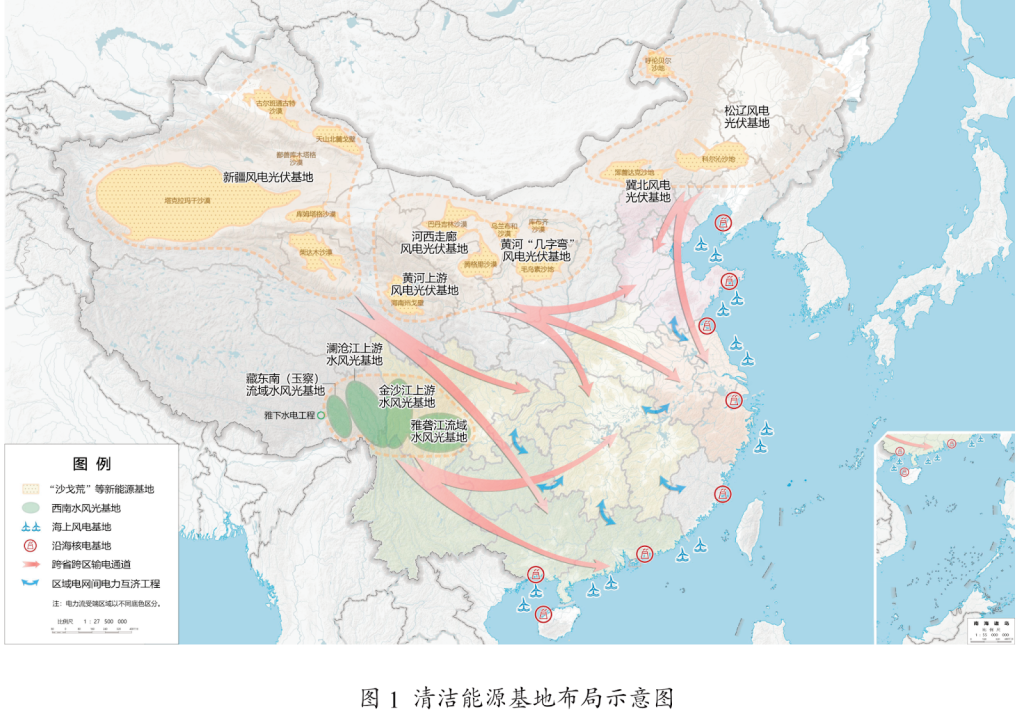
Note that this map is taken directly from the draft outline of China’s Five-Year Plan and does not imply the expression of any opinion whatsoever by the Centre for Research on Energy and Clean Air (CREA) concerning the legal status of any country, territory, city or area or of its authorities, or concerning the delimitation of its frontiers or boundaries. Yellow areas: desert new energy bases; green areas: southwestern water-wind-solar bases; wind turbines: offshore wind bases; red circles: coastal nuclear bases; red arrows: cross-region electricity transmission channels; blue arrows: cross-province electricity exchange projects.
Map of clean energy bases and electricity transmission routes in China’s 15th Five-Year Plan
However, it offers limited clarity on the overall scale of renewable expansion needed in the coming years. China has already reached its previous target of 1,200GW of solar and wind capacity in 2024, and the new long-term goal of 3,600GW by 2035 implies an average pace of roughly 200GW per year. If energy demand continues to grow rapidly, particularly with the expansion of manufacturing and electrification, a faster buildout of around 300GW per year is needed to keep the energy transition on track.
Another new development is a major emphasis on hydropower development, including the controversial Medog hydropower station and advancing planning of hydropower in the Nu river, a long-standing point of contention between hydropower developers and proponents of conservation and tourism. These also come in the context of China targeting new infrastructure developments in the face of the real estate sector slowdown.
Offshore wind is to reach over 100GW, up from 48GW at the end of 2025, implying over 10GW per year added. This is less than the 150GW cumulative capacity and 15GW per year added that the industry is aiming for, but still significant.
The development of concentrating solar power (CSP) gets a mention, perhaps surprisingly, as the technology has been thoroughly sidelined by solar photovoltaics during the past decade.
Nuclear power development will continue, but continue to be restricted to coastal sites, significantly limiting the potential of the industry. The target is 110GW of capacity by 2030, up from 62GW at the end of 2025, implying 10GW per year added during the five-year period.
Industrial decarbonisation is taking on new momentum
Two key zero-carbon infrastructure initiatives have been raised prominently in the new five-year plan: zero-carbon industrial parks and transport corridors.
Zero-carbon industrial parks are a significant initiative to decarbonise industrial energy use, involving direct clean electricity supply and green hydrogen supply for industrial plants.
Building zero-carbon transport corridors is a new initiative focusing on improving rapid charging and battery swapping infrastructure along the busiest transport routes to enable electrified freight and passenger transport. This comes following an ambitious plan unveiled last year to double the charging infrastructure over the coming three years.
A new major focus is on hydrogen and other green fuels. While the priority of clean energy development has been to displace coal in power generation, there will be more emphasis on replacing oil and gas in industry and transport, in line with China’s energy security goals. It also reflects concerns about being able to integrate all of the solar and wind being built into the grid.
As a part of the efforts to begin controlling carbon intensity and total carbon emissions, the government vows to ‘place all fixed-asset investment projects under strict energy conservation examination and carbon emissions assessment’. The requirement is achieving emission reductions at least equal to the emissions from the project elsewhere before launching a new high-emission industrial project. The regulators will also push to eliminate ‘outdated’ industrial capacity.
The plan also proposes, for the first time, exploring benefit-sharing mechanisms between regions that transfer industries and those that receive them, including carbon emission indicators, to support the orderly relocation of key industries within China. This reflects a practical challenge as carbon constraints tighten. Regions hosting heavy industry tend to bear the bulk of emissions and environmental pressure, but are also reluctant to lose the perceived economic benefits. Allowing some sharing of fiscal revenues and carbon quotas could help facilitate industrial relocation: the sending regions could retain part of the tax base while easing its emissions burden, while the receiving region would gain some fiscal benefits while taking on additional emissions. At the same time, it raises questions about how regional carbon targets will be managed. If emissions indicators become part of inter-regional bargaining, emissions could increasingly shift geographically as industries relocate, making it harder to track progress at the provincial level. Much will depend on how these mechanisms are implemented in practice.
Conclusions
China’s 15th Five-year Plan continues the pattern in the country’s climate policy established in the past five years: strong support for scaling up clean energy and emerging low-carbon industries, but continued caution when it comes to setting firm constraints on fossil fuel consumption and emission growth.
China’s decision-makers will see the escalating U.S.-Israel-Iran war and disruption of oil and gas shipments through the Strait of Hormuz as a validation of their emphasis on energy security and reducing reliance on oil and gas imports. Clean energy, electrification and green fuels are playing an increasing role within that strategy. In general, higher fossil fuel prices will speed up the transition by making clean energy more competitive, but will also boost the coal-to-chemicals industry by increasing the margin between the price of oil and domestic coal.
China is positioning its energy transition not only as a domestic energy security and decarbonisation effort but also as part of a broader attempt to shape global standards and technologies in the low-carbon economy. Through expanding clean-energy industries, infrastructure and supply chains, Beijing aims to contribute what it often describes as a ‘Chinese solution’ to global sustainable development and to provide more green public goods to the international community.
For this ambition to carry credibility internationally, however, progress at home will remain decisive. Accelerating domestic energy transition will be essential if China is to demonstrate that it can deliver the ‘green and low-carbon Chinese solution’ it promotes as part of building ‘a community with a shared future for mankind’.