

The global plastic pollution crisis could be solved within 15 years and for less than $1 billion, according to an ambitious plan to stop litter getting into the oceans.
Boyan Slat, an inventor, environmentalist and the chief executive of The Ocean Cleanup, a nonprofit organisation, argues that to call his plan a bargain would be to sell it short.
“It is the world’s cheapest problem to solve,” the 31-year-old said. “If we’re off by a factor of two or three, it’s still the cheapest world problem. Even if we’re off by a factor of 100, it’s still the cheapest world problem.”
But, crucially, he added: “It’s not solved yet. We still need to raise a significant amount of money, and there is a big execution challenge.”

Boyan Slat
THE OCEAN CLEANUP
His confidence relies on research that suggests that stopping pollution in just 30 cities around the world will cut a third of the plastic waste that enters the oceans. Slat plans to tackle these first 30 cities by 2030 at a cost of $350 million (£260 million).
His method uses floating barriers to trap plastic in the cities’ rivers. If it cannot be scooped up by traditional excavators, “interceptors” — autonomous boats with conveyor belts — are sent to gather the waste and send it for recycling or disposal.
The momentum from that would enable the charity to stop 90 per cent of floating plastic from entering the ocean by 2040, and to clear up the “legacy” waste, particularly in hotspots such as the “great Pacific garbage patch” — an accumulation of about 100,000 tonnes floating between Hawaii and California. In total, he believes, it would cost less than $1 billion.
“So 2040 is our publicly stated goal to get to 90 per cent, but I think we can go faster than that, depending on how things go in the next few years.”
Slat, who grew up in the Dutch city of Delft, dropped out of his degree in aerospace engineering after one semester to set up his project. “I realised if I wanted to make this a success, I needed to dedicate all my time to this.”
He added: “I thought if it didn’t work out, I could always go back to uni after half a year.” That was 13 years ago.
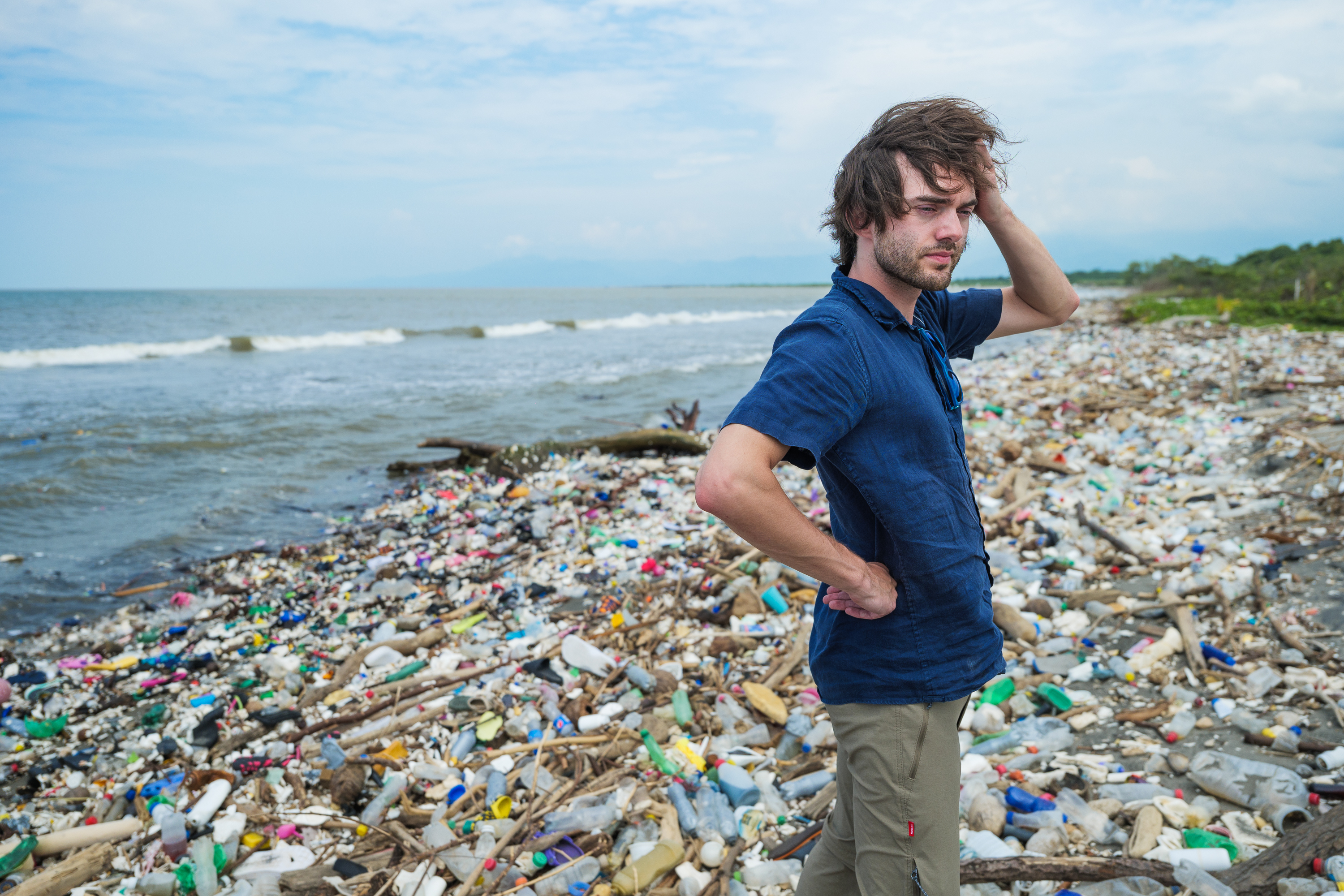
Boyan Slat on a beach near the mouth of the Motagua river in Guatemala
THE OCEAN CLEANUP
Slat describes stopping plastic entering the ocean as a “quick fix” — a way of “buying the world time” to stop producing plastic waste in the first place.
Most developed countries have already stopped plastic getting into the ocean, he said. The poorest countries are also not a huge part of the problem, because they simply do not throw away much plastic. The big problem is those middle-income countries where there is enough wealth to have high plastic consumption, but not enough wealth to have developed effective waste-management systems.
“About 60 per cent comes from Asia, 20 per cent from Africa and 20 per cent from the Americas,” he said.
The team is already working on rivers across the world, including Indonesia, India, Colombia, the Philippines and the Caribbean, and has so far extracted nearly 50 million kilograms of rubbish.
Watch an Interceptor work in Los Angeles:
The focus of the problem among this demographic of countries means it is a relatively simple problem to target those rivers where the most plastic is being spewed into the oceans.
Slat pointed to the Motagua river in Guatemala, which sends more plastic into the sea than all 38 members of the OECD. “That one river is about 2 per cent of global plastic emissions,” he said.
Antonio Lopez, 59, knows first-hand the scale of the problem. He worked as a fisherman in El Quetzalito, on the banks of the Motagua, before the deluge of plastic began flowing about 30 years ago.
“It got to the point where I couldn’t catch fish anymore, because of the amount of plastic in the river and ocean. Any fish we caught had eaten plastic or had plastic rings from drinks bottles and cans stuck around them.”
One of Slat’s interceptors arrived in September 2024, cleaning the river to the point Lopez has been able to start fishing again.
Slat said: “I think by next year we’ll be at one deployment a week. And then we want to get to two deployments per week. Then we need only four or five more doublings to get the job done.”
They have received significant donations in the past, including $25 million from Airbnb co-founder Joe Gebbia in 2023. Coldplay have backed the project by funding the clean-up of rivers in Malaysia and Indonesia.
But last week the charity received its biggest donation to date — $121 million from the Audacious Project, the charitable funding offshoot of the TED organisation.
“Daring ideas matter most when they become achievable,” said Chris Anderson, founder of the Audacious Project and TED chairman, announcing the funding.
Slat said his ultimate goal was to put himself out of business. “My job every day is to accelerate the death of my creation. I see this as a project, not as an ongoing business. And the sooner we figure this out, the sooner we scale up and have cleaner oceans, the better.”
He added: “The world needs a success story. There is a lot of pessimism, a lot of fatalism, especially among people of my generation. But if we can say, ‘There was a time when the oceans were filled with plastic, that two thirds of the planet was polluted, and then we solved it’ — I think that will be a case of action inspiring action.”