
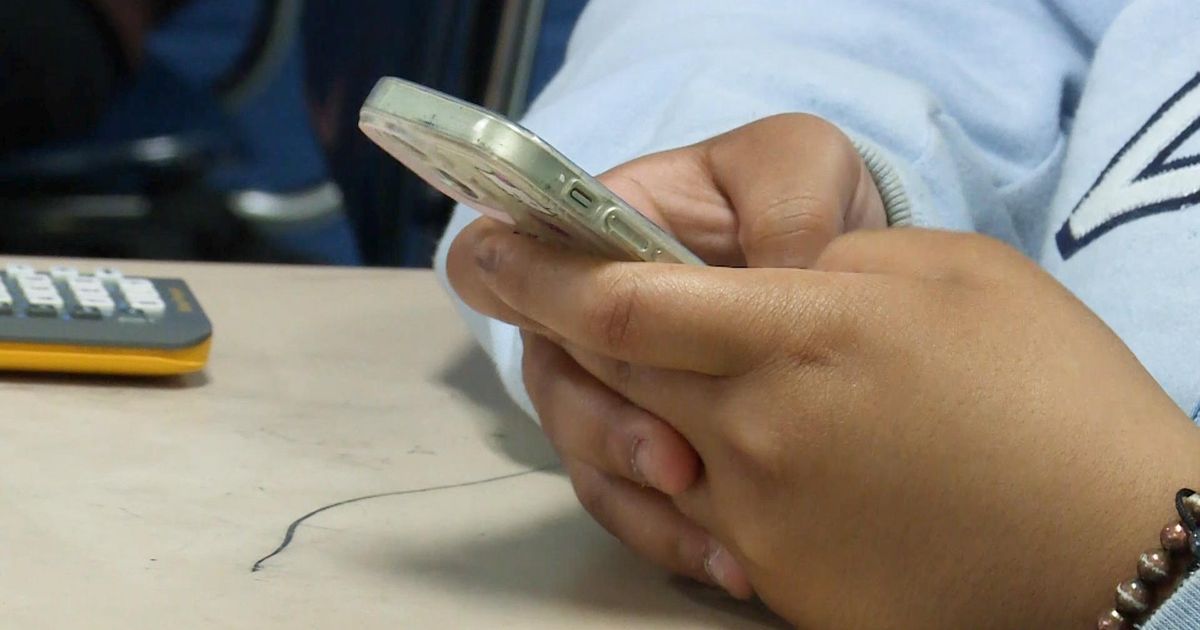
A new study shows students in schools in states without firm cellphone policies spend a third of their school day on their phones.
The results detail the magnitude of a problem education leaders, politicians and advocacy groups have been attempting to solve in recent years, as bipartisan concern has shot up over the impact of cellphones and social media apps on young people.
Researchers with the University of North Carolina at Chapel Hill studied the cellphone use of middle and high school students at different points from 2021 through 2024. They studied iPhone users, specifically, and gained access to the phones’ screentime data.
They found students spent an average of 20 minutes every hour on their phones, largely looking at social media and entertainment apps, said Eva Telzer, a professor in the university’s psychology and neuroscience department. Telzer is also co-director of the university’s Winston Center on Technology and Brain Development.
The results were associated with students having less “cognitive control.” In other words, they had less control over their minds for tasks such as regulating thoughts or emotions or effectively working toward goals. Adolescent students who are more frequently checking their phones showed poor cognitive control in a separate experimental task the researchers conducted outside of school.
“So they are showing these impairments in the way that their minds are working, which is going to interfere with their ability to engage and learn in the classroom,” Telzer said. Those could worsen academic performance and can have long-term impacts on children’s developing brains, scholastically and emotionally, she said.
North Carolina law now requires school boards to have strict device policies, including cellphones, tablets and other wireless communication devices.
WRAL reported last year that schools have for years reported having policies restricting cellphone use but that many people said those policies were ineffective.
The policies and approaches were generally not as strict as the new state law requires and were often enforced differently classroom-to-classroom. Students told WRAL News that inconsistency was confusing and led to resentment among some students who preferred one approach over another. School leaders said they believed consistent, administrator-backed approaches were more effective.
Many schools were in the middle of changing their approaches.
Schools have to contend with the creativity of young people their policies may not anticipate, Telzer said. Students have brought “burner” phones to school to place in phone cubbies at the front of classrooms, and some will bring their own tool to unlock pouches for their phones that they can keep at their desks, she said.
“On the one hand, it we know that adolescents should not have their phones during school. It is clearly problematic,” she said. “On the other hand, it’s very challenging for policies to work because adolescents will go very far out of their way to get access.”
Telzer said she wasn’t sure new policies were working. No research has identified effective ways to curb cellphone use in schools, though Telzer believes some that some approaches with anecdotal support could work. Those include consistent approaches and enforcement and starting at a very young age to make it the norm for students not to have phones during classroom time.
But any attempt by a school to curb cellphone access could meet more frustration from students based on how much access the students have to their devices at home.
Parents can help with that, Telzer said.
“It’s really challenging for parents, just as it is for teachers, to implement ways of restricting or monitoring access to their child’s smartphones,” Telzer said. “I think one of the cleanest and easiest pieces of advice is not allowing them to access their phones after a certain hour, because that will disrupt their ability to sleep, not having phones out during social interactions at home.”
That could be not allowing phone use at dinner or after dinner. If parents can avoid their own phones, that can help model the behavior for their children Telzer said. But it’s a really challenging problem for parents, Telzer said, because parents largely didn’t grow up with the devices themselves. Adolescents, especially, need clear communication about rules.
While cellphones remain a challenge, Telzer believes they’re just one of many challenges technology poses in the classroom. Data shows students are often not using their school-issued laptops for schoolwork during class, instead messaging friends or watching non-academic videos. Artificial intelligence is another challenge to making sure students are learning effectively, she said.