
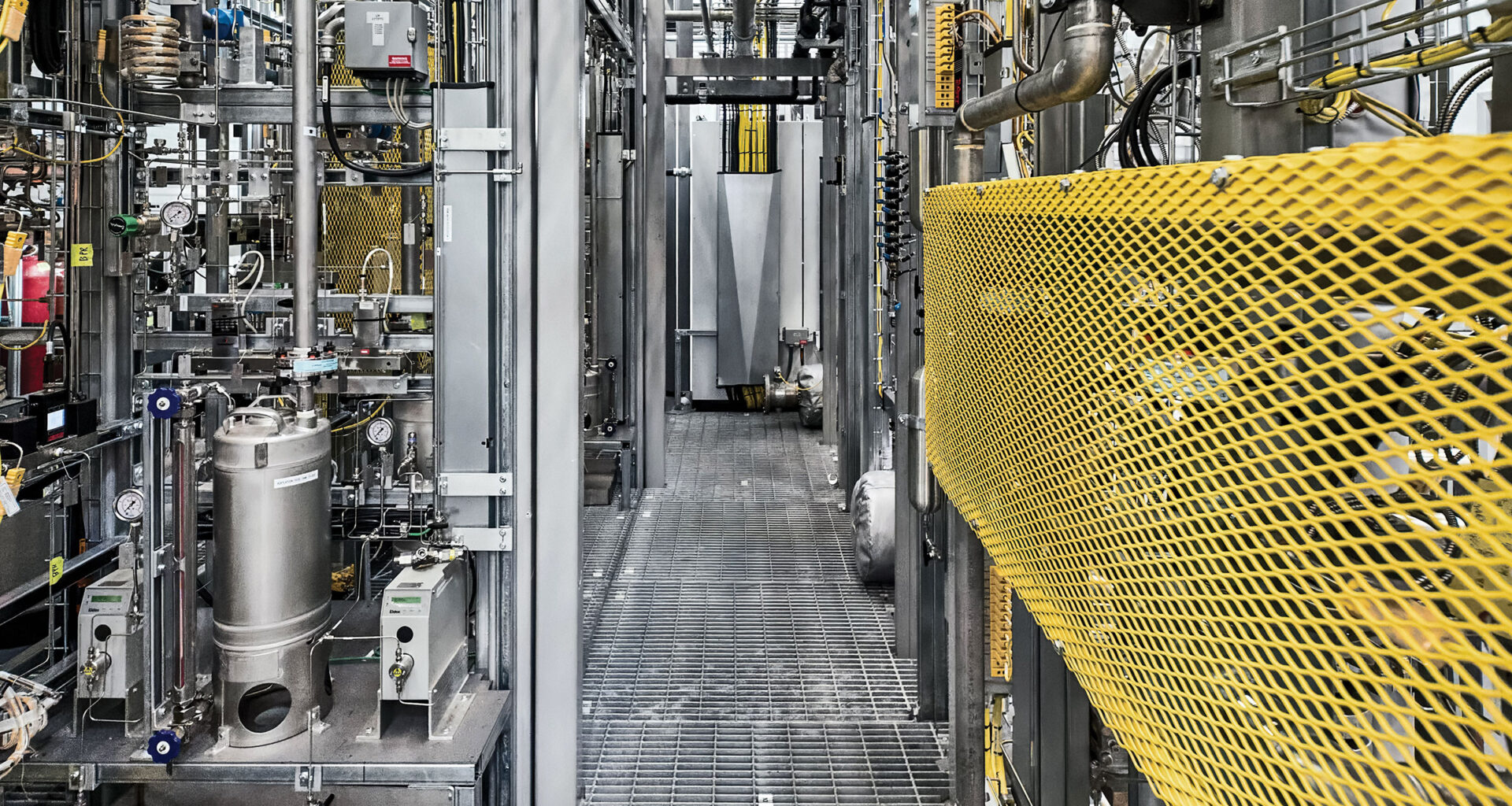
If the sustainable-chemistry world has a holy grail, it’s turning carbon dioxide from threat into feedstock. And two start-ups are reporting advances in their quest to make CO2 a feedstock for fuel: Air Company (AirCo) plans to make modular units for the US military, and Prometheus Fuels has an electrochemical pathway to kerosene.
AirCo, one of C&EN’s 10 Start-Ups to Watch in 2022, announced today it is working with the US Air Force to deploy the firm’s thermochemical process for making transportation fuels from CO2 and hydrogen. The plan is to build reactors inside shipping containers so that the military can make fuel in the field instead of hauling it across the world and through conflict zones. The partnership includes $15 million in new military funding for AirCo’s work on the project.
The most autonomous version of the system would get its CO2 from the ambient air via direct air capture (DAC), CEO Gregory Constantine says. Small modular nuclear reactors would provide both process heat and the electricity needed to make hydrogen by splitting water. The full cost of delivered fuel in military operations can be hundreds of dollars per liter because of long and dangerous supply chains, he says. So despite the high price of DAC and nuclear-powered electrolytic hydrogen, “we’re a significantly cheaper option,” he says.
AirCo uses fixed-bed reactors to flow H2 and CO2 over solid catalyst pellets at elevated temperatures and pressures. Though previous results suggested that the reaction follows a novel mechanism, Constantine now says it is a variation of the well-known Fischer-Tropsch process. The firm’s family of catalysts yield combinations of methanol, ethanol, jet-fuel alkanes, and aromatic hydrocarbons.
The modular systems will be toughened and mass-produced versions of the pilot plant AirCo has operated for several years in Brooklyn, New York. Constantine says the company is building a manufacturing site in Pennsylvania for the modules, the first of which will be ready to switch on in 2027.
The plan fits in well with technology programs the US government has been advancing in recent months. In October, the US Army and the US Department of Energy announced the Janus Program, a plan to have the first small modular nuclear reactor in operation at a military base by the end of 2028. Army leaders at the time described using the reactors to power mobile water-purification and fuel-synthesis plants.
AirCo still plans to build commercial-scale plants that would serve the commercial aviation-fuel market.
Prometheus Fuels, meanwhile, has unveiled an electrochemical method it says will make synthetic kerosene at costs that can compete with petroleum-derived fuel. Kerosene, a mix of C6 to C20 alkanes, can form the basis for jet and diesel fuels.
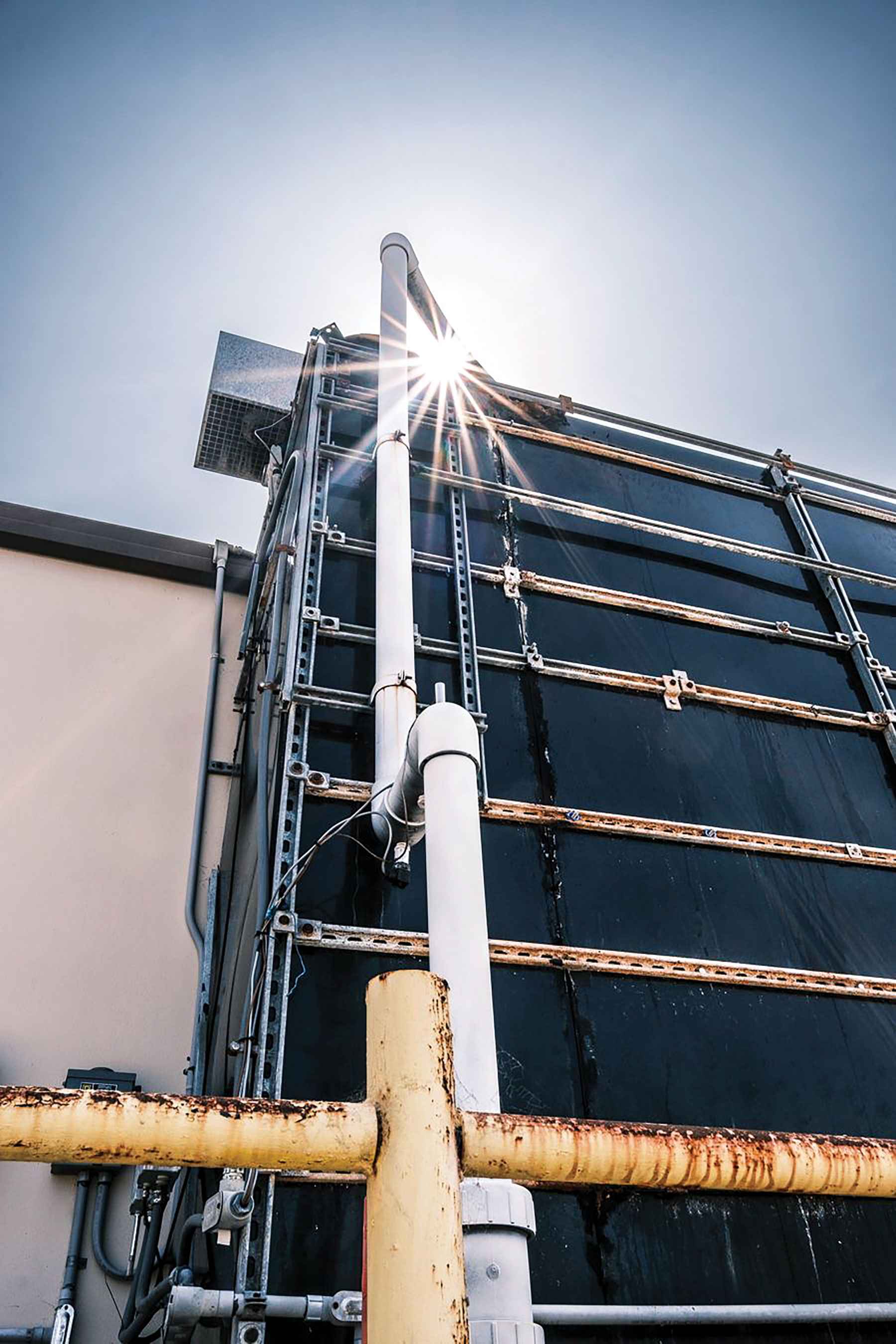
A white pipe runs up the vertical face of a black air contactor, a tall rectangular box, as the sun shines over the top.
Prometheus Fuels uses carbonate chemistry in its direct-air-capture system (shown) to collect CO2 from the air as a feedstock to make methanol and now kerosene-range hydrocarbons through an electrochemical reaction.
Credit:
Prometheus Fuels
The process starts with a DAC rig where an aqueous carbonate solvent absorbs CO2 from the ambient air. Inside the electrochemical cell, carbonate ions directly combine with water on the electrode surface to yield hydrocarbons and oxygen, Prometheus founder Rob McGinnis says. The system doesn’t make molecular hydrogen as an intermediate or extract intact CO2 from the solvent, he says, two energy-intensive steps that contribute heavily to the cost of most CO2-to-fuel and DAC processes.
“I think we make Fischer-Tropsch obsolete, which is pretty exciting,” McGinnis says. The firm has been running a pilot of the DAC side of its system with its other reactor, which makes methanol, for 4 years. McGinnis says the DAC costs about $50 per metric ton of CO2, less than a quarter of the price of systems that use heat or vacuum to strip CO2 out of the fully loaded sorbent.
Once in commercial production, a 50-cell module capable of making 2,300 L of kerosene per year would cost about $2,500, Prometheus projects. Factoring in support infrastructure, cell lifetime, and operating costs including renewable electricity, McGinnis says the firm can make kerosene for around $0.66 per L. Petroleum kerosene has traded between $0.50 and $0.70 over the past 2 years, according to the US Energy Information Administration.
Prometheus is currently raising a series C funding round with a target of $150 million, McGinnis says, and deployment of the kerosene system will depend on how that effort goes.
Direct electroreduction of CO2 to kerosene-range alkanes is a big claim, says Anthony Shoji Hall, a professor at the University of Pennsylvania who studies electrocatalysis. “If they truly made C15, then that would be amazing,” he says, “but I’m skeptical.”
Hall says recent literature supports some of the mechanistic steps that Prometheus describes on its website, but the mass flow near the electrode surface and the nature of the reactive carbonate species need further interrogation. “I’m not completely sure they are seeing what they think they see,” he says. “But what they are doing is extremely novel. Making C4+ products is super hard.”
Both Prometheus and AirCo are leading with modular systems the size of a tractor trailer or smaller, as is the DAC-to-gasoline start-up Aircela. It’s a solid go-to-market strategy for new chemistry, but big, stationary plants will be more efficient and profitable in the long term, says Eve Pope, a senior technology analyst at the consulting firm IDTechEx.
Still, the case for starting with modular systems is strong, Pope says. “Modular e-fuel reactors allow for faster deployment, flexibility, and easy production expansion,” she says. “Key design focuses at the moment are efficiency, compactness, modularity, and renewable load-following ability.”
Constantine says he is encouraged to see other sustainable chemical-technology firms getting traction, even if they might be competitors. “The rise of other successful companies in the hardware space is going to make companies like ours more effective, more efficient, and easier to get to scale,” he says, “which is great for the next era of industrialization.”

Chemical & Engineering News
ISSN 0009-2347
Copyright ©
2026 American Chemical Society