
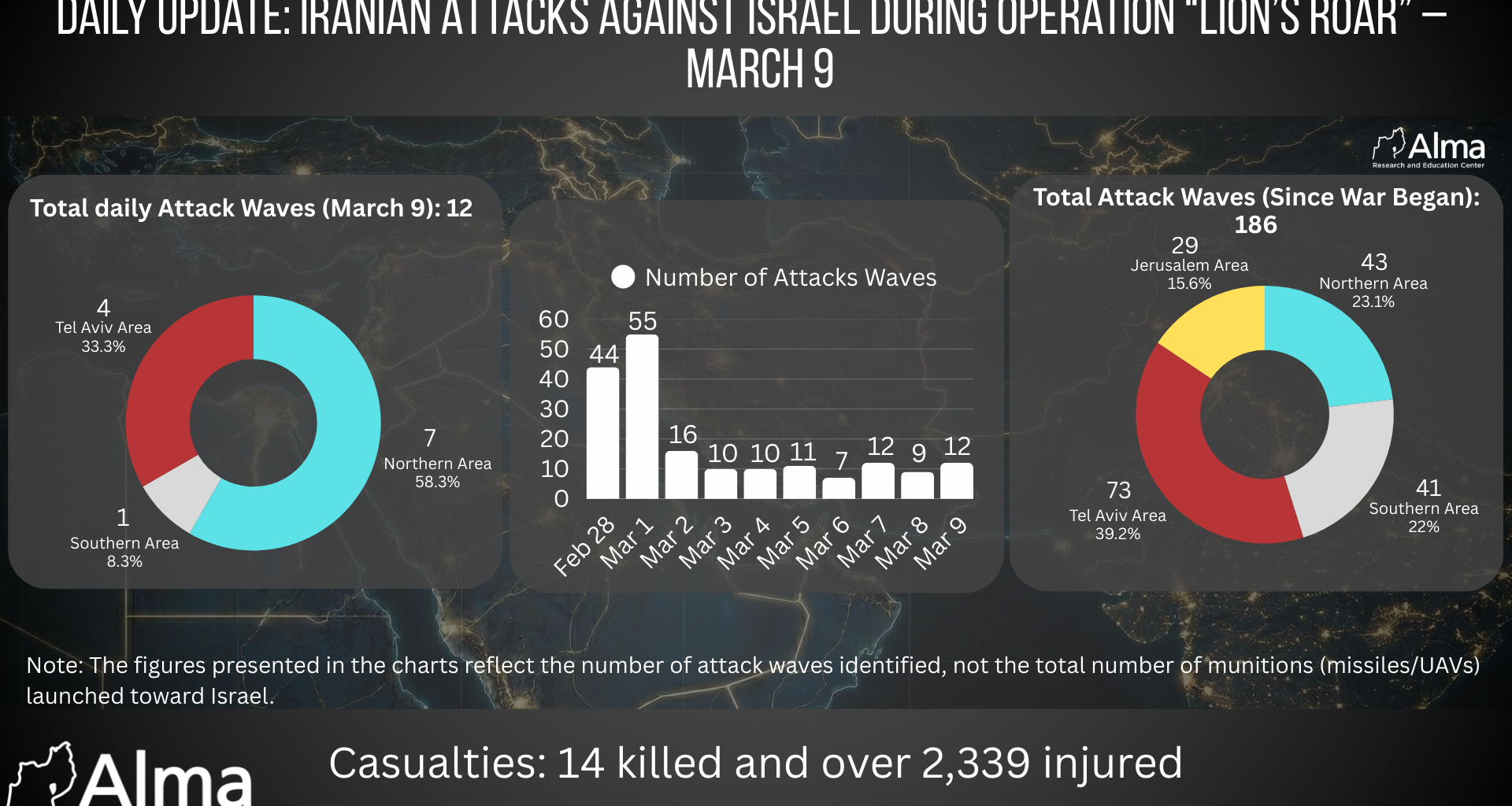
On March 9, 12 waves of attacks against Israel were recorded. Unlike previous days, most of the attacks were directed toward the northern region, which absorbed 7 attack waves (58.3%) of the total that day. The Tel Aviv and central region experienced 4 waves (33.3%), while the southern region experienced only one wave (8.3%). These data indicate a notable shift in the pattern of fire. After several days during which the center of the country was the primary target, yesterday saw a trend of more extensive fire directed toward the northern region. It is possible that the increase in fire toward northern Israel is related to the Iranian statement regarding an attempt to strike oil refineries in Israel. Examining the daily trend, it can be said that the first two days of the war (February 28 and March 1) were the most intense in terms of the number of Iranian attacks against Israel. From the third day (March 2) onward, a relative stabilization in the number of attack waves can be observed, which in recent days has been around 10–12 waves per day. Since the beginning of the fighting, a total of 186 attack waves have been recorded. The Tel Aviv area remains the primary target with 73 waves (39.2%), followed by the south with 41 waves (22%), and the north with 43 waves (23.1%). This figure highlights that the extensive fire toward the north in the past day increased its relative share of the total attacks. The Jerusalem area has so far absorbed 29 waves (15.6%). The data refer to the number of attack waves identified, not to the total number of missiles or unmanned aerial vehicles launched. Impact on the Civilian Sphere in Israel •Since the beginning of the war, 14 civilians in Israel have been killed, and 2,339 have been injured to varying degrees. •In the past 24 hours alone, two civilians were killed in the Tel Aviv area, and approximately 200 others were injured as a result of Iranian missile fire. •According to reports, the missile that killed the two civilians carried a warhead that splits in the air into multiple sub-munitions, resulting in several impact points. Since the beginning of the war, Iran has been using missiles of this type, which contain small bomblets that disperse in the air (with a dispersion radius of up to about 8 kilometers) and has been launching them toward the Tel Aviv area, a highly densely populated region. •Yesterday, several impacts in the central region caused casualties and damage to property. •More than 3,000 residents have been forced to leave their homes due to missile strikes and interceptor debris. •The main cities where impacts from Iranian missiles have been recorded are Tel Aviv, Bnei Brak, Ramat Gan, Petah Tikva, Beit Shemesh, and Be’er Sheva.
